
Jonathan the Aldabra giant tortoise is the oldest land animal in the world today at an estimated 194 years old. Now, a team of scientists have analysed his genes to reveal his secret to a long life.
The species is native to Aldabra Island, a coral atoll that is part of the Seychelles. Aldabra giant tortoises are one of the world’s largest tortoise species – and can also reach staggering ages of more than 150 years old.
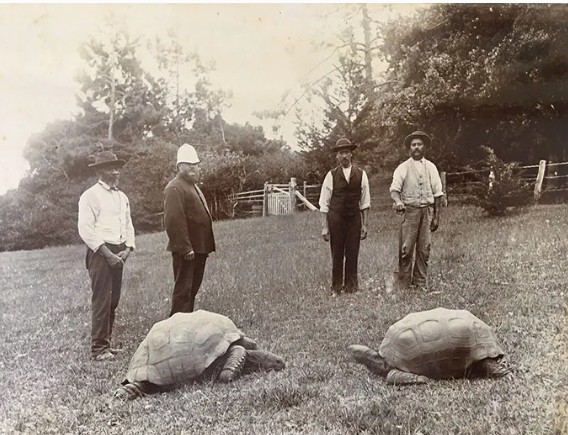
Jonathan has lived most of his life on the island of Saint Helena, a British Overseas Territory in the South Atlantic Ocean. He arrived from the Seychelles 144 years ago, already fully grown, as a gift to the governor.
- What’s the longest living land animal? Meet the ‘giant’ that’s older than Yellowstone National Park
- How long do tortoises live?
The team’s findings, published in the journal Science Advances, highlight 287 unique gene variants in Jonathan that reduce the usual effects of ageing. These genes control key processes in the body, including inflammation reduction, insulin regulation, DNA damage repair and cancer suppression.
Other studies have shown that the longevity of species such as immortal jellyfish, naked mole rats and bowhead whales has been linked to some of these variants.
Researchers widely accept that damage to genetic material, cells and tissues accumulates with age and cannot be repaired, which causes the loss of function associated with ageing. However, they are less clear on what causes this damage – and why repairs are usually more effective in younger organisms than older ones.
A DNA first
The team also compared Jonathan’s epigenome – which works as an ‘on/off’ switch of his genes – with those of younger Aldabra giant tortoises. Usually, the epigenome in an animal changes over time, which contributes to the ageing process – and is usually a reason why things begin to go wrong in older bodies. But the researchers found that the switches controlling Jonathan’s DNA repair and metabolism genes were very similar to those in younger tortoises.
Previous genome analysis of Lonesome George – the last giant Pinta Island tortoise who lived to around 100 years old – has shown that he also contained longevity-related genes, but this study was the first to investigate the epigenome of a giant tortoise.
- These giants are thriving on a remote island in the Indian Ocean. But there's a problem – their eggs aren't hatching
- Return of the giant: how the Galápagos tortoise is being brought back from extinction
“We found that the gene regulators involved in energy production and DNA repair have remained incredibly stable in Jonathan over almost two centuries,” says Justin Gerlach at the University of Cambridge, who was involved in the study.
“There are few creatures that could tell us more about ageing than the giant tortoises of the Galapagos and Seychelles islands. Working with a very old giant tortoise is such a privilege: you get a sense of the tortoise being your collaborator, not your study subject.”
The study was led by researchers at the longevity research non-profit Kallel. They hope that further research could be used to develop treatments for humans – with Kallel’s founder Stephen Clark explaining that “aging is the greatest risk factor for nearly every chronic disease we face.”
Read the full findings here: Epigenetic insights into extreme longevity in the world’s oldest terrestrial animal, Jonathan
Top image: Jonathan the giant tortoise at Plantation House, Saint Helena. Credit: StHelena/Getty Images


