
A team of researchers has found a well-preserved bird feather in fossilised dinosaur poop – and it contains clues that could help explain the mystery of why modern birds are the only living descendants of dinosaurs. The findings were published in the journal Current Biology.
- Fossil poo, fossil vomit, fossil penis... World's 10 weirdest fossils that will have you scratching your head
- How gross? 8 animals that eat their own poop (or someone else's)
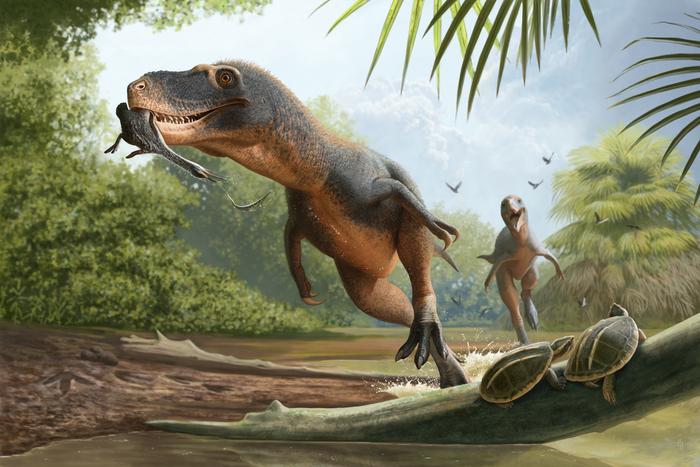
Around 66 million years ago, a dinosaur ate a bird, and sometime later, left parts of that bird behind in its faeces. Now a millennia later, its fossilised poop offers a hint towards solving one of the biggest mysteries in palaeontology.
Although the idea was contested for a long time, today it’s a rarely-disputed fact that birds the only surviving dinosaurs. They have evolved from the theropod group, one of the three major clades of dinosaurs, which included T.Rex.
The earliest known bird is Archaeopteryx from 150 million years ago. Birds evolved for nearly 100 million years – an evolution that could have been entirely cut short when an asteroid struck Earth 66 million years ago, resulting in the fifth mass extinction. Nearly all the dinosaurs, including nearly all the birds, became extinct.
But one group of birds, Neornithes, survived, and every living bird today is one of their descendants. The question is – why?
- Mega volcanoes, asteroid impacts and 'the great dying' – 5 deadly mass extinctions that changed life on Earth forever
- “It triggered catastrophic global cooling and was twice the size of the one that killed the dinosaurs.” 6 deadliest, most apocalyptic asteroids to ever hit Earth
Studying the fossil
Jingmai O’Connor, lead author of the published study and associate curator of fossil reptiles at the Field Museum in Chicago, USA, has spent years studying fossils in search of an answer to this question. And one fossil in particular has helped her answer this huge question in palaeontology.
The fossil was unearthed in 2016, when David DeMar Jr., a research scientist and the Hell Creek Project collections manager at the University of Washington Burke Museum, and co-author of the study, was conducting fieldwork in northeastern Montana.
“I was crawling up a rocky outcrop collecting fish fossils when I came across a dark, reddish-brown nodule about half the size of a golf ball,” he recalls.
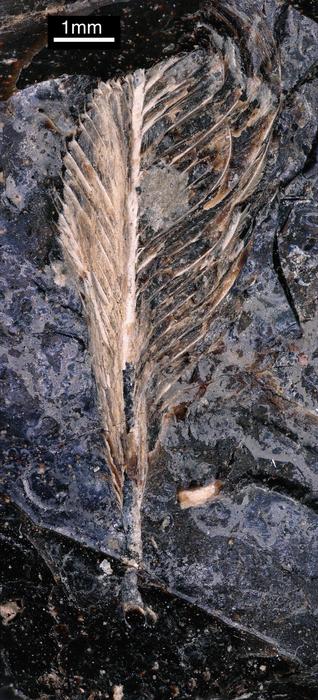
“I picked it up and scanned its surface through my hand lens, and that’s when I couldn’t believe what I was seeing: a tiny fossil feather. I was cautiously optimistic about its discovery, because feathers had not yet been found in the Hell Creek Formation, even after more than 150 years of prospecting.”
The fossil was taken to the laboratory, where the researchers used computer tomography (CT) scanning to examine its mineral composition.
The coprolite (fossilised faeces) contained multiple feathers, tiny scales from a gar (an ancient group of fish), and leg bones from a hesperornithiform – a lineage of flightless aquatic birds within the Ornithurae group. These were the first hesperornithiform feathers ever found.
One feather remained largely intact, measuring just 9.3mm.
“Hesperornithiforms were aquatic birds, ecologically similar to loons. Most couldn’t fly and instead, they used their specialised feet to dive down into the water to hunt for things such as fish. The feathers showed adaptations for being underwater that we see in living aquatic birds,” says O’Connor.
These birds are close cousins of the Neornithes – the only survivors of the mass extinction – but they were not part of that group themselves.
The mystery
Scientists have proposed many different hypotheses for why Neornithes survived – one of them being that their proximity to water helped shield them from the effects of the asteroid impact. But other groups of birds who lived by water, such as hesperornithiforms, perished.
The scientists say that the hesperornithiform feathers represent a kind of ‘middle ground’ between the feathers of enantiornithines (the most common birds alive in the Cretaceous period) and modern birds.
“Some of these diving birds’ feathers seem to have been modern-looking and waterproof, but they also had some smaller, fuzzy, primitive body feathers that we associate with dinosaurs and enantiornithines,” explains O’Connor.
One of the most important functions of the feathers on a bird’s body is insulation. After the dinosaur-killing asteroid hit Earth, the planet was plunged into an impact winter. So, if the hesperornithiforms’ and enantiornithines’ feathers weren’t as good at keeping them warm as Neornithes’ feathers, it could have had severe consequences for their survival.
“We think the types of feathers that these birds had, and/or the way they moulted those feathers, may have been one of the underlying causes of the selectivity of the end-Cretaceous mass extinction – essentially, why some birds died out and why others survived,” continues O’Connor.
Future research
These findings have not only provided another piece of the puzzle in the mystery of the dinosaur extinction. According to Greg Wilson Mantilla, a professor at the University of Washington, curator of vertebrate palaeontology at the Burke Museum, and co-author of the study, these findings give “an incredible window into predator-prey interactions 66 million years ago.”
O’Connor has also highlighted the hope for more palaeontologists to explore studying coprolites and the secrets they might hold.
“Since no one has studied feathers in coprolites before, this opens up a whole new avenue for investigation. We only knew to look at this one because of how it happened to be split open, with the feather exposed – it was literally a lucky break,” she said.
“I hope more scientists start CT scanning coprolites and taking a closer look at them to see what might be inside.”
Read the full findings here.
Top image: Makoshika State Park, Montana, USA, where some of the Hell Creek Formation lies. Credit: zrfphoto/Getty Images


