
Slicing off the head of prey can require some unusual adaptations. In the list below, we explore a bird with double-jointed legs – perfect for snatching chicks from nests, an insect with a saw on its head – perfect for neck-cutting surgery, and a bird that has evolved to whip prey back-and-forth so quickly that its neck snaps.
If you don’t like gory details, you might not want to read on…
- 'Mike the Headless Chicken': who was he and how long did he live without a head?
- Headless animals? Oh yes... Discover 10 animals that can survive without their heads — at least for a while
9 animals that decapitate their prey
African harrier-hawk (Polyboroides typus)

A raptor native to sub-Saharan Africa, the acrobatic African harrier-hawk sometimes tears the head off its prey.
With double-jointed legs that can bend both forwards and backwards, these birds of prey hook the chicks of small birds – such as weaverbirds – out of their nests. Once holding the chick in its talon, the hawk may then tear off its head to ensure a quick kill.
- They strike with clenched talons at 200mph, crush skulls, shred prey, and can inflict deep head wounds on humans – 10 deadliest birds of prey on the planet
- 10 fastest birds of prey in the world – able to reach speeds of almost 200 MPH, these deadly aerial predators strike in a blink of an eye
Interestingly, African harrier-hawks have figured out how to use songbird defence tactics to their benefit. When hawks get too close to songbird nests, the parents will aggressively mob the bird in an attempt to get it to leave. But the hawk has learnt that being mobbed means a nest is close by – and so it stays in the area and looks for a nest to raid.
Brahminy blind snake (Indotyphlops braminus)

Most snakes swallow their prey whole, but there are a few exceptions. The Brahminy blind snake, native to Africa and Asia, is one of them.
A worm-like snake that spends most of its time underground, the blind snake often decapitates termites before eating them. To do this, it pounces on a termite from behind, puts everything but the termite’s head into its mouth, and then rubs the termite’s head against the ground until the head pops off.
But why go to all this effort?
While termites are nutritious, their heads are difficult to digest and contain nasty toxins. The Brahminy blind snakes’ solution means they still get to eat one of their favourite foods, but without having to deal with the less appetising parts of the meal.
Dung beetle (Canthon virens)

Canthon virens, native to South America, hunt down and behead leafcutter ant queens.
Female dung beetles launch themselves on the queen from above, and then stand on her back and cut off her head. Following this, the beetle then rolls the head to a desired location and buries it.
But not only does she bury the ant’s head, she also buries herself and a male dung beetle at the same time. She will then mate with the male and lay her fertilised egg near the decapitated queen’s head, which serves as a food source for the developing larva.
Shoebill (Balaeniceps rex)
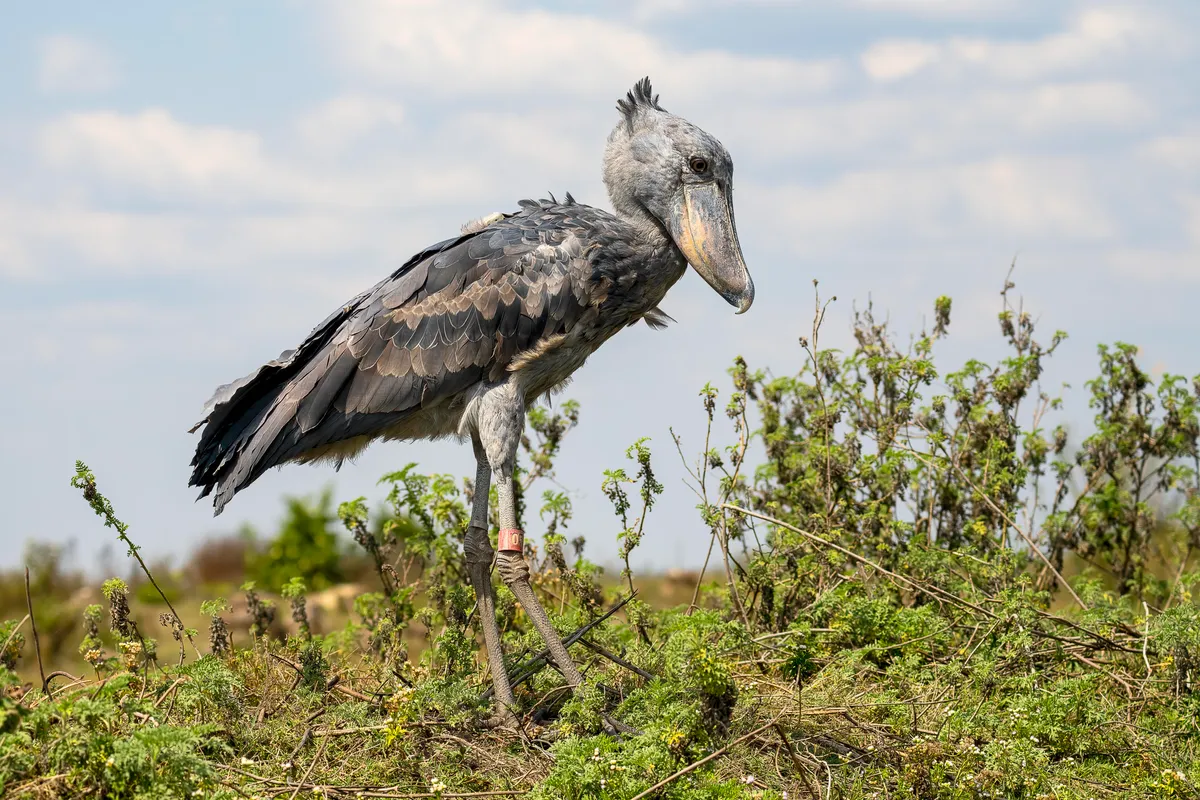
Over four-foot-tall, this weird-looking bird has an eight-foot wingspan and a gigantic beak with a hooked tip. It is fair to say that the shoebill is an unusual looking bird. And not only is it unusual looking, but it also has an unusual hunting method. Its thick, powerful beak can snap right through the neck of its prey.
Native to the swamps of tropical East Africa, the shoebill preys on fish such as lungfish and catfish. It has two main hunting methods: stand-and-wait (often for hours on end), or wade-and-disturb. Either way, once a fish is swimming within striking distance, it is likely to meet a grisly end.
With one quick snap, the fish can be decapitated. Indeed, shoebills are known for beheading prey quite often, possibly because it is a quick and efficient method of killing.
To complement their main diet of fish, shoebills have also been known to eat baby crocodiles.
- Weirdest birds on the planet: meet the strangest wonders of the avian world – including one that asks humans for help and another that smells like a cow
- Don’t think birds can look scary? Think again – these creepy birds look like they're out of a horror film
Great horned owl (Bubo virginianus)

Native to the Americas, the great horned owl often decapitates larger prey such as rabbits or bigger birds (like chickens or hawks) so that the carcass is more transportable – especially in the breeding season, when they need to get food to their chicks. They do this by using their powerful beaks and incredible talons, which are one-inch long and razor-sharp.
These owls have also been known to tear the legs and the wings off their prey, also for transportation purposes. So, if you ever find a leg, a head, a wing, or a headless body while out for a wander in American countryside, you know who the culprit could be…
Phorid flies
The Phoridae are a family of over 4000 flies, usually smaller than 6mm in length. We don’t know much about many of these tiny species, although some have rather intriguing names. There are the coffin flies, the bee-killing flies, and the ant-decapitating flies.
The ant-decapitating flies, native to Central and South America, have been observed beheading trap-jaw ants. To do this, a female fly uses her proboscis to saw off the head. This is possible because her probiscis is extremely long and tipped with a razor-sharp blade. That’s right – she essentially has a surgical saw attached to her head.
The females then either lay an egg near the ant’s head so that the larva can feast on it, or the female eats the contents of the head. It is thought that the heads must contain key nutrients for female reproduction.
Asian giant hornet (Vespa mandarinia japonica)

The world’s largest hornet (growing up to 5cm long), the Asian giant hornet is widespread across Asia. These fierce insects break into beehives to feast on the honey and larvae within. But in order to get to those tasty morsels, they must tackle the thousands of bees protecting the hive. To do this, they chop off their heads with huge, powerful jaws.
A single hornet can decapitate forty bees per minute – that’s one beheading every 1.5 seconds. A group of thirty Asian giant hornets can destroy an entire hive of up to 30,000 individuals in just a few hours.
But the Japanese honeybee (Apis cerana japonica) has an impressive defence mechanism against these predators. When a hornet attacks their hive, more than 500 worker bees surround it and vibrate their muscles. This generates enough heat to cook the hornet alive.
- The animals that cook their prey alive before eating
- Watch brutal BBC footage of honeybees killing a humongous Japanese giant hornet in the most horrifying way
Red foxes

Red foxes often decapitate larger prey such as rabbits and chickens. They kill by biting the back of the neck and severing the spinal cord, and then tear off the head. They have been known to eat only the head, leaving the rest of the carcass.
This may be a behaviour specific to well-fed foxes, who can afford to be choosy. It is thought they eat the head in particular because brains are a nutritious snack, with high fat and protein contents. Sometimes, foxes will bury both the head and the decapitated body of their prey separately, so they can return later for a tasty meal.
- What's the difference between foxes and dogs? Why foxes are much more than 'wild dogs'
- The 10 deadliest dogs on Earth: Discover the world's most ferocious and savage wild canine hunters
Loggerhead shrike (Lanius ludovicianus)
Native to America, the nine-inch-tall loggerhead shrike is a songbird with one of the goriest mealtimes in the animal kingdom.
Unlike most songbirds, the loggerhead shrike is predatory. Its prey ranges from insects to small mammals, small birds, and even venomous snakes.
To kill prey that can be as heavy as they are, shrikes employ a shake-and-snap method. They pinch their prey’s neck in their beak and then they shake their prey so vigorously that the neck snaps.
While technically not decapitation (the head does not fall off), shrikes do sever the nerve connection between head and neck – resulting in a quick death.
Following the kill, shrikes will often impale the body of their prey on a thorn or barbed wire. By anchoring the carcass, they can tear flesh from it with ease. Sometimes their prey is still alive when they do this.
Is it any wonder they have been nicknamed the ‘butcher bird’?


