
When we think of dangerous animals, we often think of sharks, bears, lions, crocs and huge snakes that could swallow a person whole.
But many of the most dangerous animals on the planet – those that could kill us in the blink of an eye – aren’t what we’d expect.
In this list of animals that can kill a human in minutes, we explore beautiful sea creatures, cute amphibians, funny looking fish, and unassuming insects, all of which could stop your heart beating before there’s time to find help.
8 animals that can kill you in minutes
Killer Bees

A hybrid of European and African honeybees, killer bees – found in the Americas – are extremely aggressive.
Their venom is technically no more potent than African or European honeybee venom, but when killer bees sense a threat they go all-out, responding ten times faster and stinging ten times more than European and African honeybees.
It is the sheer number of stings that poses such a danger to humans. While African and European honeybees only mobilise a small number of the colony to defend the nest, in killer bees almost the whole colony rushes to the hive’s defence. This can be thousands of bees, with some reports of swarms in the hundreds of thousands.
When a person is stung many times, a biological chain reaction happens which results in muscle breakdown, kidney failure, an irregular heart rhythm and, sometimes, death within minutes.
A person does not need to be allergic to bees for death to occur, and as few as 500 stings can be fatal. So, if a swarm of 100,000 is chasing you, you’d better find shelter fast.
Sydney Funnel-web Spider (Atrax robustus)
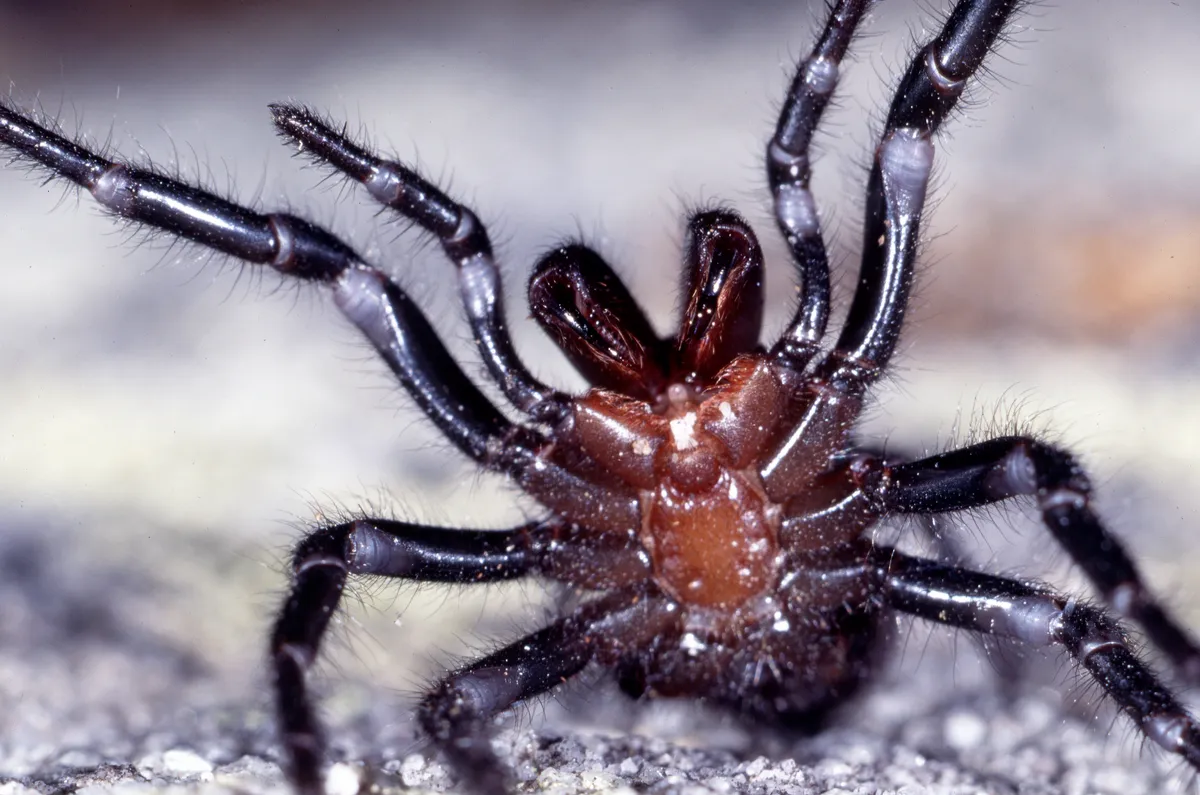
Sitting in funnels woven from silk, the Sydney funnel-web spider – native to Australia – will dart out of its hidey-hole when prey walks close. Using large fangs, the spider injects deadly venom into its prey – which can be as large as a lizard – and then drag its meal back into its burrow.
This spider has the deadliest venom of any spider in the world.
When it bites a person, symptoms will start in just a few minutes. First, there is often a burning sensation across the face, then drooling, then the inability to breathe properly. Not long afterwards the victim may fall into a coma, and then comes the collapse of the circulatory system and death.
This can all happen in the space of fifteen minutes.
Thankfully, since the development of the antivenom programme in 1981, nobody in Australia has died from a Sydney funnel-web spider bite.
- It has an incredibly painful bite and you can die just hours after being bitten
- World's most venomous spiders: Are these 10 deadly spiders as fearsome as their reputation?
Tiger puffer (Takifugu rubripes)

If you’re out for a meal and see fugu on the menu, you might want to think twice before tucking in.
Fugu is a dish prepared from pufferfish – often the tiger puffer. This species of pufferfish has lethal levels of a toxin called tetrodotoxin (TTX) in its body.
- Why are pufferfish so deadly poisonous - able to kill a human - and how on earth do they avoid poisoning themselves?
- These toxic ‘water balloon’ fish contain enough poison in their gonads to kill 30 humans – and they draw sand circles to impress a mate
TTX is 1,000 times more powerful than cyanide. It works by binding to nerve cells and blocking signals between the body and the brain. The first symptoms of TTX poisoning are numbness and tingling around the mouth, followed by paralysis and death. Generally, people remain conscious until the very end.
Eating incorrectly prepared pufferfish has been known to kill in as little as seventeen minutes, and unfortunately there’s no known antidote for TTX poisoning. Medical treatment involves supplying life support and hoping the body will manage to clear the toxin.
Inland Taipan (Oxyuranus microlepidotus)

With enough venom to kill 100 adult humans, this is the most venomous snake on the planet. Perhaps unsurprisingly, it is another native of Australia. Shy and reclusive, the inland taipan rarely comes into contact with humans, but if you were to be bitten by one you could be dead in less than 30 minutes.
- It's over 2 metres long and has enough venom in one bite to kill 100 adults. Meet one of the deadliest animals on the planet
- Deadliest snakes on the pl: Meet the world's most venomous snakes whose lethal bites can kill a human...
The first symptoms after a bite are often a headache, blurred vision, drowsiness and muscle weakness. Not long after this, you might experience shortness of breath, multi-organ failure, and, without treatment, death is likely to follow.
More than 80% of untreated Inland Taipan bites are fatal, making it one of the most dangerous animals on earth.
Reticulated Python (Malayopython reticulatus)
Native to South and Southeast Asia, this snake will literally squeeze the life from you.
Reticulated pythons are constrictors, meaning that they loop their thick bodies around their prey and then, with their powerful muscles, squeeze as hard as they can.
- At 10 metres long this snake is not only the world's longest and heaviest, but one of the deadliest too, capable of swallowing a human whole
- Which deadly snakes are able to crush and eat people?
Contrary to popular belief, death does not occur because of crushing, suffocation or broken bones, but because blood can no longer flow throughout the body, leading to the heart being unable to beat.
At up to 10 metres long and 75kg, there is little chance of escape once one of these giants has its body wrapped around yours, and death can take just minutes.
Golden Poison Frog (Phyllobates terribilis)

With a species name that literally translates to ‘fearsome’, this bright yellow beauty, native to Colombia, has a deadly secret – batrachotoxins that seep out of its colourful skin. These toxins are so potent that just touching one of these frogs can be potentially fatal, and one 6cm adult has enough poison in its body to kill twenty adult humans.
The poison works by messing with communication between nerve cells. This leads to paralysis, heart failure, and death.
It is this species that native Colombians use to poison their hunting darts. The frog’s poison is so potent and long-lasting that these toxin-tipped weapons can stay lethal for years.
Australian Box Jellyfish (Chironex fleckeri)

One of the most dangerous species on the planet, the Australian box jellyfish is found in the tropical Indo-Pacific ocean. It was first described because a scientist – Dr. Hugo Flecker – decided to look into the unexplained deaths of swimmers. He identified this species as the cause.
With 3-metre-long tentacles that trail through the water, releasing microscopic poison-filled darts when touched, these are a swimmer’s worst nightmare.
The initial sting is incredibly painful, causing an intense burning sensation. The pain might not last for too long, though, as death from cardiac arrest can follow in as little as two minutes.
Blue-ringed Octopus (Hapalochlaena)

Found between Australia and Japan, blue-ringed octopuses are beautiful killers. When threatened, their skin turns bright yellow and flashes with stark blue and black rings – a clear warning signal, referred to as ‘aposematic colouration’ by biologists.
- These are the deadliest octopuses in the world – and one has enough venom to kill dozens of humans within minutes
- This tiny, deadly animal has venom so lethal it could kill a human within minutes – and there's no antidote
With enough venom to kill more than 20 people, one bite from their parrot-like beak can kill within minutes. There is no antivenom available.
Their venom contains many different toxins, including – like the pufferfish – TTX. Symptoms of a bite include tingling, difficulty breathing and paralysis. Death quickly follows.
Perhaps most worryingly, a bite from a Blue-ringed Octopus often doesn’t hurt at all, so someone may not know they’ve been bitten until it is too late…
Not many animals can kill quite so swiftly nor quite so quietly, meaning the Blue-ringed Octopus wins top spot on this list.


