
Tracking the movements of emperor penguins is vital to understand their breeding cycles, which helps inform conservation efforts. But researchers are faced with a problem: during the polar winter, Antarctica plunges into darkness, 24 hours a day.
Now, for the first time, scientists have used satellite radar imagery from the European Space Agency (ESA) to track the birds’ movements during this critical season.
- Massive iceberg hits Antarctic island. Here's what happened to the penguins that live there
- They can jump, lay half-eggs and never get cold feet: penguin facts that prove just how incredible these seabirds are
One of the agency’s radars was used to record the comings and goings of penguin colonies throughout winter between 2017 and 2024.
The birds, which are roughly four feet high, stood out against the flatter winter sea ice, enabling researchers to track the movements of three colonies at Atka Bay, Coulman Island and Cape Washington in Antarctica.
The researchers then combined the satellite radar imagery with summer optical imagery from the ESA and NASA. Interestingly, the radar imagery also picked up trails of penguin guano during late summer. This was confirmed by additional optical imagery, helping the team to further piece together the penguins’ movements.
The findings, which are published in the journal Communications Earth & Environment, revealed that all three colonies showed movement during the polar winter – although this varied between years and colonies.
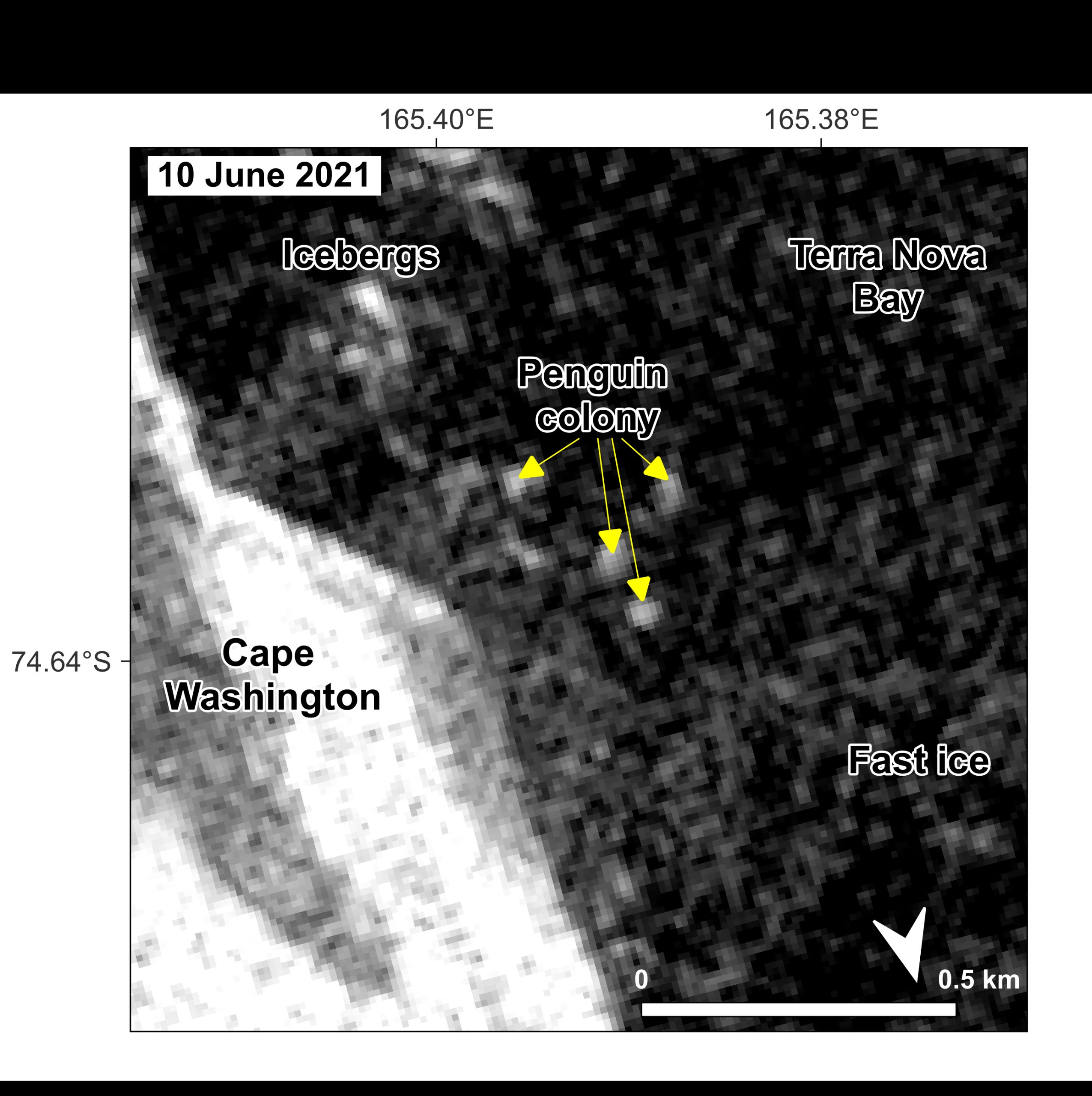
Different groups within the colonies were also shown to move away as one from the sea ice edge, despite its apparent stability. It’s likely this coherent movement was caused by meteorological drivers, such as weather and climate, say the researchers.
“We’ve shown that satellite radar imaging is a very useful tool for understanding their behaviour during a key part of the breeding cycle and particularly their response to environmental change during winter,” says Grant Macdonald, the study’s lead author and a postdoctoral researcher at Durham University, UK.
“Gaining a year-round picture of their behaviours is important because we know the penguins are very vulnerable to climate change and changes in sea ice or the floating parts of the Antarctic ice sheet breaking up.”
Earlier this year, the emperor penguin was classed as Endangered by the IUCN. They face threats from climate change, as they rely on stable sea ice to breed and raise chicks. But now, their population is predicted to rapidly decline due to decreasing Antarctic sea ice.
Top image: emperor penguins and chicks at Snow Hill Island in Antarctica. Credit Dr Peter Fretwell, British Antarctic Survey.


