
A study of penguin fossils, conducted by researchers from China University of Geosciences in Beijing, has revealed how ancient bones can offer a glimpse into climate change from millions of years ago.
- "It's believed that something went terribly wrong and the mother died while giving birth..." 7 groundbreaking fossil discoveries that changed the world
- "Seeing these iconic birds marching through the wilderness fills me with wonder": a day in the life of a penguin researcher
This study, published in the journal Fossil Record, is the first use of vertebrate fossils to reconstruct ancient climate change, linking penguin bone chemistry to Antarctica’s environmental history.
The penguin fossils, found on Seymour Island (located around the tip of Graham Land on the Antarctic Peninsula), date back to the Eocene epoch, which spanned approximately 34-56 million years ago.
Seymour Island provides insight into a significant chapter of Earth’s history of climate change. As the island’s rock layers stack up in a mostly unbroken sequence, they offer a unique look into major geodynamic changes, including the initial growth of the Antarctic ice sheet and the opening of Drake Passage.
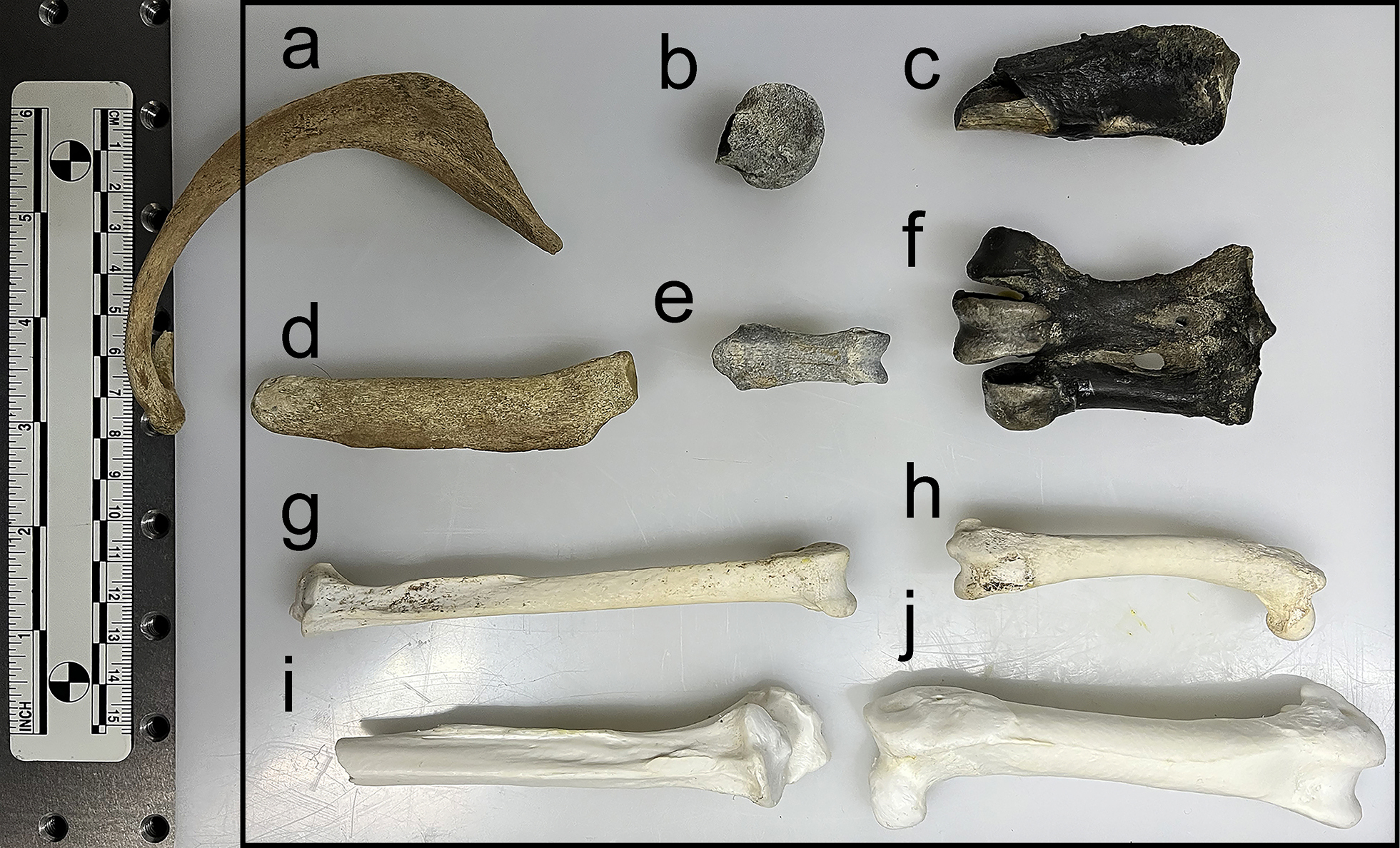
This makes Seymour Island a rare natural laboratory for tracing how climate conditions on our planet shifted over millions of years. Although scientists traditionally relied on whole-rock geochemical approaches to study this area, this new study offers a fresh source of environmental data.
“Penguins are among the most iconic animals of Antarctica and represent one of the most distinctive groups of birds, having completely lost the ability to fly and instead using their flipper-like wings for swimming,” say the research team.
“Seymour Island preserves one of the world’s richest and most stratigraphically continuous records of Eocene penguin fossils. These fossils span an important interval of Antarctic climate evolution, from the relatively warm and humid conditions of the early Eocene to the cooler climate of the middle and late Eocene.”
The fossil chemistry
To analyse the fossils, the scientists used a technique called micro-X-ray fluorescence mapping, which allowed them to map chemical elements across the surface of the bones.
The analysis found that the oldest fossils, from around 54-55 million years ago, had much higher levels of titanium, silicon and potassium. These chemical patterns point to intense rock weathering – a sign that the climate of that time was warm and humid, causing more erosion and runoff into the area where the penguins died and their bones fossilised.
“Based on the statigraphic, sedimentological and paleoclimatic evidence, we interpret this pattern as being consistent with stronger continental weathering and terrestrial material input under the warm and humid conditions of the early Eocene,” adds the research team.
The scanning method also detected iron, manganese and sulphur patterns trapped within the bones – reflecting local chemical changes in the marine sediment as the fossils were buried over millions of years.
Fragile cargo
Studying fossils so rare without damaging them can prove tricky – which is why the researchers turned to the chemical scanning method. Even still, it came with its own set of challenges.
“One of the main challenges was obtaining reliable elemental information without damaging the fossils. The irregular shapes and curved surfaces of the fossil bones created practical difficulties during scanning,” said the research team.
“To minimise the influence of variations in surface height, we positioned the bones as horizontally as possible and maintained a relatively constant distance between the scanning head and the bone surface.”
The research team highlighted that studying bone geochemistry has emerged as a valuable tool for understanding historical Earth systems and climate change – alongside more traditional methods like marine sediment drilling and microfossil analysis.
“An important finding for us was that the elemental information preserved in penguin bones may record not only how external materials entered the bones, but also differences in weathering input, depositional conditions and early diagenetic environments,” they explain.
“We believe that fossils can provide an important complementary source of information for studying paleoenvironmental changes on the Antarctic Peninsula.”
Read the full findings here.
Top image: King penguins fill the beach on Salisbury Plain, South Georgia Island. Credit: Catherine Harold/Getty Images


