
The Steller’s sea eagle looks like a character that you might find in a fantastical children’s book rather than a real flesh-and-blood animal.
It is jaw-droppingly huge, with striking dark and white feathers, a bright-yellow bill so large and powerful it seems almost prehistoric, and taloned feet roughly the size of a human hand. Found in the cold coastal margins of north-east Asia, this magnificent raptor is built for ice, salmon runs and sea winds – and is the heaviest eagle alive today.
How big is the Steller’s sea eagle?
The Steller’s sea eagle is widely regarded as the heaviest living eagle, with large females reaching about 9kg. Its wingspan can approach 2.45m, meaning that when it opens its wings fully, it is wider than most human adults are tall.
Other eagles, including the harpy eagle and Philippine eagle, can rival it in different measures of size, but for sheer mass the Steller’s sea eagle is hard to beat.
- 9 brutal photos of the world’s most powerful bird that can rip monkeys and sloths from branches
- It has legs as thick as wrists and is able to rip monkeys from branches with deadly talons: Meet the world's most powerful bird
Where does the Steller’s sea eagle live?
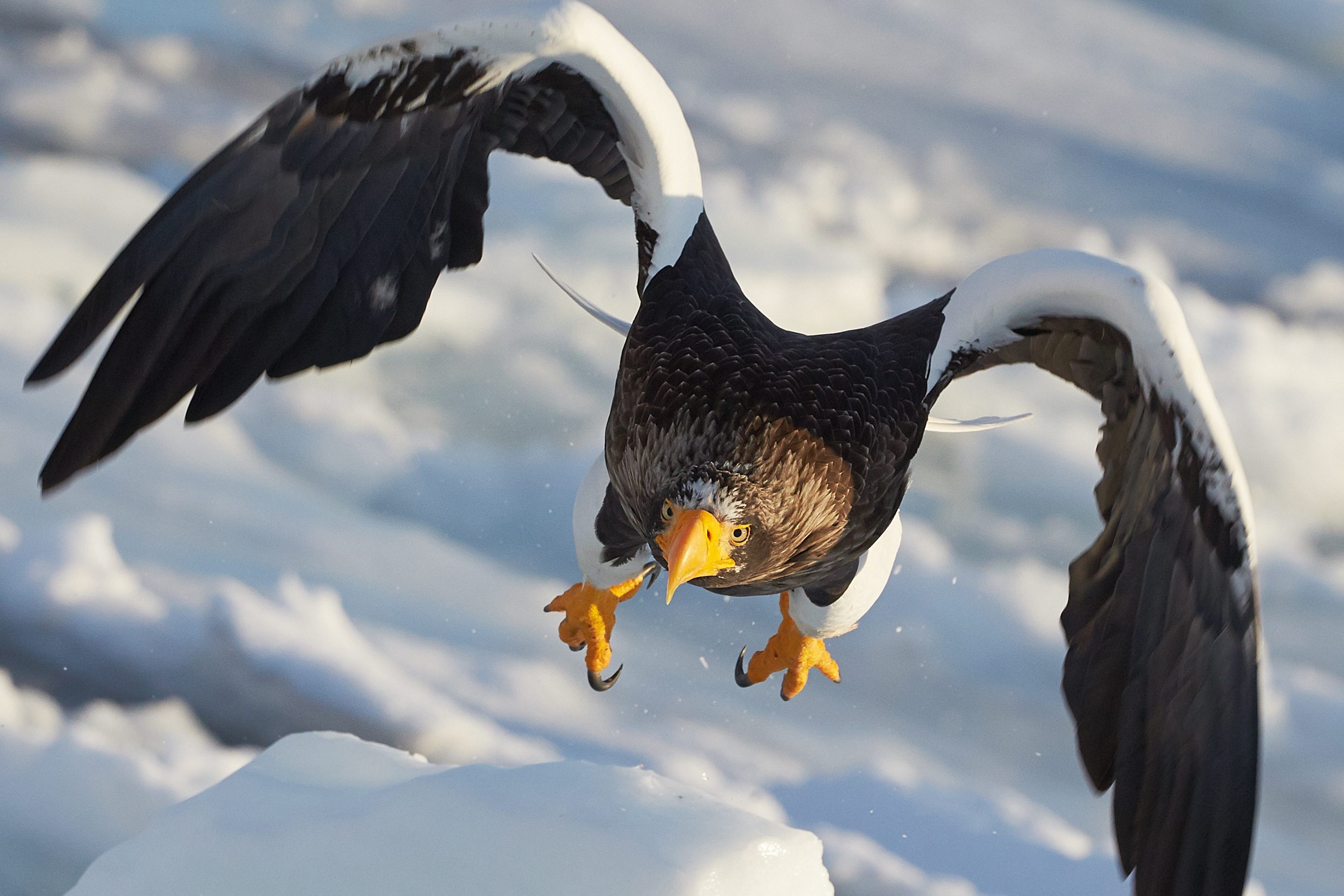
The Steller’s sea eagle is known to breed in northeastern Siberia in Russia, on the coastline and islands of the Sea of Okhotsk and the Bering Sea. The Kamchatka Peninsula is a stonghold. It is closely tied to rocky sea coasts and rivers with cliffs or mature trees suitable for nesting.
In winter, the Steller’s sea eagle often moves south, with many individuals travelling to Hokkaido in Japan and the southern Kuril Islands. A few turn up much farther afield, including in Korea, China and, very occasionally, North America. Such vagrants cause understandable excitement: a bird this large, this rare and this spectacular is not easily overlooked.
Who was Steller?
Georg Wilhelm Steller was an 18th-century German naturalist with a talent for attaching his name to spectacular animals. While exploring the Russian Far East and Alaska on an expedition led by Danish cartographer Vitus Bering, he described several northern Pacific species, including Steller’s jay, Steller’s eider, the extinct Steller’s sea cow and, of course, the Steller’s sea eagle.
What does it eat?
Fish is the main event, especially salmon and trout in its breeding range. When salmon gather in rivers to spawn, the Steller’s sea eagle can feed on living fish and on those that have died after spawning. This seasonal glut is one reason its nest is usually built close to water.
The Steller’s sea eagle is not fussy, however. It also eats cod, crabs, shellfish, squid, seabirds, ducks, small mammals and carrion, including deer carcasses. In hard conditions, flexibility is survival.
How does it hunt?
The Steller’s sea eagle may watch from a tree, cliff or other perch before launching itself at prey. It also hunts from the air, diving towards water and snatching fish in its powerful talons. At times, it stands in shallow water or on ice and simply grabs fish as they pass.
Like other eagles, it practises kleptoparasitism, which means stealing food from other birds. Given its size, it is well equipped for this. A smaller bird with a fish has good reason to be nervous when the Steller’s sea eagle appears overhead.
How fast is the Steller’s sea eagle?
They can cruise at around 30mph but when diving to catch prey they can reach an impressive 100mph
- 10 fastest birds of prey in the world – able to reach speeds of almost 200 MPH, these deadly aerial predators strike in a blink of an eye
- It's the fastest animal in the world and its deadly claws can catch prey mid-air: Meet one of the world's most incredible birds of prey
How does it breed?
The Steller’s sea eagle builds an enormous nest, or aerie, high in a large tree or on a rocky cliff, often close to the shoreline. A pair may return to the same nest year after year, adding fresh branches until the structure becomes huge. Some aeries can reach 1.8–2.4m across.
- 10 jaw-dropping eagle moments captured in photos and film that reveal the brutal hunting behaviour of this powerful bird of prey
- Meet the world's deadliest-ever eagles, including a 18kg mighty raptor that terrified New Zealanders until its extinction in the 15th century
Mating begins in late winter and by spring the female usually lays one to three greenish-white eggs, which hatch after about 38–45 days. Although more than one chick can be raised, often only one survives. The young eagle is downy and helpless at first, but grows quickly on a rich diet of fish and may be ready to fly at around 10 weeks old.
Does it have any predators?
An adult Steller’s sea eagle has no known natural predators. Once fully grown, it sits very near the top of its food chain. But eggs and hatchlings are more vulnerable, with martens and crows among the animals known to raid nests. In some areas, brown bears can also take nestlings.
Is the Steller’s sea eagle threatened?
The Steller’s sea eagle is listed as Vulnerable by the IUCN and its population is thought to be declining. Estimates vary, but there may be fewer than 5,000 mature individuals left in the wild.
The threats are multiple. Logging and development can damage nesting habitat, while pollution affects rivers and coastal waters. Overfishing can reduce food supplies, and in Japan the eagle has been poisoned after scavenging deer carcasses containing lead ammunition, though lead-bullet restrictions have been introduced in parts of its wintering range.
The Steller’s sea eagle is legally protected in countries including Russia and Japan, but its rarity and remote habitat means it remains a difficult bird to study and conserve.
- They strike with clenched talons at 200mph, crush skulls, shred prey, and can inflict deep head wounds on humans – 10 deadliest birds of prey on the planet
- 12 brutal birds of prey photos that capture their deadly power, grace and majesty
- Bald eagle vs golden eagle: what's the difference between these two gigantic raptors?


