
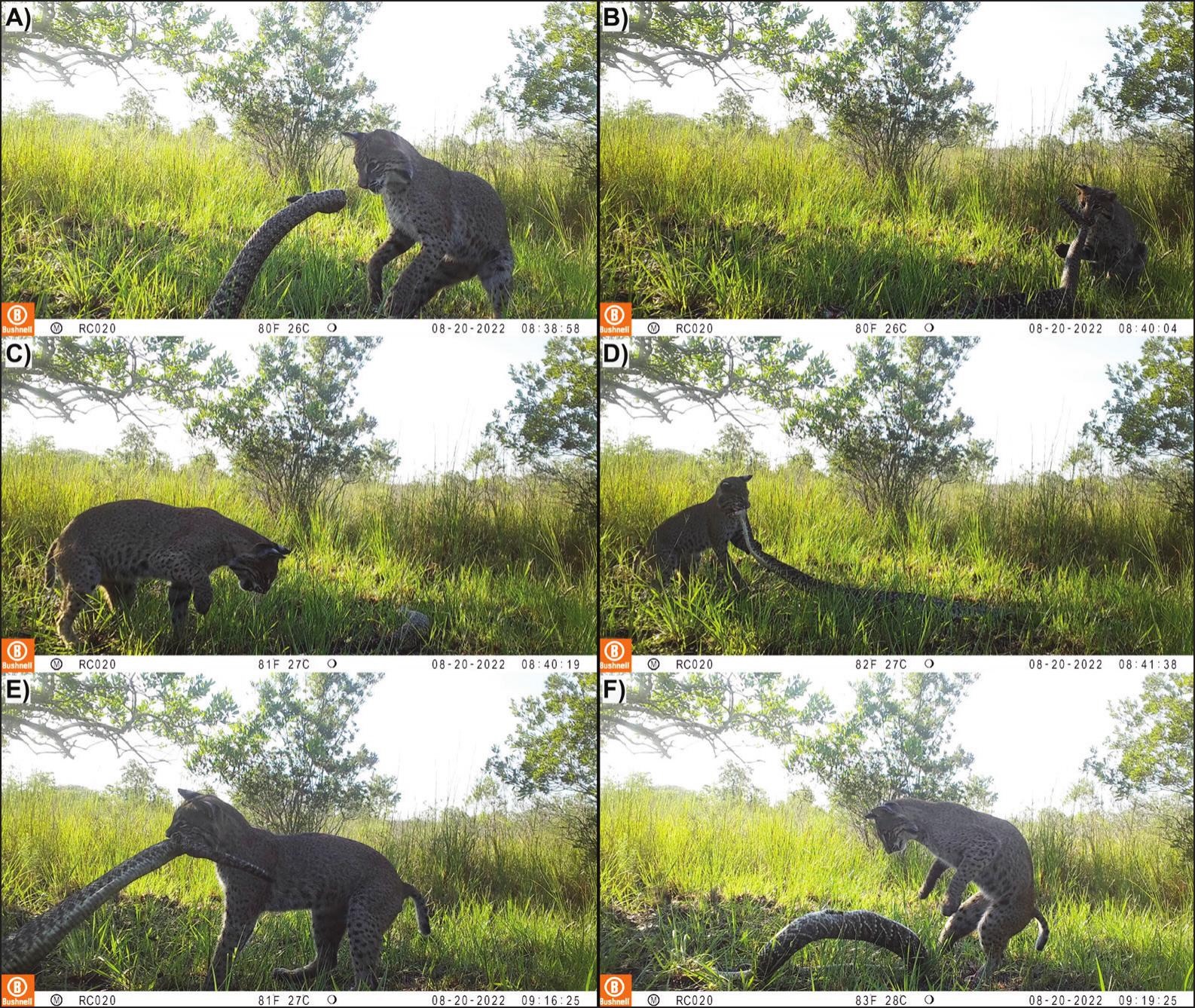
Photos taken by a camera-trap in Florida have captured the dramatic moment a bobcat takes on a sizeable eastern diamondback rattlesnake – the largest rattlesnake species in the world by both length and weight.
- Meet the animals brave enough to hunt and devour the world’s deadliest, most venomous snakes
- It might look like a bit like your pet cat – but this fierce predator is a skilful swimmer who can sprint at 30mph and is anything but cuddly…
In the image set, the medium-sized wild cat can be seen attacking the rattlesnake's tail, clawing its body and biting its head. Additional images show the snake on its back, with visible wounds to the head, midbody and tail.
Despite being injured, the snake tried on several occasions to attack the bobcat but was unsuccessful.
A new paper, led by wildlife biologist Mohamed Khalil Meliane and published in the journal Southeastern Naturalist, documents the behaviour (photographed in 2022).
“Adult rattlesnakes are infrequently documented as prey, and direct evidence of mammalian attacks on large venomous snakes is limited,” say the authors.
- "That’s the length of a double decker bus!" 33ft monster tops biggest snakes in the world list
- 10 amazing snake facts you (probably) won't have heard before
- These are the world's deadliest snakes
- 9 weirdest snakes on the planet
- Snake Island, the terrifying island off Brazil that only scientists and soldiers can visit
- Largest snake species in the world discovered in Amazon rainforest – and it's a whopper!
The authors note several other incidents of bobcats attacking reptiles. A 2021 paper, published in Southeastern Naturalist, reported the bobcat’s “capacity to kill adult pythons based on an examination of a dead Burmese python female where claw scratches on the carcass and signs at a nearby cache site were consistent with an attack by a bobcat.”
In a 2022 study, published in Ecology and Evolution, researchers documented a bobcat predating Burmese python eggs in the Florida Everglades – the only known nest predator for the species in the US.
Then, in 2025, bobcat predation on American alligator juveniles was detailed in Southeastern Naturalist.
“Our observation provides primary photographic evidence that bobcats can attack and severely wound adult vipers,” say the authors of the new study. “It also supports previous indirect evidence of predation on Burmese pythons by confirming the species' capacity to kill large reptiles, even venomous ones.
“Together, these observations form a growing body of evidence that Bobcats can attack or consume relatively large reptiles, including dangerous or invasive taxa, and that such interactions may be under-detected.”
Read more about the study.
Top image credit: Mohamed Khalil Meliane et al. Southeastern Naturalist 2026
More wildlife stories from around the world
- A carnivore has moved into Florida's Everglades – and it's threatening native crocodiles and alligators
- “We would find piles of rattlesnakes.” Scientists witness undocumented snake behaviour in Wyoming's mountains
- It's the biggest snake den on the planet – 100,000 crammed into a small cavern
- 61 black mambas captured in African city. Here's what experts found in their scales – and why it matters


