
With truly enormous goggly eyes, sticky-out swivelling ears and long grippy fingers, Yoda-like tarsiers look almost otherworldly.
Come nightfall, these tiny primates become agile hunters, clinging to upright trunks before springing through the vegetation in pursuit of insects and other small prey. Their name comes from their extraordinarily elongated ankle bones – tarsals – which help power those prodigious leaps. Found only on a scattering of South-East Asian islands, tarsiers belong to an ancient and highly distinctive branch of the primate family tree.
- "It looks like a porcupine, but has a bird-like beak, a pouch like a kangaroo and lays eggs like a reptile." 10 weirdest, bizarrest mammals on the planet
- Yoda-like tarsiers are struggling to sleep – and it could be the death of them, warn scientists
How many species of tarsier are there?
There are currently 14 recognised living species in the family Tarsiidae, divided between three genera. The Philippine tarsier (Carlito syrichta) is the sole member of Carlito; the western tarsier (Cephalopachus bancanus) is the only species in Cephalopachus, found on Borneo, Sumatra and nearby islands; and the remaining 12 belong to Tarsius, found on Sulawesi and nearby islands. The picture is still evolving: several species have only been formally described in recent decades, including Niemitz’s tarsier in 2019.
Are tarsiers monkeys?
No. Tarsiers occupy their own branch of the primate family tree. They belong to the haplorhines, the major primate group that also contains monkeys, apes and humans, rather than the strepsirrhines, which include lemurs and lorises. The lineage of tarsiers is ancient: fossils show that recognisably tarsier-like primates were living at least 45 million years ago.
- It’s the size of a pet cat, looks like a bandit and uses its enormous tail to flirt
- Monkeys may eat flowers to alleviate postpartum depression, study finds
Where do tarsiers live?
Tarsiers survive only on islands in South-East Asia, including Borneo, Sumatra, Sulawesi, the southern Philippines and smaller surrounding islands. Different species can have remarkably restricted ranges: the Peleng tarsier, for example, occurs only on Peleng and neighbouring Banggai, while the Siau Island tarsier is confined to the volcanic island of Siau. They are strongly associated with old-growth forest and dense vegetation, though some species also use secondary forest, plantations and other disturbed habitats where suitable vertical stems remain.
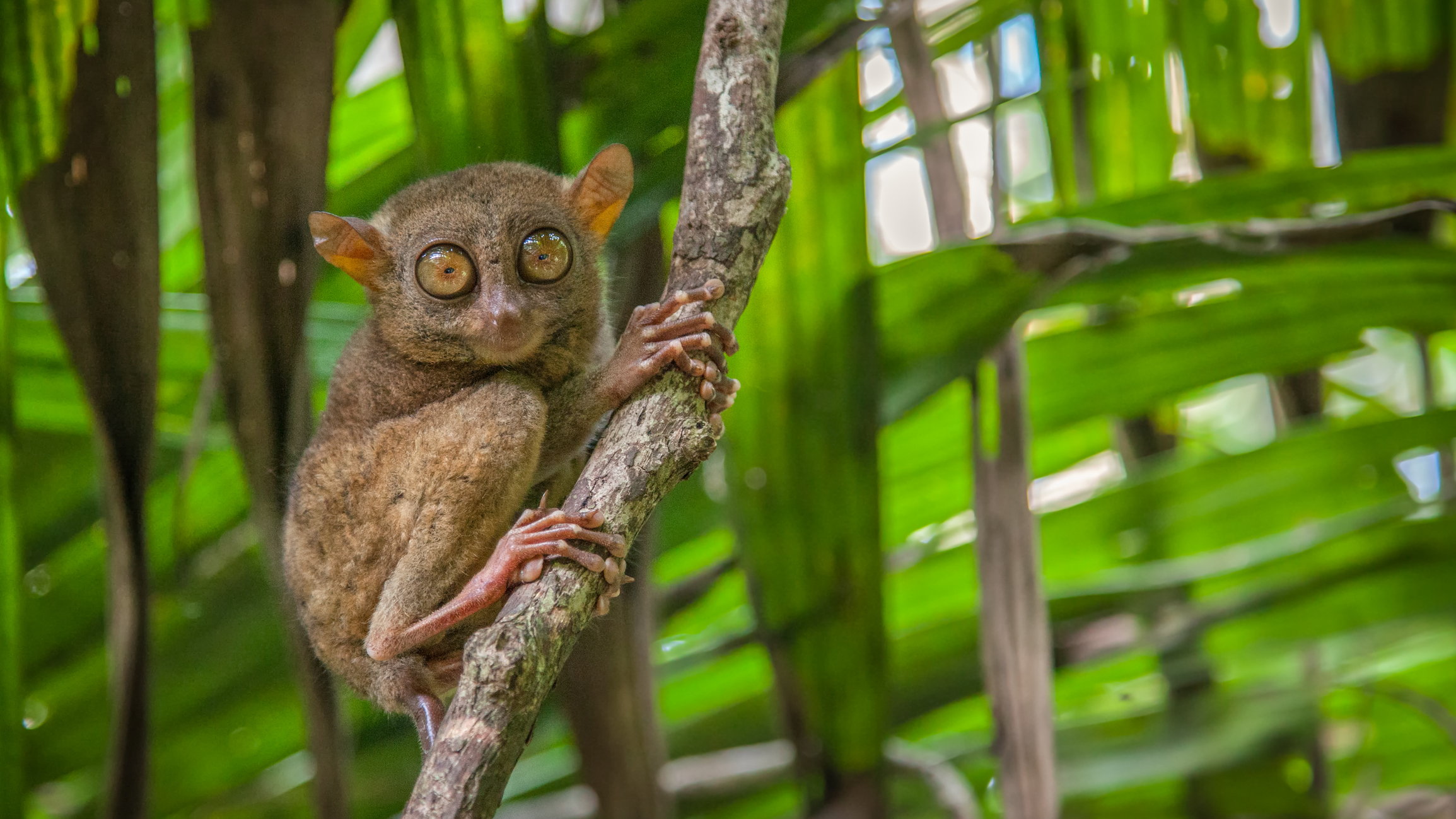
Why are their eyes so enormous?
Tarsiers are nocturnal hunters and their huge forward-facing eyes are adapted to gather as much light as possible. Many nocturnal mammals have a tapetum lucidum, a reflective layer behind the retina that bounces light back across its light-sensitive cells, effectively giving the eye another opportunity to capture it. Tarsiers lack this structure, so instead have evolved exceptionally large eyes to maximise the light reaching the retina. Their eyeballs are so large that they cannot move them around in their sockets as we do. Instead, a remarkably mobile neck allows a tarsier to turn its head about 180° in either direction.
- 11 weirdest, bizarrest eyes on the planet, including a creature with a mystifying, danger-seeing third eye: Discover the eyes that take ordinary to extraordinary
- This predator uses its 24 eyes to help with transferring sperm packets during courtship. It could be lurking in the shallows near you
How do they move?
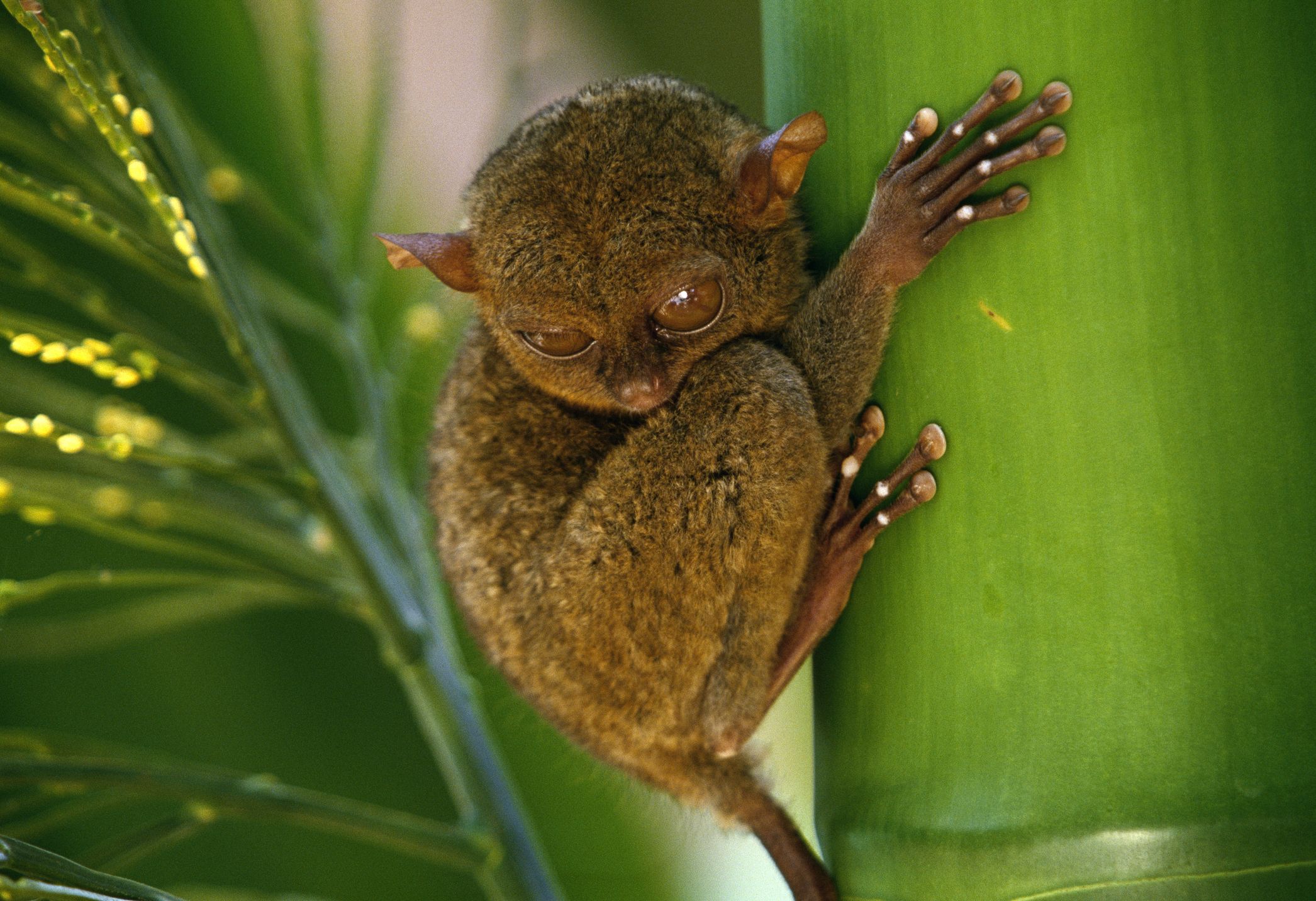
Tarsiers are specialists in vertical clinging and leaping, gripping an upright trunk before springing to another support. Their hindlimbs are extraordinarily long, and much of that length comes from elongated ankle, or tarsal, bones – the feature that gives the animals their name. Long fingers and toes, often ending in rounded gripping pads, help them cling securely after landing.
What do tarsiers eat?
Animal prey, and nothing else. Tarsiers are unusual among primates in being entirely carnivorous. Insects make up much of the diet, including beetles, moths and grasshoppers, but some species also tackle small vertebrates such as lizards, snakes and birds.
What do they do during the day?
After a night spent hunting, tarsiers retreat to sheltered sleeping sites. The details vary between species: dense tangles of vegetation, tree hollows and clusters of vines may all provide cover, while some Sulawesi tarsiers repeatedly return to favoured sleeping trees. In several species, these sites are also associated with bursts of vocal activity around dawn, as animals finish their nocturnal activity and settle down for the day.
Do tarsiers talk to one another?
Definitely, although different species communicate differently. Several Sulawesi tarsiers are famous for intricate male-female duets, while Philippine tarsiers have been recorded making extremely high-pitched calls with a dominant frequency of 70 kHz, well above the upper limit of human hearing. Researchers speculate that this may help them avoid detection by predators and prey, while also improving detection against low-frequency background noise.
How do tarsiers breed?
Knowledge is lacking for some species, but tarsier reproduction involves unusually heavy investment in a single infant. Gestation lasts about six months and females normally give birth to one young. The newborn is remarkably well developed, arriving furred and with its eyes open, and can cling and climb almost immediately. In species studied closely, mothers may carry tiny infants in the mouth and ‘park’ them on vegetation while they forage nearby.
- What are primates?
- "22% of US men believe they could beat a chimpanzee in a fight" – Here’s how humans actually stack up against the world’s 10 strongest primates
Are tarsiers under threat?
Broadly, yes, but their conservation status varies depending on the exact species. The Philippine tarsier is Near Threatened, the western tarsier is Vulnerable, and several Sulawesi-region species are Endangered. Threats include habitat destruction and fragmentation; light and sound pollution; hunting for the illegal pet trade; and agricultural chemical pollution. The Siau Island tarsier, which occupies a tiny range, is especially vulnerable and listed as Critically Endangered.
A TARSIER’S SPECIAL FEATURESScientific family name: Tarsiidae
Head and body length: About 9–16cm
Tail length: About 20–25cm
Weight: About 80–150g
Lifespan: About 8–15 years, depending on species and whether wild or captive
top image: Tarsier portrait in a forest at Bohol Island - Philippines. Credit: nikpal/ Getty Images
More wildlife stories from around the world:
- Brave, kick-ass female zebra saves foal from infanticidal male
- Watch brutal but incredible BBC footage – narrated by David Attenborough – of ferocious hippos battling for supremacy
- Heart-stopping moment a crocodile attacks a vulnerable lion cub on a Zambian river – watch incredible footage of how its pride reacts


