
Scientists documented the first long-distance travel of an Arabian Sea humpback whale (ASHW): a small population of only around 82 individuals that live off Oman’s coast.
Unlike other humpbacks around the world, these endangered whales usually stay close to home. The population is genetically distinct from other humpbacks, having diverged around 70,000 years ago, and individuals usually stay within the Arabian Sea rather than undertaking long migrations between feeding and breeding grounds.
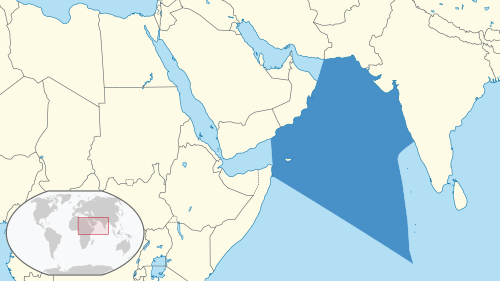
But a new study has revealed an anomaly: when scientists attached satellite tags to some of the whales to track their movements, one female surprised them by swimming across the Arabian Sea to Goa, India, before returning home in a 7,000km round trip.
This is the first direct evidence of a humpback from this population crossing the Arabian Sea. The findings are published in the journal Frontiers in Marine Science.
“The Arabian Sea humpback whale (Megaptera novaeangliae; ASHW) is understood to be the only population of this species that does not undertake long-range seasonal migrations between high- and low-latitude waters,” write the authors in the study.
To learn more about these animals, researchers used 14 satellite tags to track where some of the whales went between February 2014 and December 2017.
Following the whales
“Leading into this study we had so many questions about the daily life of the mysterious humpback whales found in the Arabian Sea, of which we would only get fleeting glimpses during long hot hours of boat surveys,” says the study’s author Andrew Willson in a press release.
“Tagging these whales allowed us to peel back the lid of the sea and check in online to see where they were each day.”
- Drone captures incredible 10-tonne whale rescue in Australia
- When researchers attached cameras to baby humpback whales they discovered something amazing
The whales mostly “stayed within a very restricted home range along the coast of Oman,” says Willson, a marine scientist who is founding director of Future Seas Global SPC. Monsoons in the region make these waters incredibly productive so there is plenty of food to support Arabian Sea humpback whales all year, meaning they don’t need to migrate seasonally like other populations.
But an intrepid voyager called Luban travelled all the way to Goa, spending around a month off the coast of India before coming back home. The researchers think she might have been travelling to find food or reproduce.
- Scientists put three decades of whale migration data into a digital map – this is what they saw
- Drone captures incredible whale hunting behaviour in Canada. Experts think they've only just learned how to do it
Willson was happy to know that she’d made it back to Omani waters safely, saying: “It’s always a relief when we make resightings of these amazing whales given the limited size of the population.”
Fishing and ship strikes can threaten the survival of small, fragile populations like this one, so it’s important to understand where these whales go and what human activity they might cross along the way.
The researchers hope their data will help to protect these whales.
“Coastal fishing communities in Oman have revered and respected these whales for many generations,” says Aida Al Jabri, a marine expert at the Oman Environment Authority. By showing which waters the whales like to spend time in, the findings can help to prevent overlap with fishing activity.
“This is critical to supporting their conservation,” he says.
The anomalous whale that departed from homebody life to visit India could be a sign of a shift within the population.
“The Arabian Sea provides unique conditions allowing a once-migratory species to completely change its ecology. It’s a testament to how extraordinary the region is,” says the study’s co-author Suaad Al Harthi, executive director of the Environment Society of Oman.
“We hope their adaptability will help ASHWs in uncertain times when their domain is influenced by accelerated climate change.”


