
As global water temperatures continue to increase, many scientists are concerned about the potential impact on corals, which can bleach and die when waters get too warm.
But there may be hope. A new study published in the journal Science Advances suggests that healthy corals might have the healing touch.
“Brief contact with healthy corals can reverse the effects of coral bleaching,” says the study’s lead author Danny Collins, a marine scientist at the Stanford Doerr School of Sustainability.
Corals are tiny animals that have colourful microalgae called zooxanthellae living inside their tissues. These symbiotic algae are helpful houseguests, which create energy through photosynthesis and share it with their coral host – a sort of ‘thanks for having me’ gift, if you will.
But, like any house-sharing situation, the roommates sometimes fall out. When water temperatures get too high, the coral kicks the algae out. Without its colourful friend taking shelter inside, it turns white: a process known as bleaching.
It’s a race against the clock for the algae to return because the zooxanthellae are the coral’s main source of food.
“There is an ongoing, urgent race for solutions to mitigate the catastrophic loss of coral due to bleaching,” write the authors in the paper. “With widespread impacts from four global bleaching events occurring in 1998, 2010, 2015-16 and 2023-25, and predictions of mass coral bleaching occurring annually by 2080, coral reefs are approaching tipping points of collapse.”
The bleaching itself doesn’t kill the coral. If temperatures come back down soon enough, algae can return and the coral can recover. If not, or if it returns too slowly, the coral can starve and die.
- Can the Great Barrier Reef be saved? How Australia’s indigenous peoples could hold the key
- Satellite images reveal more than 1,000 unmapped coral reefs in Australia
- Florida scientists are using underwater umbrellas to protect coral reefs
- Watch: Astonishing ‘explosion of life’ coral spawning in Cambodia stuns scientists
Collins and colleagues wondered if anything could speed up the recovery of a reef once it had bleached. “Coral bleaching can result in such high mortality that bleached corals are often treated as a lost cause,” he says. “However, not only are bleached corals not dead, they have remarkable potential to recover.”
The scientists knew harmful bacteria can spread when corals touch and wondered whether physical contact might also have a beneficial effect.
So, they explored what would happen when they put bleached and healthy corals in contact with each other and they were amazed by what they found. “Their tissues fuse together, creating a tissue bridge through which the healthy coral rapidly sends large numbers of beneficial algae into the bleached coral,” he says.
This point of contact between the two corals allowed algae to transfer into the bleached coral where they can replicate.
As a result, the bleached coral recovered remarkably quickly. “Just five days of contact is enough to jumpstart recovery, after which the healthy coral can be removed and the bleached coral can fully recover on its own,” says Collins.
It didn’t take long for the coral to return to a healthy state. “All bleached coral in direct contact with healthy coral (n = 5) achieved complete recovery within eight weeks,” they write in the study, and one fragment recovered in just four weeks.
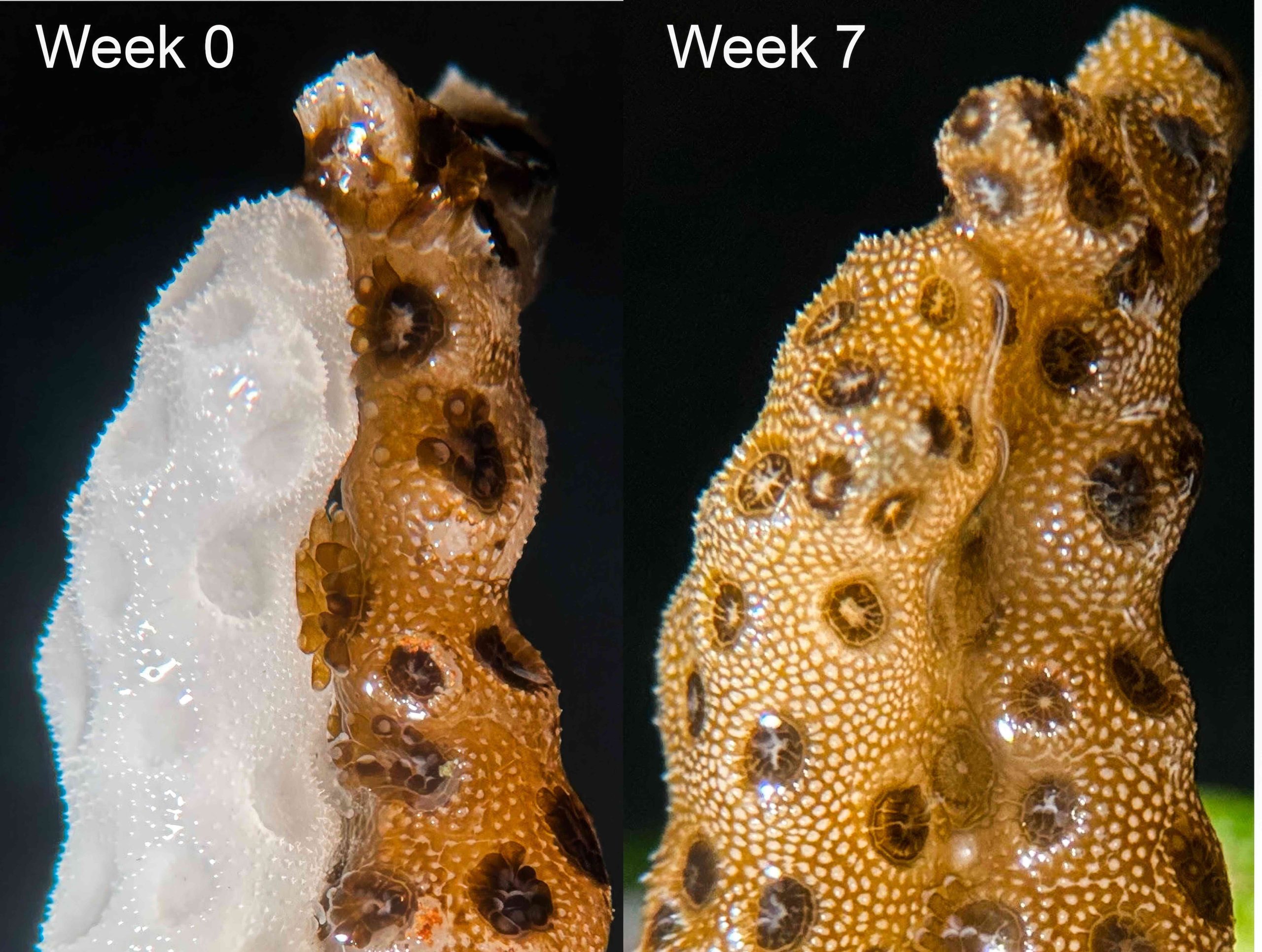
And the corals didn’t need to be touching the entire time – “only brief physical contact” is required, they say.
“A single week of contact, and in some cases as few as three days, provides sufficient symbionts to initiate sustained and full self-recovery,” according to the study. “By one week, symbiont population doubling time is approximately 4 days, up to an order of magnitude faster than most recovery times for corals in the field.”
This is the first time researchers have shown that corals can recover from bleaching merely by touching healthy corals.
There are some caveats. Collins notes that this won’t work between just any corals. “This current approach requires contact between corals of the same clone, which may limit is application on reefs,” he says, “however, the major advance is now knowing the remarkable potential for bleached corals to rapidly recover once symbionts are reintroduced.”
More research is needed to understand how this new finding can be translated from the lab into large-scale bleached reefs.
But he’s hopeful that this is a first step that could lead to real-world solutions that help reefs bounce back from bleaching events.
Collins adds: “These results offer hope for coral reefs and could inspire a new set of interventions focused on helping bleached corals recover.”
More wildlife stories from around the world
- This coral reef gets bombed every 62 minutes. And it’s changing the way the ocean sounds
- Colossal squid filmed alive in deep ocean for the first time ever
- Gigantic iceberg breaks free in Antarctica, revealing ghostly mega-nest beneath
- NASA officials sent over 2,000 baby jellyfish into space. Tens of thousands more came back to Earth


