
An international team of researchers has solved the mystery of how narwhal tusks acquire their twisted structure. The findings have been published in the journal Nature Communications.
- Incredible drone footage of narwhals in the Arctic reveals never-before-filmed behaviour
- 'Unicorn of the sea' washes ashore in Ireland. The bizarre Arctic animal has never been seen here before
Narwhals are often called the ‘unicorns of the seas’, and not without reason. Back in the Middle Ages and the Renaissance, the narwhal tusk was often sold as a unicorn horn. The mythical unicorn was so revered that the Danish-Norwegian king Frederik III famously ordered a coronation chair made entirely from narwhal tusks as a sign of his power and social status.
Despite extensive research, we still don’t know what exactly the narwhal uses its tusk for. Scientists have many theories – sexual signalling, hunting, infighting or play.
But for now, scientists solved another mystery – how exactly does the tusk obtain its characteristic twisted structure?
The structure
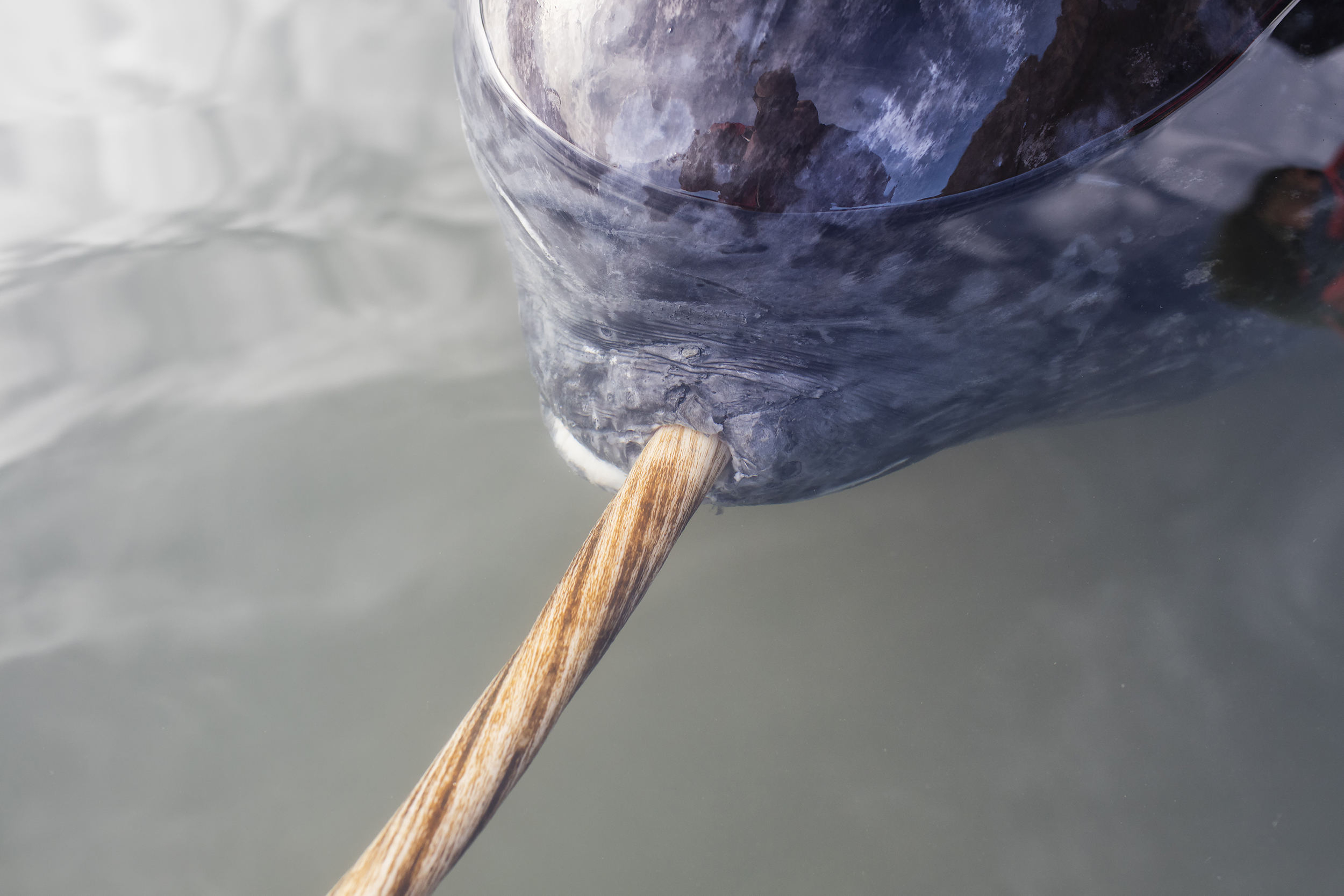
Narwhals aren’t the only animals that sport this long, pointed tooth, but it’s still unique – it’s the only one that sticks straight out in a spiralled form and doesn’t follow a curved shape.
Narwhals have two upper teeth – the left canine tooth in males grows into the twisted husk, protruding from the maxillary bone and through the upper left lip. The right tooth in males and both teeth in females are embedded in the skull.
There are rare cases of females growing a tusk and males without one – and even double-tusked individuals have been observed. The tusk can exceed a whopping 2m in length and always twists in a left-handed helix. Even in the rare cases when it’s the right tooth, it develops into a tusk.
“Like bones or other teeth in the animal kingdom, the narwhal tusk is a complex composite material whose structure extends from tiny nanoscale building blocks to the visible form of the entire tooth,” says Marianne Liebi, co-author of the study.
The tusk is made of dentine: the same material that forms the core of human teeth. On the outside, it’s covered by a thinner layer of cementum, a tissue that in other mammals normally occurs only at the root of the tooth. Both parts contain collagen fibres, acting as internal reinforcement, which are in turn strengthened by tiny mineral crystals that give the material its hardness.

The challenge
It’s exactly this complicated architecture of the tusk that presented the main challenge for the researchers.
“The collagen fibres and mineral crystals are on the nanometre scale, while the spiral of the tooth only becomes visible at centimetre and metre lengths,” explains Liebi.
Visualising the shape of the tusk in both ranges required a specific X-ray technique: tensor tomography. In this method, the tooth is rotated and scanned point by point, and when the X-rays come across regularly arranged structures within the material, they produce patterns. From those patterns, scientists can calculate how the nanometre-sized collagen fibres are oriented inside.
Finally, from millions of measurements, a 3D image of the internal architecture of the tusk can be constructed – from the tiny, nanometre-scale fibres to the macroscopic form of the whole tooth.
But, to the surprise of the research team, the data revealed nothing.
“That puzzled us quite a bit,” says Liebi. Based on previous mechanical tests, the scientists thought the spiral shape would be reflected in the collagen fibres and mineral crystals. “But instead of a helix, all we saw was a regular pattern.”
The answer to this puzzle required them to take a step back. Instead of focusing on individual pixels, they needed to analyse spatial orientation.
“When we compared how these points were oriented relative to each other, a directional trend began to appear,” recalls the first author of the study, Adrian Rodriguez-Palomo.
“All we had to do then was connect the dots – as in a children’s paint-by-numbers kit – and suddenly the structure became visible: two intertwined spirals.”
The outer layer of the tooth forms a left-handed helix, while the mineralised collagen structures inside the tooth follow a spiral pattern in the opposite direction.
Reinforcement
This newly-discovered structure is no accident – the double helix configuration makes the tooth more stable under bending and torsion. This is echoed across the animal kingdom, for example, in the helical reinforcement of the deep-sea glass sponge Euplectella aspergillum, which helps it withstand strong ocean currents.
The study also determined that the double-spiral structure is encoded in the animal’s genetics and remains stable throughout its life. The maximum lifespan for a narwhal is around 80 years, and the tooth continues to grow with the animal.
This discovery provides new insight into how complicated structures form in the natural world, which can be used to inspire the design of materials in fields such as construction or medicine. It also could offer a glance into environmental and climate conditions of the past.
“Since whales can live up to 80 years, their teeth form a kind of historical record of changing environmental conditions throughout the animal’s lifetime,” says Henrik Birkedal, who led the research project, from Denmark’s Aarhus University.
“And because the North Atlantic is currently undergoing very rapid changes, it is obvious to investigate whether we can trace these changes in the hard tissue of the narwhal tusk. That is what we are now working on.”
Read the full findings here.
Top image: Narwhals with tusks swimming in North West Greenland. Credit: Carsten Egevang
