The River Thames might sometimes look bleak and murky but there are animals living in these waters. This includes several species of fish, such as seabass and flounder, wading birds and sometimes even the occasional seal or porpoise.
In late September, some rare visitors arrived in the tidal Thames near the town of Gravesend, east of London: a pod of long-finned pilot whales.
A ship’s pilot saw the whales (which are technically a species of dolphin) and reported them to the Port of London Authority (PLA) who also informed the British Divers Marine Life Rescue (BDMLR) and local authorities.
“The whales are beautiful but, given this isn’t a normal place to see them, we are concerned for their welfare,” said PLA in a statement at the time. “We will continue to do all we can to keep them safe.”
The experts kept a close eye on the whales and let boats know to be careful while sailing along the river. One of the pod appeared to be poorly and was no longer swimming with the group.
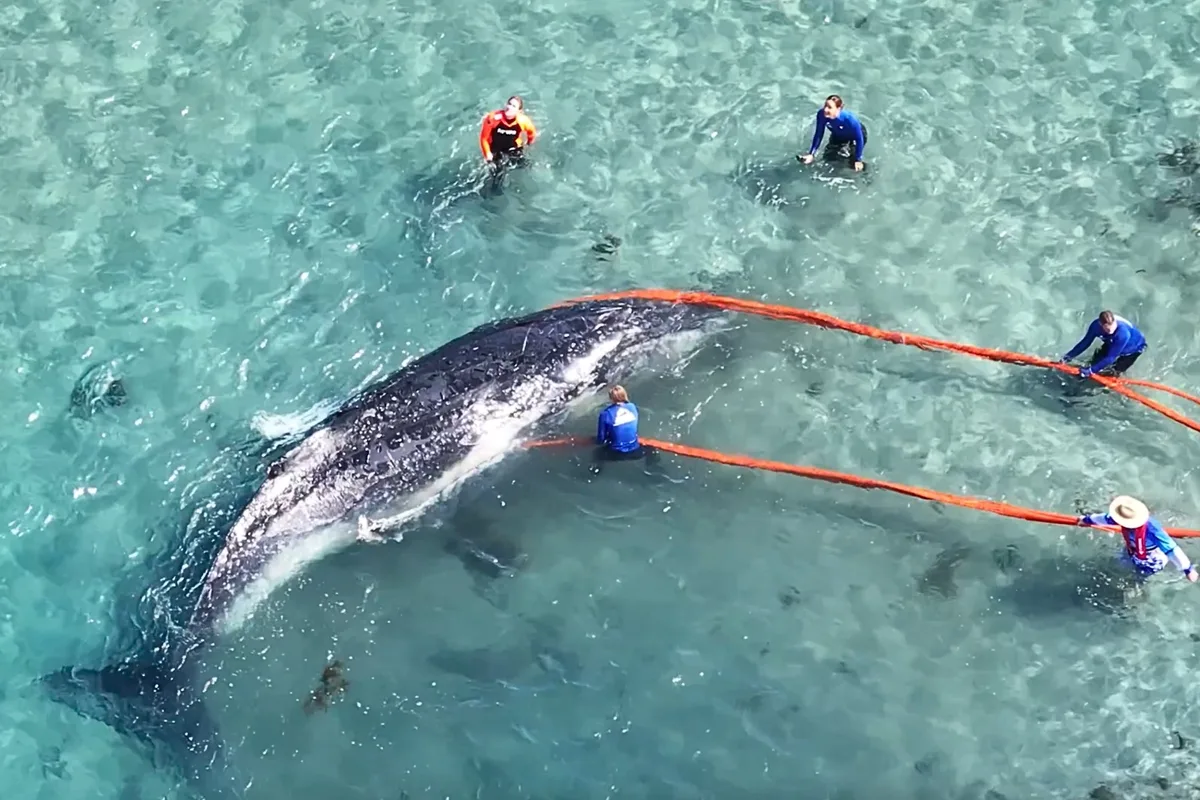
When responders went to check on the animal, they found two pilot whales together. Sadly, one three-metre female had already died but the rescuers hoped they could help the survivor. “The live animal refloated on the incoming tide after dark and went out to deeper waters where it could rejoin the rest of the pod,” said PLA in a later update.
- Why do whales breach? 6 theories behind their spectacular aerial acrobatics
- How does sound affect whales and dolphins?
- Crab wanders through Suez Canal into Mediterranean Sea. Now scientists are worried
- Researchers tag 8 pilot whales in Hawai'i then follow them into the darkness. What they find is "unbelievable"
Pilot whales aren’t meant to be in this environment so the experts wanted to encourage them back out to the open sea as quickly as they could. They did this by ‘herding’ them in the right direction.
“Starting near Sea Reach, the flotilla of eight boats stayed behind the pod slowly and carefully encouraging them to swim eastwards towards the North Sea,” said PLA. “After a 6-hour journey covering more than 20 nautical miles, with plenty of pauses for the whales and their calves to rest, the pod had reached the outer limits of the Thames Estuary.”
During this time, another whale seemed to be sick and separated itself from the group. It was later found washed up dead onshore.
Thankfully, there was better news for the rest of the 20-something strong pod. After shepherding the animals back towards deeper waters, the PLA and BDMLR didn’t see the pilot whales in the Thames Estuary again. This should mean the wanderers found their way back to sea.
In its last update on the situation, the PLA said: “we are hopeful they made it out to the deeper water.”
More wildlife stories from around the world
- Deep-sea scientists discover 57 new species in a canyon nearly twice as deep as the Grand Canyon
- In the 1950s, whaling ended around these remote Scottish islands. Decades later, up to 30 minke whales were spotted in one great gathering
- Arctic bobtail squid seen alive in natural habitat for first time ever
- “Fish-prawn” hybrid filmed walking backwards in the deep sea
Top image: Pilot whales in the tidal. Credit: Thames Port of London Authority