
Before a ship is scuttled to become an artificial reef, it must be properly prepared to make sure it doesn’t add any toxins into the environment.
In the case of the USS Kittiwake – an artificial reef now around 20 metres underwater off Seven Mile Beach in Grand Cayman – this brief was taken so seriously that project managers spent an extra $40,000 to make sure less than a kilo of rubber gaskets were free of toxic PCBs.
Named after the kittiwake gull, the ship was commissioned in 1946 as a submarine rescue vessel.
The ship was kitted out with everything she would need to assist the crews of sunken submarines, from a diving bell and hyperbaric chamber to salvage gear and scuba diving equipment. Many of her missions remain classified but there are no records of her responding to any submarines in distress during her almost 50 years of service. Although submarines did sink during this time, the circumstances were such that rescue was sadly impossible.
- "At first, they are little more than bare surfaces in the ocean’s vast expanse.” Why do sunken ships make good artificial reefs?
- It's longer than the Leaning Tower of Pisa, weighs 499 tonnes and sits 24 metres below the surface, where sharks patrol Noonu Atoll’s tropical waters
During her long career, the Kittiwake supported training exercises, conducted salvage missions, helped to free the grounded USS Missouri battleship in 1950 and was on hand to support the test of the first Polaris ballistic missiles in 1960.
“The ship’s most memorable duty was the diligent recovery of the Challenger Space Shuttle,” says Cayman Islands Tourism on its website.
After the tragic explosion of the spacecraft in 1986, the Kittiwake was one of the vessels involved in the salvage operation. She retrieved a piece of rocket booster (contact 214) from the seabed.
“The Sunbird and Kittiwake were each assigned one SRB [Solid Rocket Booster] shell target for recovery,” according to the US Navy Naval Sea Systems Command Report of the recovery operation. “On 17 April Kitiwake entered a two-point moor and recovered Contact #214.”
After nearly five decades of service, the Kittiwake was decommissioned in 1994. According to Wrecksite, the US Maritime Administration (marad) decided she should become an artificial reef and asked for proposals from around the world. The Cayman Islands was chosen as a suitable destination and preparations began to turn her into an artificial reef.
- It's bigger than Central Park, is 24 metres down in the ocean – and contains hundreds of subway cars – and a few tanks
- On a site the size of 27 football fields, 2 million of these were dropped in the ocean to create an artificial reef – instead, it became a disaster
This was a long and arduous process. To comply with the Toxic Substances Control Act, she had to be thoroughly cleaned of all hazardous materials. Any oil, wiring, asbestos, lead-based paint and polychlorinated biphenyls (PCBs) had to be removed.
“You never realise how many miles of wire have to be stripped and how many square yards of paint have to be chipped until you are obligated to remove them from a five-deck, 251-foot ship,” the late Nancy Easterbrook, who managed the project to bring the 76.5-metre Kittiwake to the Caymans, told Divers Alert Network.
Every tiny detail mattered – no matter how small. For example, the ship had 32 seacocks (valves that control the flow of water in or out of the ship) and each seacock had a rubber gasket to prevent leaks.
The team didn’t know whether the original gaskets contained toxic PCBs so they had to replace them with non-toxic options just to be sure. In total, two pounds of rubber had to be replaced – that’s around the weight of one small pineapple.
- This haunting shipwreck in North Carolina has its own 'shark ballroom'
- Sunken warships fill this eerie lagoon – and they're scattered with gas masks, skulls and bullet casings
Because these seacocks were under the surface of the water, the ship had to be put into dry dock for the seals to be changed. This element of the preparation alone cost $40,000 – but it was worth it to make sure there was no risk of contaminants onboard, said Easterbrook: “As far as we were concerned, the cleaner the better.”
When she was finally ready, the ship was towed from Virginia to the Cayman Islands, arriving on Christmas Day 2010. She was scuttled in January 2011 and has been on the ocean floor ever since.
In 2017, the ship was dislodged by a tropical storm and now lies tilted on its side on the seafloor.
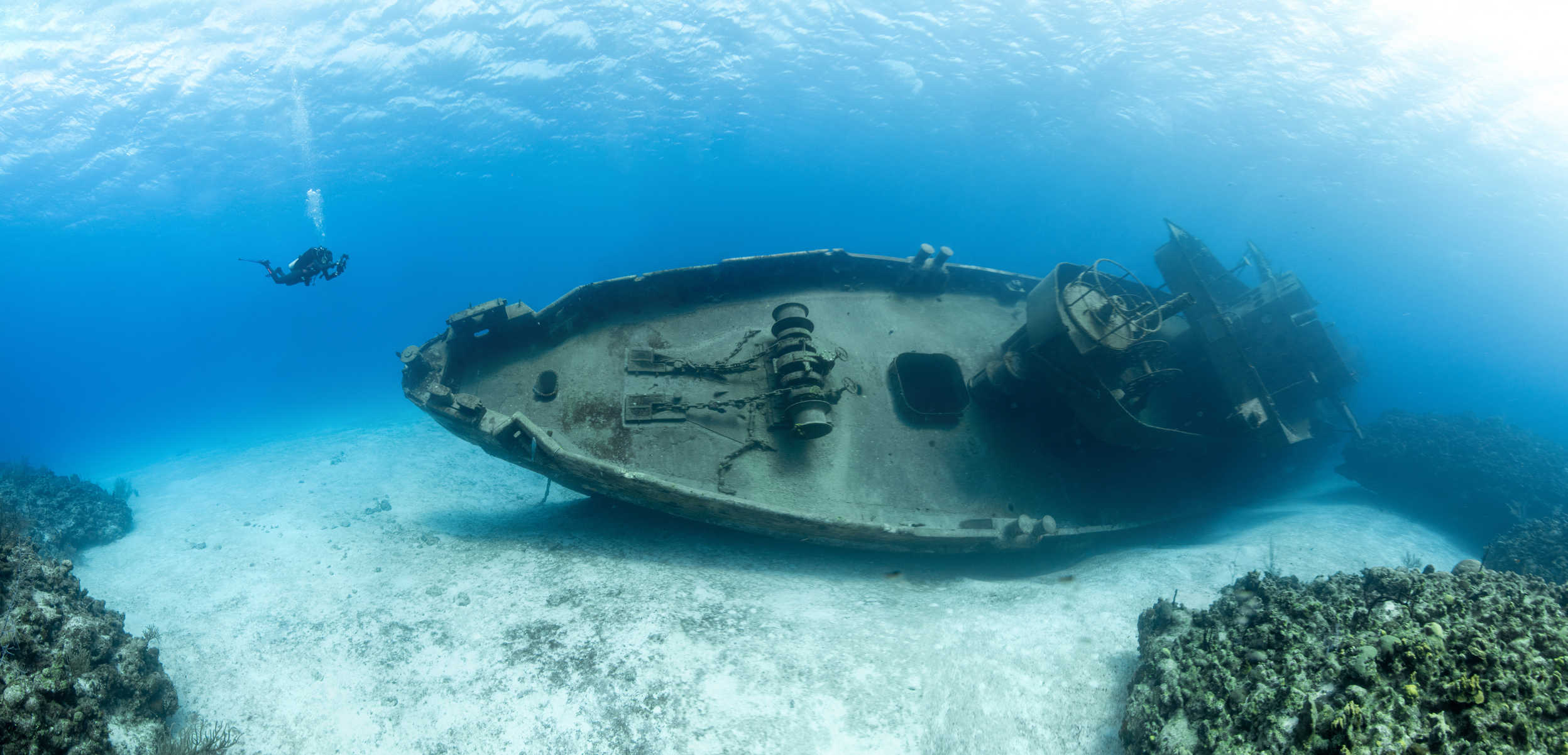
This man-made reef is shallow enough that snorkellers can visit too. Her funnel is just under 10 metres from the surface and the visibility in the gin-clear waters is often so good that you can look right down into the hull.
“Divers can discover the crew’s quarters, the recompression chamber, ammunition lockers and even the heads (bathrooms) – complete with mirrors,” says Explore Cayman on its website.
While some divers like to explore the structure and imagine what the Kittiwake’s life above the waves might have been like, others come specifically for the marine life attracted by this artificial reef.
Since she was sunk in 2011, corals and sponges have clung onto her hull, giving a pop of colour. Many animals, including sea turtles, groupers, stingrays, squirrelfish, eagle rays and barracudas, also visit her protected waters.
top image: USS Kittywake shipwreck on a sunny day. Credit: MartinHristov/ Getty Images
Discover more environmental stories from around the world:


