
By analysing the teeth of five whales who died on Scottish shores in the past three decades, researchers created a ‘dental time machine’ – allowing them to reconstruct the life stories of the animals and identify one of the oldest male killer whales on record.
The study, which relied on traces of radioactive fallout trapped in the teeth of two sperm whales and three killer whales, was led by scientists from the Scottish Universities Environmental Research Centre (SUERC): Centre for the Isotope Sciences, in partnership with researchers from Universities of Glasgow, Edinburgh and St Andrews and National Museums Scotland.
The findings are published in the journal Frontiers in Marine Science.
The research team used radiocarbon dating, which is one of the most widely used scientific dating methods. Radiocarbon (also called carbon-14) is constantly being created in the atmosphere by the interaction of cosmic rays with atmospheric nitrogen – it’s then incorporated into plants by photosynthesis, and animals acquire it by eating the plants. When an organism dies, it stops exchanging radiocarbon with its environment, and so the amount of carbon it contains decreases.
Based on this, measuring the amount of radiocarbon in a sample from a dead organism can be used to calculate when it died.
In the mid 20th century, the levels of radiocarbon in Earth’s atmosphere suddenly increased due to above-ground nuclear tests carried out from the 1940s until 1963. The fallout from those tests then entered ecosystems both on land and in the sea.
In this study, scientists took advantage of that distinctive spike – and subsequent decline – of radiocarbon. By using the SUERC’s accelerator mass spectrometer, they were able to estimate when different parts of the whales’ teeth formed, offering clues into where the whales called home, what they ate, and how long they lived.
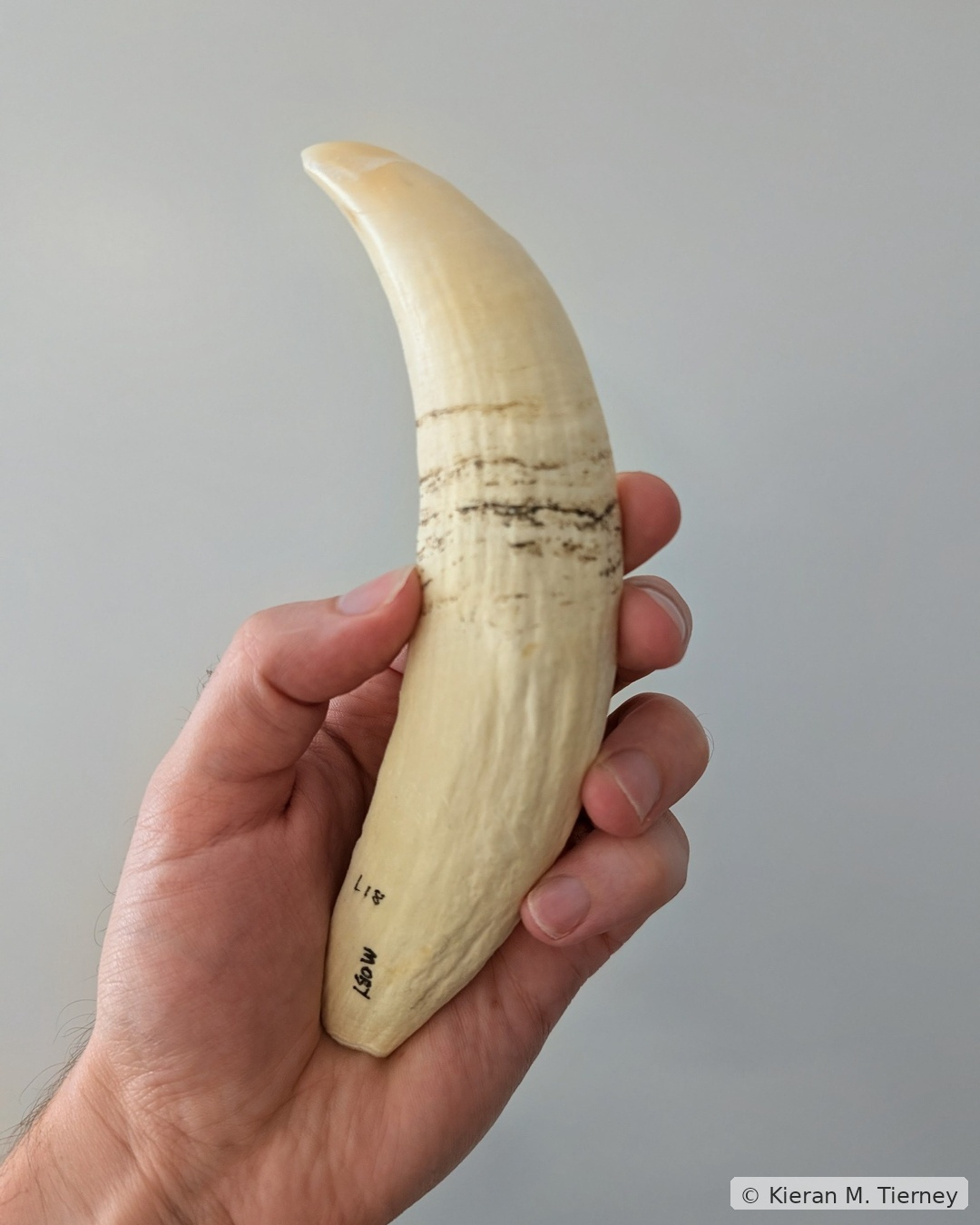
Sperm whales
The teeth used in the study included samples from two high-profile Scottish whale strandings. Sperm whale Moby became stranded on mudflats along the Firth of Forth, a bay in the east of Scotland, in 1997. Orca Lulu was washed ashore on the Scottish island Tiree in 2016 with signs of entanglement.
The testing revealed that Moby was at least 43 years old when he died in 1997, since the innermost layers of his teeth were formed before fallout from nuclear weapons entered the marine environment. The other sperm whale studied was younger than Moby when it was found stranded on a beach in the Orkney archipelago off the northeastern coast of Scotland in 1994.
Both whales showed rising nitrogen isotope values in their teeth as they aged (a finding consistent with previous studies), which showed that male sperm whales are born in warmer subtropical waters before moving to cooler, higher-latitude waters as they mature.
- This haunting sound was captured near Bermuda in 1949. It's the oldest known whale song recording
- "First-of-its-kind event." Whale shark swims "astounding" 1,200km from Madagascar to Seychelles

Orcas
Analysis of the three orcas’ teeth showed some surprising results. While the teeth of a male orca stranded in Shetland in 1995 showed an annual layer pattern as expected, a second male (stranded on the island of South Uist in 2015) turned out to be a more complicated case.
Counting the layers in the tooth suggested his age to be around 50 years, placing his birth in the early 1960s. But the radiocarbon record showed pre-weapons-testing radiocarbon levels – putting his birth further back. The researchers deduced that the teeth layers became increasingly compressed with age and no longer presented a clear record.
Since the radiocarbon evidence suggest he was around 65 or older, this makes him one of the oldest male orcas on record.
The tooth taken from Lulu, who died in 2016, showed no signs of the nuclear weapons testing signal, but carried a radioactive fingerprint the scientists refer to as the ‘Sellafield signal’. These radiocarbon discharges were produced by the Sellafield nuclear reprocessing facility, Europe’s largest nuclear site based on the coast of Cumbria, northwest England. Released into the Irish Sea, they were then carried to the west of Scotland.
The strength of this signal suggested that Lulu was part of the West Coast Community of orcas, mostly foraging there throughout her life. The high values of the nitrogen isotope in her teeth point to her role as an apex predator in Scottish waters, with a diet most likely containing a big proportion of marine mammals.
This is consistent with what is already known about the West Coast Community of orcas – which as of 2023 consists of only two individuals, down from around twenty in the 1980s, when it was first observed.
- "Raw and brutal": whale watchers look on astonished as orcas kill humpback whale in South Africa
- Scientists put three decades of whale migration data into a digital map – this is what they saw
Understanding whales
This study offers a rare, detailed glance into the lives of these two species. Although the researchers acknowledge its limited sample size of five individuals, it still provides information that could be useful for future conservation efforts.
“The effectiveness of conserving and managing marine mammal populations depends on how well we understand their life histories and ecology,” says Kieran Tierney, lead author of the study.
“By combining radiocarbon with stable isotope analysis, we can get a much richer picture of how these animals lived. We hope that this study adds a useful piece to our ever-growing understanding of the life-histories of these two whale species.”
Read the full findings here.
Top image: orcas in Norway. Credit: Lukasz Blusiewicz/Getty Images


