
A study in Italy has proposed that the smooth snake (Coronella austriaca) is able to deliver venom via the actions of its rear fangs, prompting the reclassification of the species.
Venomous snakes typically subdue prey with an initial strike or bite, delivering venom through hollow or grooved fangs that are positioned at the front of the mouth. The smooth snake, however, relies on constriction and feeds on lizards, juvenile snakes and small mammals, which it subdues within the coils of its body.
The new study, published in the journal Zootaxa, has found that the sheathed rear fangs of the smooth snake are connected to the venom-producing Duvernoy’s gland, suggesting that the animal may envenomate prey, once caught, to aid with digestion.
The smooth snake is native to much of central-southern Europe, parts of western Asia and southern Russia. Small numbers are found on the heaths of southern England. They are a small species of snake, slender-bodied and growing to between 60cm and 75cm in length. They are so named due to their scales which are smooth rather than keeled, as the scales of many snake species are. Smooth snakes rarely bask in direct sunlight but instead raise blood temperature through contact with their surroundings.
Coronella austriaca has a Duvernoy’s gland, which is present in many Colubridae species, the function of which is much debated. This gland is very small, with previous research suggesting a dry weight of just 1 milligram, but its secretions have been found to contain high toxicity.
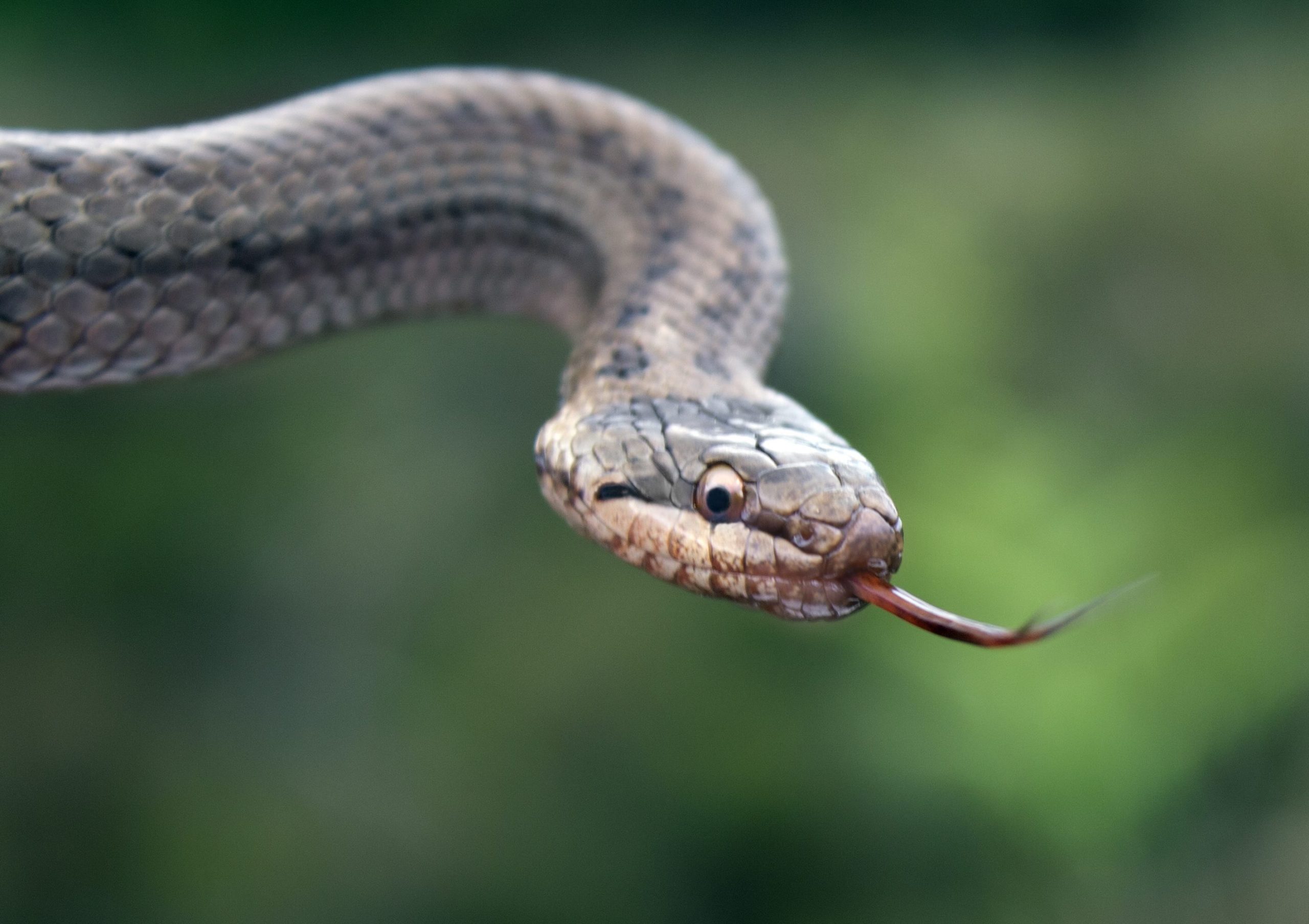
For their research, Alessandro Paterna and Grégoire Meier, from OPHIS Museo Paleontologico e Centro Erpetologico, in the city of Teramo, focussed on the cephalic anatomy of the smooth snake. Five specimens from three ontogenetic stages were used during the research, with examinations revealing the sheaths on the rear fangs that are linked to the Duvernoy’s gland.
“We must consider that Coronella austriaca presents an opisthoglyphous/rear-fanged condition,” the authors explain, “and that the secretion produced by the venom/Duvernoy glands is inoculated into the prey through prolonged and masticated bites in a low-pressure system.”
The article details an incident in which co-author Alessandro Paterna, was bitten by a male example of Coronella austriaca while surveying in the Laga Mountains in Teramo Province. Although bites from smooths snakes are common when handled, they are normally brief, but the prolonged action in this instance allowed the snake to masticate the wound, leaving Paterna with itchiness and redness. The mild symptoms lasted for less than an hour and this was the only occasion when a bite from a smooth snake resulted in any reaction other than light bleeding.
“It is important for us to clarify,” explain the authors in conclusion, “that except for the inevitable reclassification of this snake, we recommend not changing the consideration we have always had of this species, which, given its nature and size, represents absolutely no threat to humans.”
Read more about the study.
Top image credit: OgnjenO/Getty Images
More wildlife stories from around the world
- ‘Ghost’ green mamba rediscovered after 90 years
- Largest snake species in the world discovered in Amazon rainforest – and it's a whopper!
- Night-hunting snake discovered in New Guinea. It’s almost a metre long and waits for prey at the bottom of trees
- “We would find piles of rattlesnakes.” Scientists witness undocumented snake behaviour in Wyoming's mountains
- It's the biggest snake den on the planet – 100,000 crammed into a small cavern


