Hot mud, bubbling pools of boiling water, sulphur-stinking fumeroles and eruptions of steaming water that blast metres into the sky - the landscape of the Haukadalur valley and its famous geysers are one of the main tourist attractions in Iceland. At the surface it’s dramatic, dangerous and surprising, and that’s only a taste of the drama going on beneath the surface.
Part of the famed ‘Golden Circle’ tour which takes in the incredible Gullfoss waterfall and Þingvellir, no trip to Iceland would be complete without a stop at the Geysir Geothermal Area. Haukadalur where the area is located sits in southwest Iceland, and at a distance looks unremarkable… except for the plumes of steam you can see rising from the ground.
- “The first thing to go are the eyes. Eyes, apparently, cook very quickly. Flesh follows soon after, and as the animal becomes overwhelmed, water enters its mouth."
- "Known as the Gateway to Hell, where lurid-coloured acid lakes create an eerie, alien world." 10 barren dead zones where nothing survives...
As you get closer, the smell is the first thing that hits you; the distinctive rotten egg smell of hydrogen sulphide, a gas released by the geological activity that hangs in the air across the site.
The active area is around 3km2 - similar to the size of New York’s Central Park - though the main area of activity is concentrated in a smaller zone which packs in over 40 geological features from steam vents to hot springs and of course, the famous geysers.
Introducing the original star: Geysir
Did you know that Geysir at Geysir Geothermal Area is the original geyser, and the one that gave all other similar phenomena its name? Geysir comes from the Old Norse verb ‘gjosa’ which means to gush or erupt, and this word was originally used to name this specific one ‘Geysir’ in 1647. As more of these geological features were discovered around the world, geyser became the general name for the phenomena as well.
In geological time scales, Geysir itself is a mere baby - it started forming in 1150 CE which makes it younger than Oxford University where teaching started 50 years earlier. But the system underneath Geysir which supplies the boiling water for its regular eruptions has been running for over ten thousand years.
Geysir Geothermal Area sits on a particularly active part of Iceland, where two of the tectonic plates that make up Earth’s crust are gradually moving apart. On one side is the North American plate, on the other the Eurasian plate, and as they move away from each other hot magma wells up to fill the gap, so the heat powering Geysir comes from a crack in the surface of the planet.
- Something breathtaking has just been pulled from the steaming springs of Yellowstone National Park
- Twice the size of the UK – yet 80% of it is a dead zone where almost nothing survives...
You’ll be disappointed if you’re expecting to see the original Geysir erupt though - its regular shows have slowed to intermittent performances. But humans like a show and for some of its life, scientists would force Geysir to erupt by literally pouring soap flakes into it. Thankfully, this practice stopped in the 1980s as it wasn’t good for the environment, so Geysir can quiety enjoy its retirement.
Strokkur geyser, the new star of the show
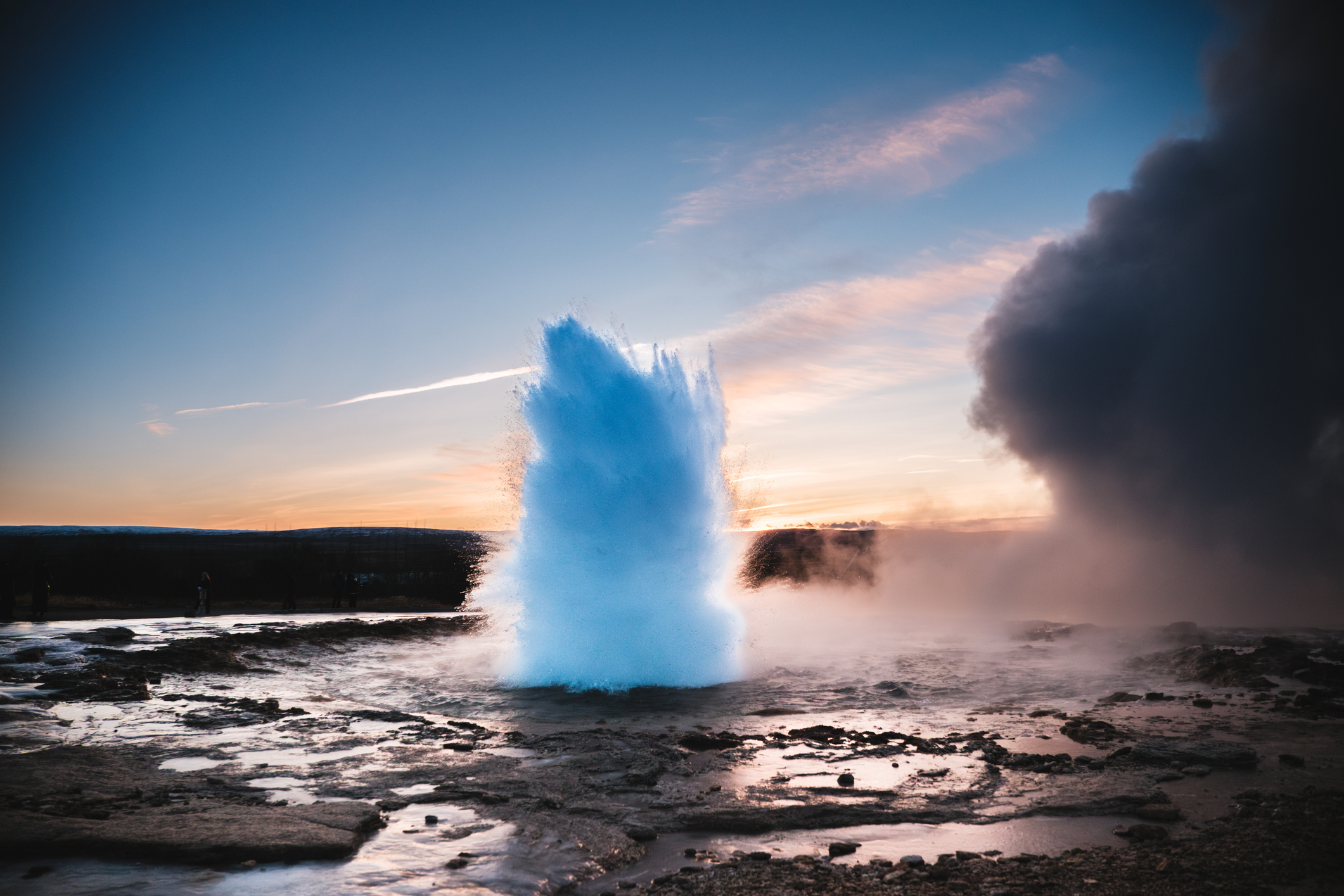
All the attention has shifted over to Strokkur now. And while it looks modest - a pool only about 8 metres across - looks can be deceptive. Beneath the quiet, steaming surface, 22 metres below ground, water is heated until it forms steam, trapped with the pressure building it up until it can’t be contained and blasts upwards, shooting boiling water up to 20 metres into the air.
The water is not to be messed with; at 80 to 100°C it is genuinely boiling and signs warn the unwary from venturing off the paths and too close. Currently, the Strokkur geyser erupts every 5 to 10 minutes, and very occasionally the water spurt can reach up to 40 metres high. Sadly this isn’t quite as dramatic as Geysir, which used to reach heights of up to 60 metres - three times higher than Strokkurs usual performance.
Strokkur also wasn’t immune to a little human meddling. Its current reliability only came about because local people unblocked its main conduit in 1963 - essentially helping Strokkur to clear its throat.
Beautiful ponds (almost) too extreme for life
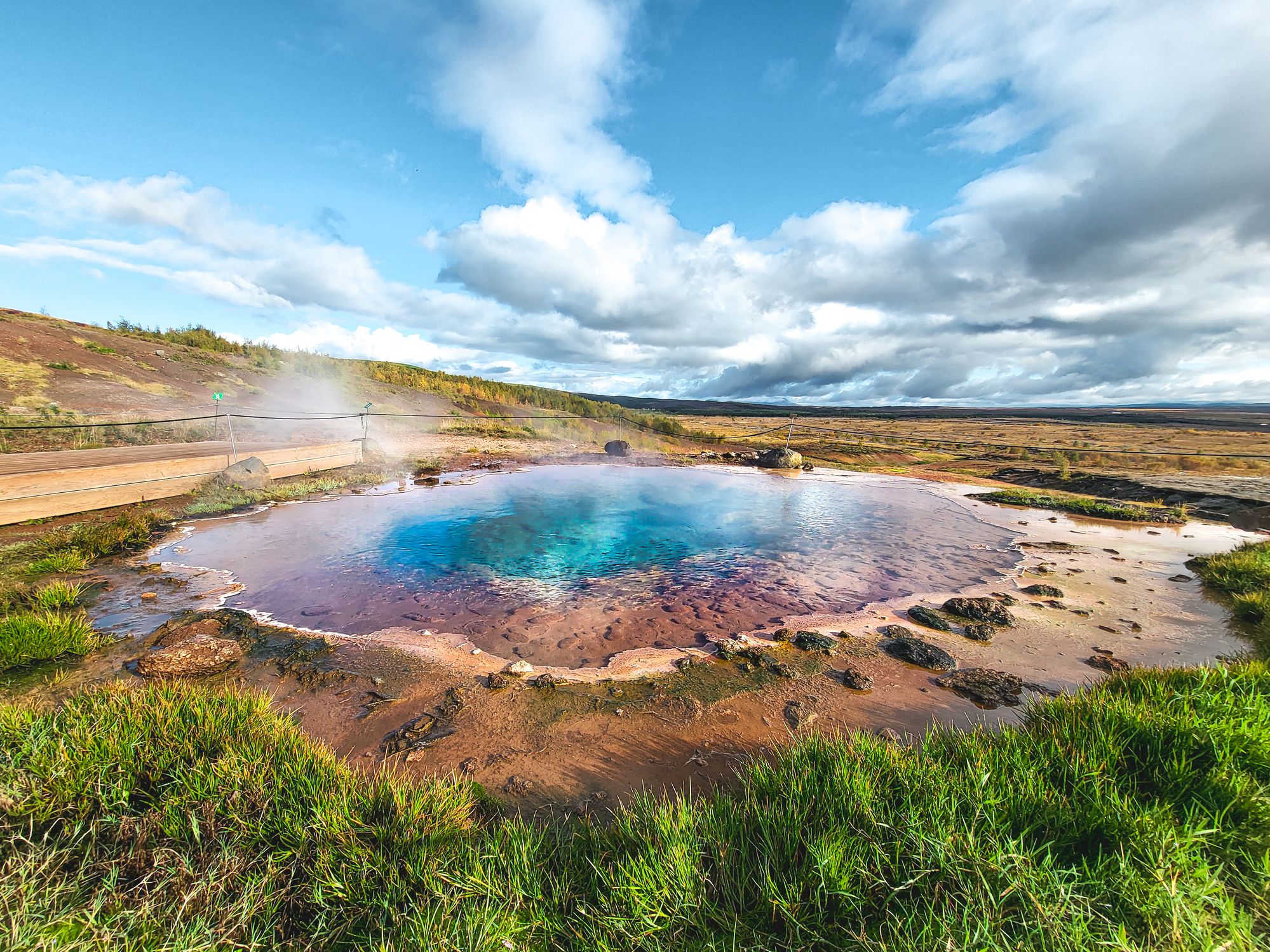
Another major draw to the Geysir Geothermal Area is Blesi, a pair of beautiful blue pools of water which look inviting - but are deceptively deadly. One is clear and warm… the other is opaque and sits at a rolling boil constantly
Like the Blue Lagoon, another famous Icelandic attraction, the colour of the water in these pools comes from the mineral silica. This is dissolved in the water, and scatters the sunlight creating the distinctive milky blue shade. Around the pools, orange, yellow and red banding provides a stark colour contrast, and this is the only area life can survive.
- The strange, very peculiar lake that forms a mythical dragon's giant eye every spring
- Iceland’s famous Blue Lagoon looks like a natural hot spring – but the truth is much stranger
122°C is the measured ceiling beyond which no celular life on Earth can survive, and the boiling pool at Blesi is just too hot. It’s also too hot for algae, which has an upper limit of 73°C.
Instead, heat-tolerant bacteria live as close as they can, and thrive by metabolising iron and sulphur, causing the yellow and red banding at the water’s edge.
A spectacularly close-up view
One of the most impressive things about Geysir Geothermal Area is just how close you can get to the features. Walkways and paths lead you around the area, allowing you to get multiple views of springs, fumerales, steam vents and of course the geysers themselves.
If you want to experience a tiny taste of the power and heat contained within our planet, it’s a must-visit. Just be careful to stick to the paths, and whatever you do, DO NOT go for a swim.
- There's a pink-faced monkey in Japan that bathes in hot springs – for a surprising reason
- "People once believed that fairy rings were dance floors for night- time fairies…" Just what is a fairy ring? And how do they form?
- It starts in the Pacific but can affect the entire planet… The strange climate phenomenon that can wreak havoc with wildlife and weather