The vivid healing water of the Blue Lagoon is one of the most popular tourist attractions in Iceland, with over one million visitors immersing themselves in the hot, mineral-rich water every year. But, while this popular spa is the result of geothermal activity, it isn’t formed by natural hot springs - the water is a by-product of a power plant.
The Blue Lagoon and the power plant
The story of the Blue Lagoon actually starts with the construction of the Svartsengi geothermal power plant. Svartsengi means ‘black meadow’ in Icelandic which provides a clue to the environment it sits in - kilometers of black lava fields, produced by volcanic eruptions.
Construction of the plant started in 1976, and it is the world's first power plant to combine both geothermal energy production - using superheated steam and water up to 240°C to drive turbines which in turn generate electricity - and also a hot water plant, supplying local towns with naturally heated water.
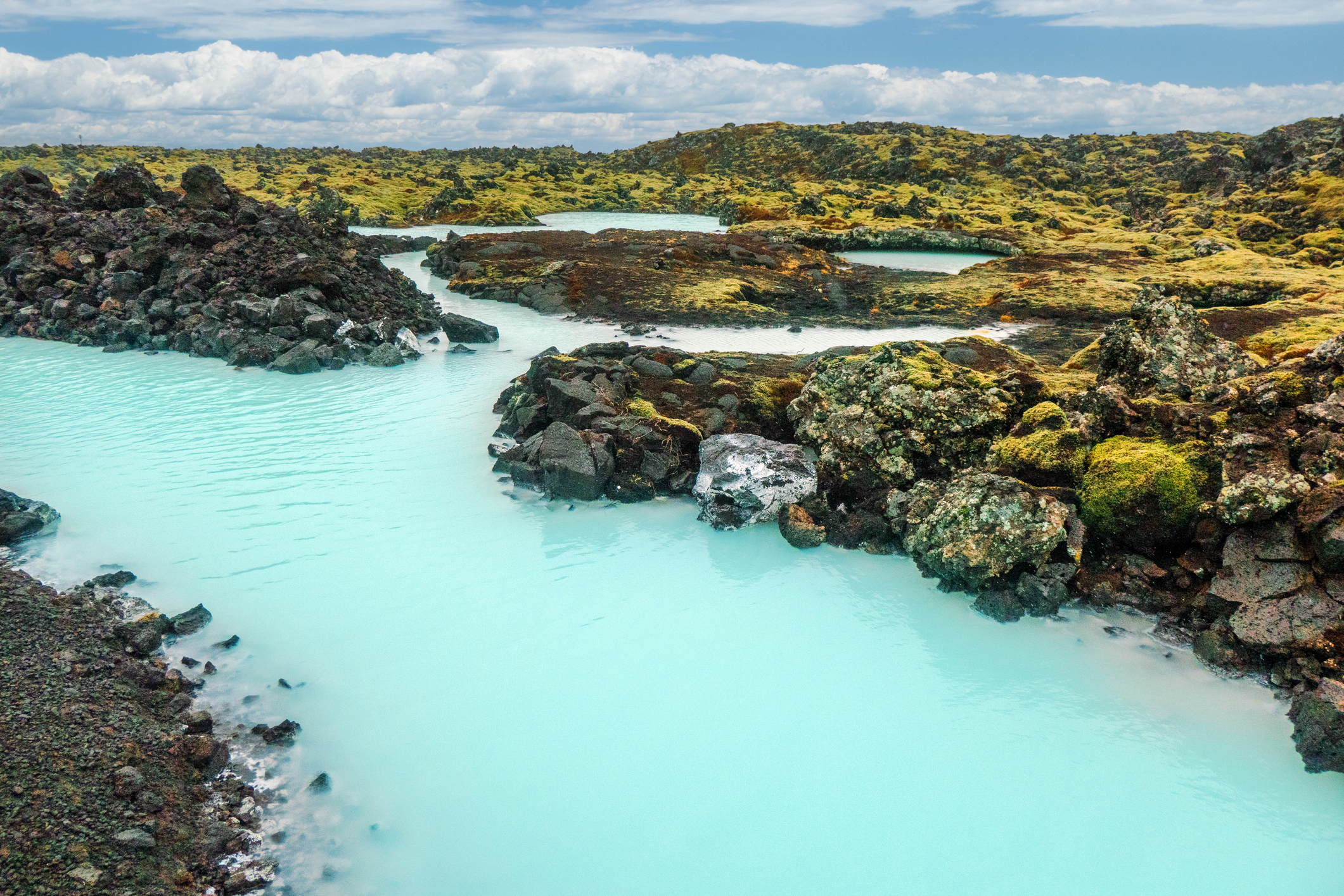
Once it had been used for energy generation, the water from the power plant was released onto the surrounding lava fields where it naturally settled into warm pools with the distinctive blue colour.
According to some sources, a power plant employee with psoriasis noticed that the water from the pools had a positive and soothing effect on their condition, in 1981. More employees started bathing in it, which led to scientific research on the effects of the water and ultimately to a skin clinic opening in 1994. Over time, this has expanded to the popular spa attraction it is today. At present, the lagoon covers around 8,700 square metres.
So actually the Blue Lagoon is a happy accidental by-product of sustainable energy production.
Why is it called the ‘Blue Lagoon’
The name for the Blue Lagoon spa pools in Iceland comes from the colour of the water, which is a startling light milky blue, and is made up of about 70% sea water and 30% fresh water, from the Svartsengi power plant.
This colour is due to the minerals in the water, and in particular silica, plus salts and algae. As the silica crystalises out of the water, it reflects sunlight, causing the eye-catching shade. The silica and other minerals settle to the bottom of the pools forming a white mud that is used as a face mask, to treat the skin, and can also be bought pre-packaged for home use.
A soothing 37 to 39°C temperature, combined with the mineral content, is believed to have a beneficial effect on the skin, relieve muscle tension, and boost general wellbeing.
There are no artificial chemicals in the water like chlorine. Instead, the minerals of the pool act as natural antibacterial agents. In addition, all bathers must fully shower before entering the pools, the water is tested regularly, and the water is constantly being refreshed so the entire volume is replaced approximately every 48 hours.
A geologically rare and active location
We have the remarkable geology of Iceland to thank for the Blue Lagoon. The island sits on both a ‘hot spot’ - the type of volcanic activity that produced the Hawaiian Islands, Canary Islands and Yellowstone - and the mid-Atlantic ridge. This is where two of the tectonic plates that make up the surface crust of the Earth move away from each other slowly, with magma welling up to fill the gap. Iceland straddles this ridge, with the western part on the North American tectonic plate, and the eastern part on the Eurasian tectonic plate.
- "Uncharted territory": soft tissue of ancient animal found entombed in volcanic rock near Rome
- Cataclysmic volcanic eruption in Hawai'i triggers astonishing explosion of life 1,200 miles away
As a result, it’s a landscape filled with and formed by dramatic volcanic eruptions, earthquakes, floods, ash flows and glacial action - hence its nickname ‘the land of fire and ice’.
The Reykjanes Peninsula, where both the Blue Lagoon and the Svartsengi power plant are located, is one of the most active areas of Iceland, where the plate boundaries meet and new land is constantly being formed.
Volcanic activity means heat, and it’s this heat that is harnessed for the power plant and lagoon. 13 boreholes drilled down into the hot ground release steam and super-heated brine.
Eruptions and earthquakes
The volcanic activity that makes this area ideal for geothermal power plants and soothing warm waters is also one of the biggest threats to the Blue Lagoon.
Unlike the familiar cone-shaped volcanoes we’re used to seeing in films, eruptions around the Reykjanes Peninsula often take a different form - fissure eruptions. A long split appears in the ground, with lava fountaining out of it and forming large lava flows that can cover huge areas.
The most recent and significant eruptions took place between 2023 and 2025, and the activity may not be over yet. Swarms of earthquakes signalled a series of lava flows which came very close to the Blue Lagoon and Svartsengi power plant, even flowing over and blocking the main road in 2024.
To attempt to protect the lagoon and power plant, Iceland has constructed huge earth walls around them. Reaching up to 25m, construction started in 2023 with the first eruptions, and over 13km of these barriers have been built so far. They’ve been effective too; visit the area, and you can see the lava flows reaching and stopping at the earth walls.
Water cooling has also been used to attempt to slow and stop flows alongside the barriers. Firefighters used hoses to jet thousands of liters of water per minute onto hot lava flows during recent eruptions. This works by causing rapid cooling of the lava surface which then solidifies, building up and blocking the flow of lava behind it as a natural barrier.
Future eruptions
The geology of the area means that future earthquakes and eruptions are extremely likely. However, it’s also one of the most monitored and studied areas in Iceland, and signs such as changes in water pressure and temperature at the power plant, smaller earthquakes and gas emissions provide warnings of imminent eruptions. Iceland is well used to this type of activity, and is well prepared to deal with it.
More stories from around the world:
- In the 1970s, over 100 ancient rhinos were found entombed in Yellowstone ash – we finally know what happened
- There’s a remote volcanic island off Brazil home to scientists, the military – and a crab called John
- Mount St. Helens erupted in 1980, then a team of gophers were helicoptered in to bring it back to life