
In the middle of the ocean off the coast of Tonga, is an underwater volcano that is always changing shape and size as eruptions build new islands that later vanish.
Known as Home Reef, this submarine volcano is located on the Tonga Volcanic Arc, west of the Tonga Trench in the South Pacific. This is among the most active volcanic arcs on the planet.
Experts first recorded an eruption of Home Reef in 1852 followed by another in 1857. Its eruptions create what are known as ephemeral islands: islands that quickly appear above the surface and then erode.
- 10 sinking islands that could be lost forever…
- It starts in the Pacific but can affect the entire planet… The strange climate phenomenon that can wreak havoc with wildlife and weather
“Cycles of eruptions and erosion have periodically created and destroyed a small island there since at least the mid-19th century,” says NASA Science on its website.
Home Reef was seemingly quiet for more than 100 years before bursting to life again in 1984. This huge eruption “produced a 12-km-high eruption plume, a large volume of floating pumice, and a 500 x 1,500m island with cliffs 30-50m high that enclosed a water-filled crater,” writes the Smithsonian Institution’s Global Volcanism Program on its website.
It became active again more than 20 years later when “another island-forming eruption in 2006 produced widespread pumice rafts that drifted as far as Australia,” according to the Global Volcanism Program.
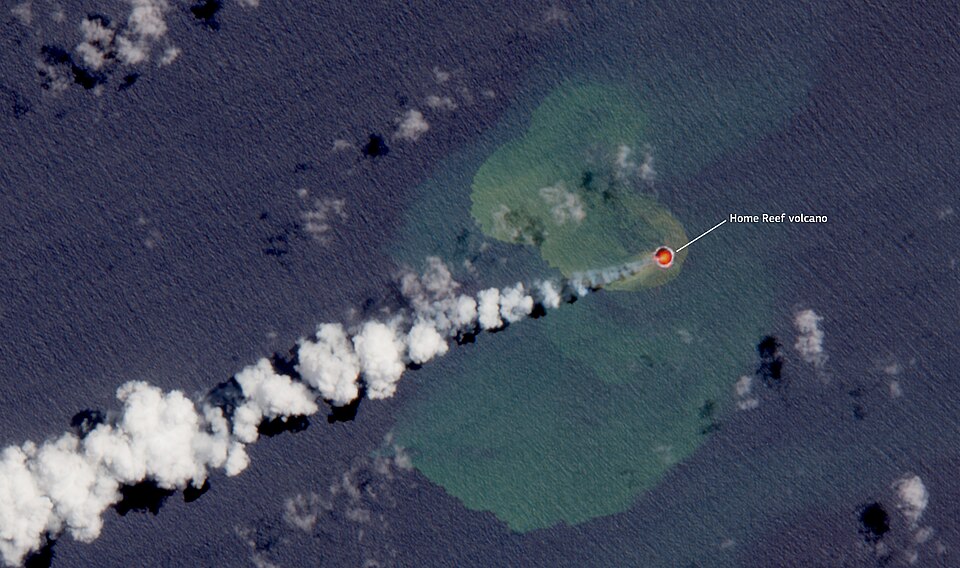
Another period of volcanic activity began in 2022 and has been rumbling on ever since. In September 2022, the volcano erupted six times in 24 hours. Pilots were warned to be careful when flying through the area because of the ash pouring into the sky and sailors were advised to stay at least 4km away.
In June 2025, an eruption at Home Reef spewed ash 12km high.
The volcanic activity causes the islands to increase in size. “Beginning in December 2025, lava flows first extended the island’s footprint to the east and south, then to the northwest, and later to the north,” says NASA Science. “Plumes of volcanic gases billowed from a 100-meter-diameter vent throughout the eruptive period.”
By February 2026, the island had grown by nearly 20 acres.
Experts are using satellites, along with other sensors, to keep an eye on the volcano’s activity. “Satellites are critical to monitoring volcanoes such as Home Reef in remote and difficult-to-access locations,” explains NASA Science.
Sometimes these satellite images pick up discoloured water around the time of an eruption. This is typically caused by volcanic gases and fluids spewing from the volcano and mixing in the water with the noxious yellow sulphur giving the water a distinctly green tinge.
“Previous research has shown that such plumes of superheated, acidic water can contain particulate matter, volcanic rock fragments, and sulphur, and that they can appear before signs of an eruption above the surface,” writes NASA Science.
Although the volcanic activity at Home Reef isn’t thought to be a risk to nearby inhabited islands, it may have an impact – both positive and negative – on the life in the region.
According to NOAA oceanographer Sharon Walker, the hot acidic plumes that spurt into the ocean can harm and even kill marine life. After an underwater volcano called Nafanua, near American Samoa, erupted, dead animals were found all over the floor of its crater.
But there can be benefits too. These volcanic jets of water can contain elements like iron that help plankton to grow. And when islands spring up, the creation of new land can provide a home for algae, insects and birds.
Second image credit: Contains modified Copernicus Sentinel data 2022, Attribution, via Wikimedia Commons. URL: https://commons.wikimedia.org/wiki/File:20220917_HomeReefVolcano_(1).jpg
- DNA reveals extraordinary way ancient iguanas made epic 5,000-mile journey to Tonga and Fiji
- Mount St. Helens erupted in 1980, then a team of gophers were helicoptered in to bring it back to life
- Mega volcanoes, asteroid impacts and 'the great dying' – 5 deadly mass extinctions that changed life on Earth forever
- Snake Island, Anthrax Island and beyond: 9 deadly Islands you'd be a fool to visit...


