
An international team of researchers has described a remarkable fossil of the long-necked marine reptile Austronaga minuta that lived around 245 million years ago, providing the oldest known example of a largely complete digestive system in a reptile.
- Researchers shined UV light on this 125-million-year-old crocodile. What they found is fascinating
- A tiny object preserved in dinosaur poop may unlock one of palaeontology’s biggest mysteries
The research was conducted by scientists from China, Germany, Switzerland, the UK and the USA. The findings were published in the journal Science Advances in July 2026.
The almost completely preserved fossil was recovered from the Guanling Formation, Luoping, eastern Yunnan Province, China – what used to be eastern Tethys Ocean back in the Triassic period.
The fossil offers the first detailed view of this prehistoric animal’s entire skeleton and large parts of its digestive system. Using various examination methods, including UV light photography and mass spectrometry, the researchers identified several internal organs, such as the stomach, liver and intestines.
“Compared with the highly specialised body shape of Austronaga, its internal organs seem less modified. The preserved organs include a large, sac-like stomach at the front, followed by a strikingly red liver in which traces of haemoglobin can still be detected,” said Dr Wei Wang, marine reptile expert at the Institute of Vertebrate Palaeontology and Palaeoanthropology in Beijing and lead author of the study.
“Behind this is a long, simple tube forming the small and large intestines. The overall arrangement shows that the digestive system of Austronaga was relatively simple in structure.”
According to co-author Dr Nick Fraser of the National Museums Scotland, Austronaga had only a single stomach chamber, in contrast with today’s birds and crocodiles, which have a two-part stomach.
“This shows that the stomachs of archosaurs were initially quite simple and only evolved later in the evolutionary process.
“It is also striking that Austronaga had a fairly short and uncomplicated digestive tract, very similar to that of today’s fish-eating reptiles,” he said.
- Jurassic squid-like animal unearthed in Wyoming is “fattest” ever discovered
- “One of the longest-running cold cases of palaeontology.” Scientists may finally know what created these strange markings
Early adaptation
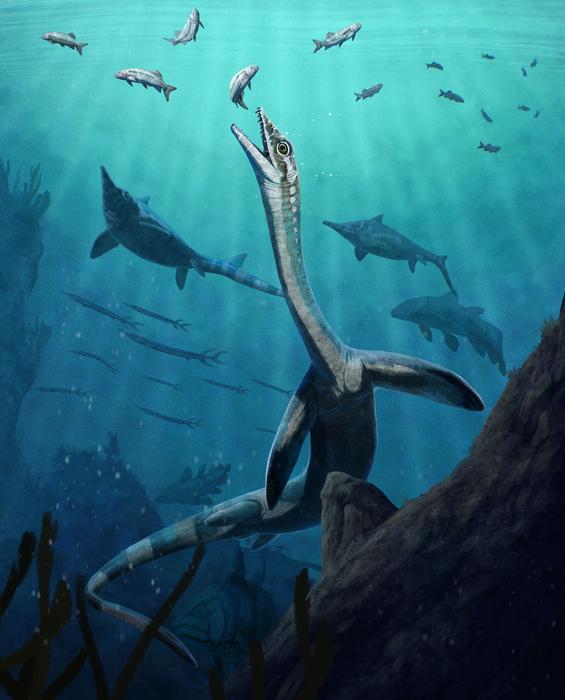
Although long-necked marine reptiles were common in the seas of today’s China during the Triassic period (with several species unearthed as fossils), Austronaga minuta is quite unique. Despite being only 60cm long, the animal had a strikingly long neck and tail and was impressively well adapted to life in water. It used its long tail for propulsion, and its elongated, fin-like front legs for steering and stabilisation. Its hind legs were not very useful for swimming.
The unusual body shape of this ancient reptile is so surprising to scientists because Austronaga minuta is not closely related to the other famous fossil sea reptiles, including ichthyosaurs or giant mosasaurs it shares this method of swimming with. Instead, it's related to land-dwelling archosaurs – a group that includes crocodiles and dinosaurs.
“The archosaurs and their ancestors were the most diverse group of reptiles on land during the time of the dinosaurs, but we always thought that their adaptation to life in the sea was limited,” said Dr Stephan Spiekman, a palaeontologist at the State Museum of Natural History Stuttgart and the University of Honenheim, and co-author of the study.
“However, the discovery of Austronaga shows that early representatives of this lineage had already developed complex adaptations to life in the oceans, comparable to those of other, better-known groups of fossil marine reptiles.”
Read the full findings here.
Top image: Skeleton of the holotype of Austronaga minuta. Credit: Wang et al.


