An exceptionally well-preserved fossil from about 125 million years ago has offered researchers an unprecedented look at the skin, soft tissues, colour and respiratory system of a prehistoric crocodilian.
Scientists from the Catalan Institute of Palaeontology Miquel Crusafont in Spain have provided the first detailed description of this extinct species (Montsecosuchus deperei). Their findings are published in the Zoological Journal of the Linnean Society.
- It might look like a dinosaur but this remarkable new discovery is actually a fearsome, deadly prehistoric crocodile that's even older than dinosaurs
- Fossil poo, fossil vomit, fossil penis... World's 10 weirdest fossils that will have you scratching your head
Crocodilians and their extinct relatives have an extensive fossil record, but fossilised soft tissues – for example skin or cartilage – are virtually unheard of. This makes this discovery particularly important, as it sheds new light on the biology of small crocodylomorphs (a group of reptiles) during the Early Cretaceous period.
The specimen was unearthed more than a century ago in the Pedrera de Meià site in Catalonia, Spain. It was partially studied in the 90s, but it’s only now that researchers uncovered the true depth of information hiding within the ancient rock.
The roughly 50cm long crocodile died in the waters of a karstic lake in what is now the foothills of the Pyrenees in northern Spain. Its body was exceptionally well preserved among the fine sediments of lake floor, which over time would become limestone, forming the Pedrera de Meià fossil site.
Under new light
The specimen, which is kept at the Museum of Natural Sciences of Barcelona, caught the attention of palaeontologists Oscar Castillo-Visa and Jesús Serrano while they were creating a database of the fossils from the Montsec mountain range, deposited in various Catalan and European museums.
After a closer look at the fossil, the researchers realised it showed structures that, when exposed to ultraviolet (UV) light, could correspond to soft tissues of the animal. UV light rays make the fossilised tissues stand out from the surrounding rock, so that structures that go unnoticed under normal light can emerge.
The UV light rays revealed an array of information about this ancient crocodilian. The team were able to document various types of soft tissues, including epidermal scales (tough, horny folds or extensions of the outer skin layer made mainly of keratin).
They were also able to describe the prehistoric animal’s skin, which showed a lot of variability in the shapes and sizes of the scales along the body.
- Staggering crocodile photos reveal just how ferocious these apex predators can be
- Vanishing crocodile caught on camera. Blink and you'll miss it
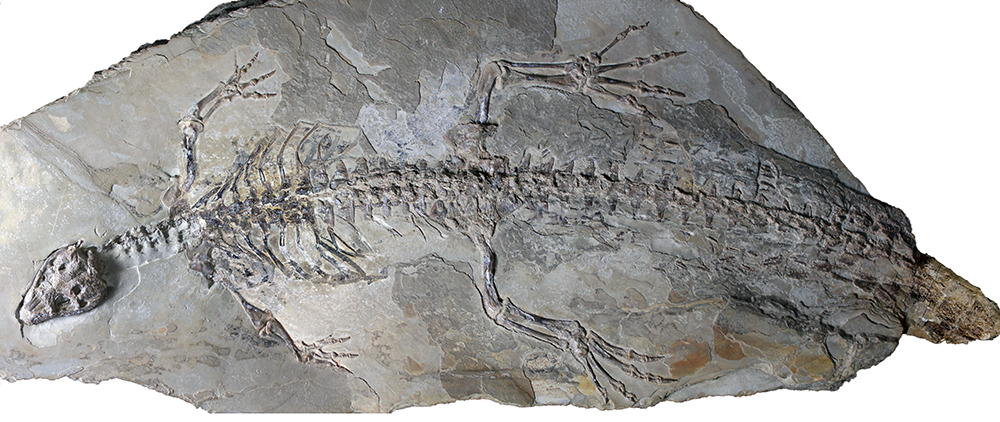
The Montsecosuchus didn’t possess the vertically flattened tail typical to all modern crocodiles. It did, however, have possible sensory organs on some on some of its scales, especially on the neck, limbs and lateral margins of the trunk and tail. In today’s crocodiles, these organs function as receptors for touch and water pressure variations, as well as thermal and chemical stimuli.
The UV rays also uncovered cartilaginous structures in the thorax (region of the body between neck and abdomen), indicating that the ancient species already had an efficient respiratory system, similar to modern crocodiles.
“These traits indicate that, despite being a primitive animal, it was already very well adapted to a semi-aquatic lifestyle,” said Oscar Castillo-Visa, lead author of the research.
- Prehistoric soft tissue from a 183-million-year-old dinosaur reveals what it really looked like - shocking scientists
- 9 animals that could take on (and probably kill) a saltwater crocodile: Just which creatures are able to take on one of the world's deadliest animals?
Ancient camouflage
Perhaps the most surprising find of the study is the colour of the crocodile’s tail. In some scales, the UV rays made visible light and dark bands arranged transversely, a pattern the researchers have interpreted as the original colour of the animal.
These bands could have functioned as camouflage, helping visually break up the animal's silhouette. This interpretation is only speculative, say the authors, but if it was confirmed, the Montsecosuchus would become the oldest member of the crocodylomoprhs with preserved colouration.
“At the moment, we cannot say for sure what colour the crocodile’s tail was, but it would be expected that it was not so different from current species, which also show different colouration patterns,” said Albert G. Sellés, co-author of the paper.
Read the full findings here.
Top image: Dorsal view of the specimen under ultraviolet light. Credit: Oscar Castillo Visa, Catalan Institute of Palaeontology Miquel Crusafont