
Despite being known as ‘bear dogs’, amphicyonids are neither bears nor dogs. Instead they’re a distinct family of distantly related carnivores that, for several million years, were among the largest and deadliest mammals alive.
What are bear dogs?
The term ‘bear dogs’ refers to a family of extinct, terrestrial mammals known as the amphicyonids, which means ‘ambiguous dog’ in Greek.
They lived from the Middle Eocene (42 million years ago) up until the Late Miocene (5.3 million years ago) and are known from several continents, including North America, Europe, Asia, and Africa.
Amphicyon, the genus the family is named after, was discovered way back in the mid-19th century. Despite being known to science for so long, palaeontologists have struggled to place bear dogs on the mammal family tree. Historically, they were grouped with Canidae (i.e. dogs) or Ursidae (i.e bears), but now it’s thought they form their own family - Amphicyonidae.
They might look quite similar to ‘dog bears’, and are similarly nicknamed, but ‘bear dogs’ are their own distinct group. The ‘dog bears’, on the other hand, are more closely related to bears and are sometimes referred to as an extinct subfamily.
And to make matters even more confusing, there are dog breeds alive today known as ‘bear dogs’ (e.g. the Karelian Bear Dog). These are definitely dogs, but being quite larger and heavily built, they’re often compared to bears.
- It didn't much look like a dog – or act like one as it climbed trees like a cat – yet it was the first-ever dog on the planet and the ancestor of all dogs today…
- 10 smallest wild dogs on the planet, from one that can climb trees like a cat to a cutie that looks like a little bear
What do bears dogs look like?
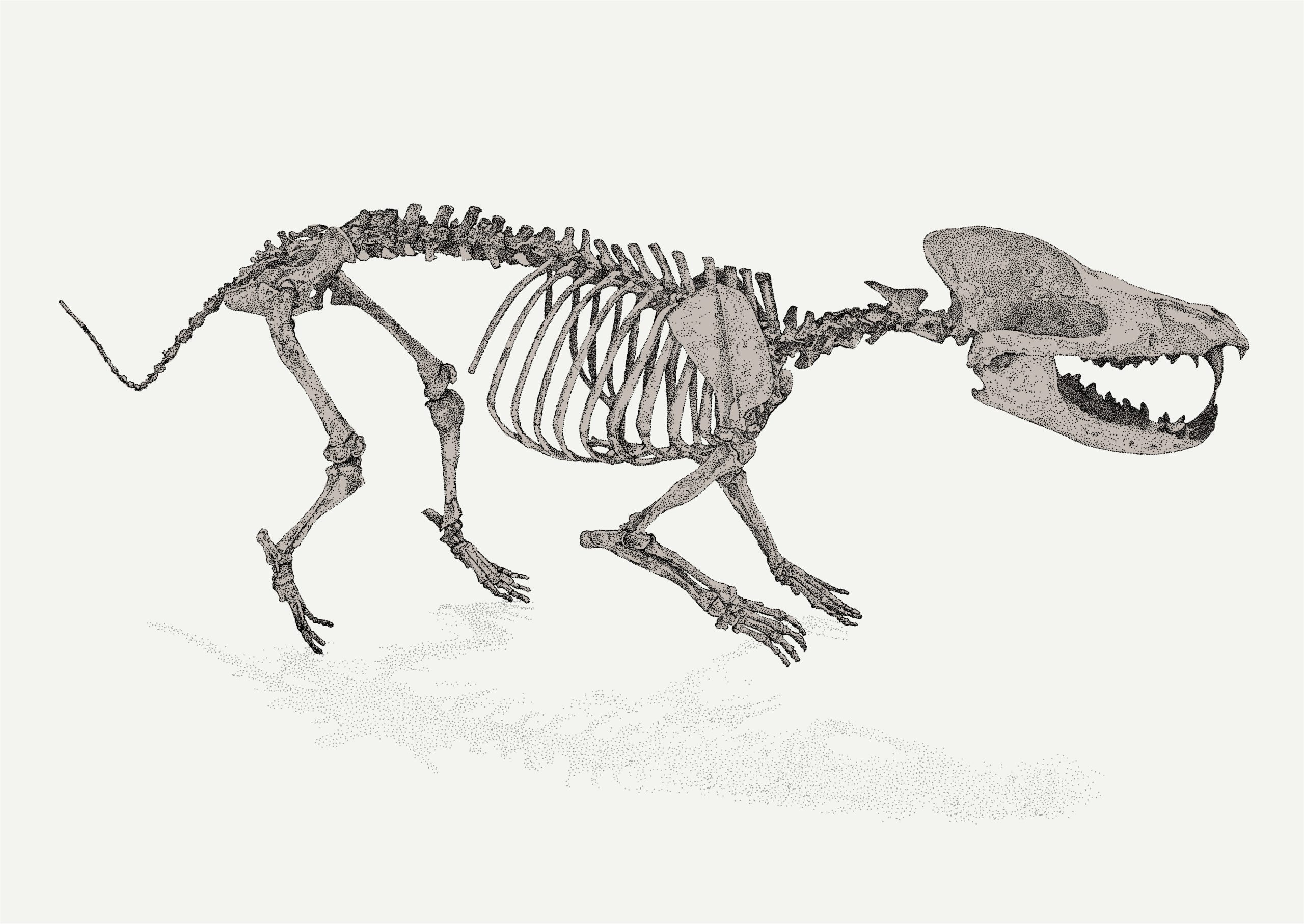
As their name may suggest, bear dogs look like crosses between bears and dogs. They had the thick, robust, and heavy-set torso of a bear, but with longer, more equally sized limbs, like those of dogs. They also had wide heads, like those of bears, with long, tapering jaws lined with canine-like teeth.
Unlike modern dogs, which walk on their toes (i.e. digitigrade), bear dogs planted the soles of their large, flat feet on the ground (i.e. platingrade), much like bears do. Their tails, though, were a lot more dog-like. It’s thought these long, fluffy tails may have been evolutionary leftovers from their smaller ancestors, which used them for balance while navigating tricky terrain.
The largest bear dog, Amphicyon ingens, is estimated to have been 2.5m-long, 120cm-tall, and more than half-a-ton in weight - up to 600kg according to some estimates. Not all bear dogs were the size of polar bears however; some, such as Gustafsonia and Angelarctocyon were no bigger than Chihuahuas, weighing between one and two kilograms.
These smaller bear dogs were some of the earliest of their kind, living long before later bear dogs evolved massive, bear-sized bodies. They looked a lot more like the earliest dogs, which emerged at a similar time from a shared ancestor that resembled modern weasels.
- This tiny, solitary bear can mimic facial expressions like humans – wait, what?
- Dogs have been herding sheep and sniffing out drugs for years. Now they’re saving wildlife too
Where did bear dogs live?
It has long been debated where bear dogs originated. It was once thought they may have crossed from Europe to North America during the Miocene, but more recent research suggests they evolved in North America during the Middle Eocene.
This North American origination is based on the discovery of small bear dogs like Gustafsonia and Angelarctocyon, which had been previously assigned to another group of extinct mammals, the miacids. This is the group that’s widely considered to have given rise to the carnivorans - the order that bear dogs and many other carnivorous mammals belong to.
The earliest bear dogs likely lived in similar environments to the earliest dogs, scurrying through the undergrowth of dense forests. However, as they evolved larger and larger body sizes, it’s believed they moved into more open habitats, such as grassy plains and forest margins.
- Can a human outrun a bear?
- How to avoid a bear attack – information that could save your life
- These are the world’s smallest (and adorable) bear species – and no, you still can’t cuddle them
As a group, bear dogs were distributed widely, with species known from North America, Europe, the Indian subcontinent, and Africa.
What did bear dogs eat?
Not much is known about the diets of bear dogs. They’ve been referred to as everything from omnivores, like modern bears, to hypercarnivores, like lions and other big cats. Some species have even been interpreted as bone eaters, filling similar niches to modern hyenas.
Amphicyon and other large bear dogs may have had a particular taste for large herbivores, if the bite marks on some fossilised bones are anything to go off. These mauled bones belong to an early species of rhino and a strange, hippo-like mammal known as an anthracothere.
How bear dogs hunted is another question debated amongst palaeontologists. Based on their long limbs, it’s thought they may have pursued prey over long distances, like wolves though not quite as fast. They may have then used their powerful forelimbs to immobilise prey before going in for a lethal bite with their robust jaws.
How do bear dogs fit in the mammal family tree?
The amphicyonids belong to a group of mammals known as caniforms, which themselves are one of the two major groups that make up the order Carnivora.
The caniforms include dogs and bears, as well as raccoons, mustelids, and even seals, walruses, and sea lions. This group split from the feliforms (i.e. the ‘cat-like’ carnivorans) roughly 43 million years ago.
- "These specialised teeth allowed them to crack, crush, and chew bones." 10 fearsome, deadly prehistoric dogs that roamed Earth millions of years ago
- "It moves like a cat, climbs like a primate and is usually found high up in trees." 5 weirdest, bizarrest wild dogs on the planet
Both dogs and bears emerged shortly after, approximately 38 million years ago, forging their own distinct, evolutionary paths. For a long time it was thought bear dogs diverged at a similar time and may even be a sister group of bears, sharing a common ancestor based on morphological similarities with their ears.
However, more recent analyses have suggested bear dogs, or amphicyonids, represent a more primitive lineage of caniforms that’s older than the origin of both bears and dogs. Indeed, the reclassification of two miacids - Gustafsonia and Angelarctocyon - as bear dogs strongly hints they may have evolved from miacids, or at least miacid-like animals.
Why did bear dogs become extinct?
The amphicyonids began to decline in the Late Miocene before facing extinction 5.3 million years ago. Bonisicyon is the last-surviving member of its family, living in East Africa a few million years after its much larger cousins had disappeared from North America and Eurasia.
In 1996, palaeontologist Suvi Viranta and colleagues put forward several theories as to why bear dogs disappeared. They found evidence that the extinction of the amphicyonids, at least in Western Europe, happened at the same time as some significant climatic changes and the reduction of forests. They also suggested competition with sabre-toothed catsmay have been partly to blame.
Other palaeontologists have suggested similar, proposing that bear dogs may have been outcompeted and replaced by mammals that were more specialised in carnivory, such as big cats and hyenas, and omnivory, such as bears.
For all their evolutionary success, bear dogs teach us a lesson: in the game of evolution it’s good to be adaptable, but sometimes you really do need to pick a lane. You can be a dog, you can be a bear, but sometimes trying to be both just leaves you stuck in evolutionary no man’s land.
top image: Illustration of a bear-dog (Amphicyon). Credit: estt/Getty Images
Discover more intriguing wildlife stories from around the world:
- It looked like a Cadbury Wispa chocolate bar, was twice the size of Manhattan and travelled 3,000km, transporting millions of animals across the ocean
- Diver finds turtle face down in a sea sponge. You won’t believe what it’s doing
- New crocodile species discovered in rocks used to build Egypt’s Great Sphinx


