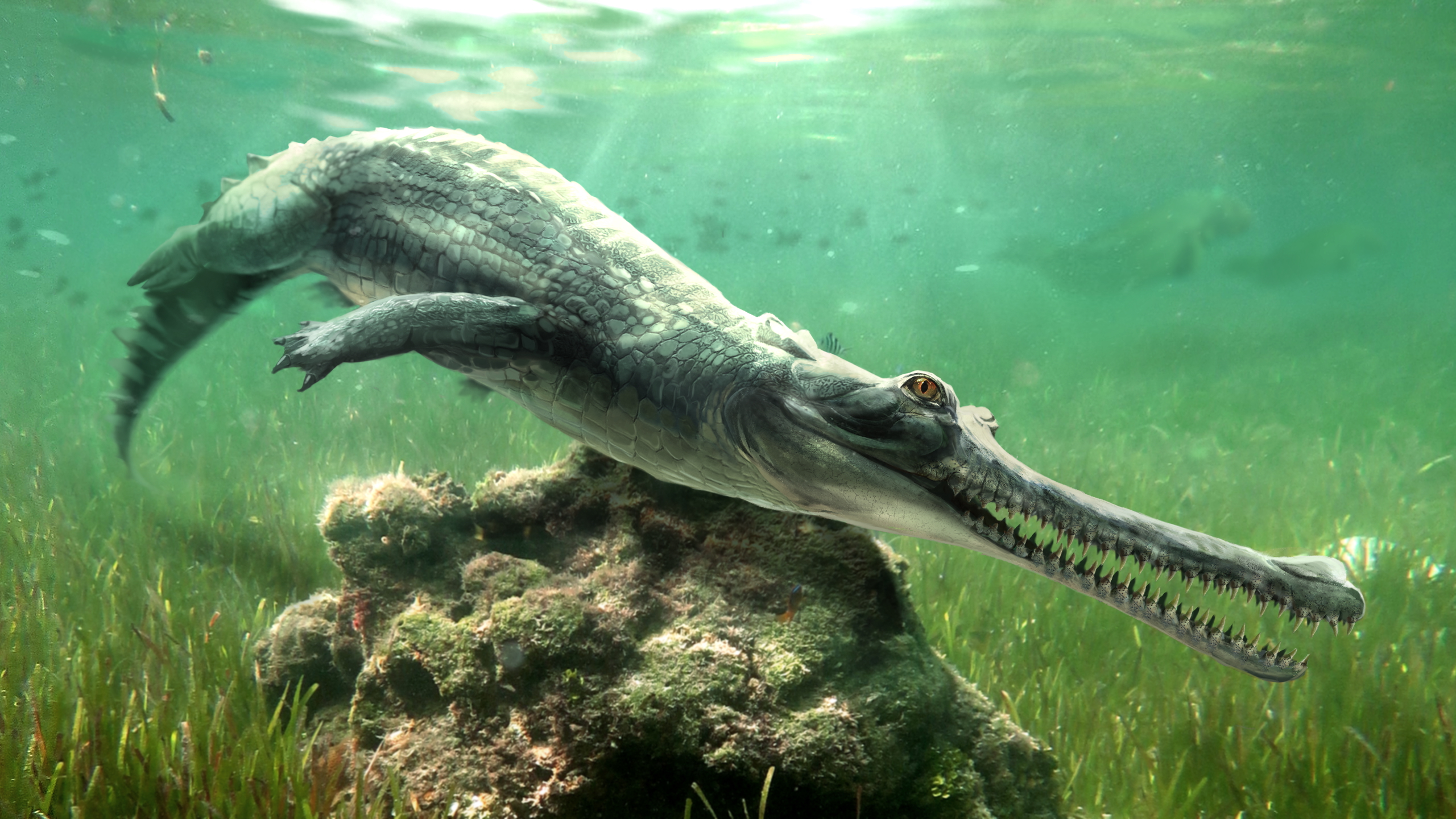
The newly described species, Herugavialis cairensis (H. cairenis), is a type of gavial. Gavials are a group of crocodiles that live in freshwater environments and are characterised by their long, thin snouts.
There are only two living species today – the gharial (Gavialis gangeticus) and the false gharial (Tomistoma schlegelii) – which are found on the Indian subcontinent and in Southeast Asia.
- Staggering crocodile photos reveal just how ferocious these apex predators can be
- Can a human outrun a crocodile? Just how fast are these deadly, ferocious reptiles?
But many extinct species have been found in the Mediterranean region. In the 1920s, several fossils of crocodilian origin were recovered from the Mokattam Formation in northern Egypt. The limestone site dates to the Middle Eocene (around 45 million years ago) and was extensively quarried from the Ancient Egyptian period, with its material used to build the Pyramids of Giza, the Great Sphinx and much of Historic Cairo.
The site is also rich in marine fossils. Many of the fossils found in the 1920s excavation, which include a nearly complete skull, were assigned to the genus Tomistoma due to their apparent resemblance to the false gharial.
- Are there any crocodiles in the sea?
- Formidable crocodile-like predator discovered in Egyptian desert
However, subsequent advances in palaeontology (such as CT scanning) have now allowed a team of international researchers to identify differences between false gharials and the fossils found in the Mokattam Formation.
Historically classified as Tomistoma cairense, the researchers detail the anatomy of its skull and revised taxonomy in a paper published in Royal Society Open Science. Micro-CT scanning allowed researchers to look inside the skull and note multiple morphological differences from the extant false gharial. These differences were reinforced by phylogenetic analysis, which looks at the evolutionary development of a species.
What’s in a name?
The Great Sphinx is famously missing the tip of its nose; similarly, the skull of H. cairenis is missing the tip of its snout, leaving the researchers in no doubt about what the new species should be named.
“Given this coincidence with the famously missing nose of the Great Sphinx, we decided to name the new crocodile after the Egyptian god Heru, who was possibly the inspiration for this iconic monument,” says Philip Mannion of University College London, who co-led the study.
While there are no crocodilians in the Mediterranean today, H. cairenis wasn’t the only gavialoid at the time – other fossils have been found in Morocco, Egypt and Italy.
“Throughout much of the last 50 million years, the Mediterranean region hosted a high diversity of crocodiles, including gavials,” says lead author Paul Burke, a researcher at the Swedish Museum of Natural History.
“However, this diversity fluctuated over time, seemingly corresponding to changes in global temperature and sea level, before the loss of all crocodiles in this region as a result of the drying of the Mediterranean approximately six million years ago.”
Top image: the Great Sphinx in front of the Pyramids of Giza, which were built using rocks from the Mokattam Formation. Credit: Kitti Boonnitrod/Getty Images