
A new prehistoric animal species has been discovered after researchers re-examined remains housed in London’s Natural History Museum.
The species, named Dinodontosaurus isiyavamanda, belonged to a group of vertebrate mammals that flourished before the rise of the dinosaurs.
An extensive collection of its fossilised remains was unearthed during a 1963 expedition in what is now Tanzania. The remains were moved to the Natural History Museum and were featured in a master’s thesis in the 1990s, but only partly studied.
By examining one of the undescribed associated skeletons belonging to the dicynodont herbivorous group, along with a more recently uncovered fragmentary skull, an international research team found that the Tanzanian fossils belonged to the genus Dinodontosaurus. Further study confirmed that the fossils represent a previously unknown species, which has now been described in the Journal of Vertebrate Palaeontology.
“Imagine a huge pig with a turtle’s beak and tusks slightly shorter than those of a walrus,” explains Hady George, the lead author of the paper and a PhD student at the University of Bristol, UK, describing the species.
“Dinodontosaurus isiyavamanda was one of the dominant herbivores of its environment. Dinodontosaurus translates to ‘terrible-toothed lizard'/reptile which is a reference to its large tusks. However, it’s not a reptile but an ancient relative of mammals.”
Its name references the land of the Wamanda people, who inhabit the region of Tanzania where the fossils were found. And the official classification of the fossil has wider implications when considering the timeline of prehistoric life.
“Our discovery marks the first confirmed record of the genus Dinodontosaurus outside South America,” remarks George.
“The finding links the Tanzanian and South American fossil-bearing rocks, showing they are of equivalent age.”
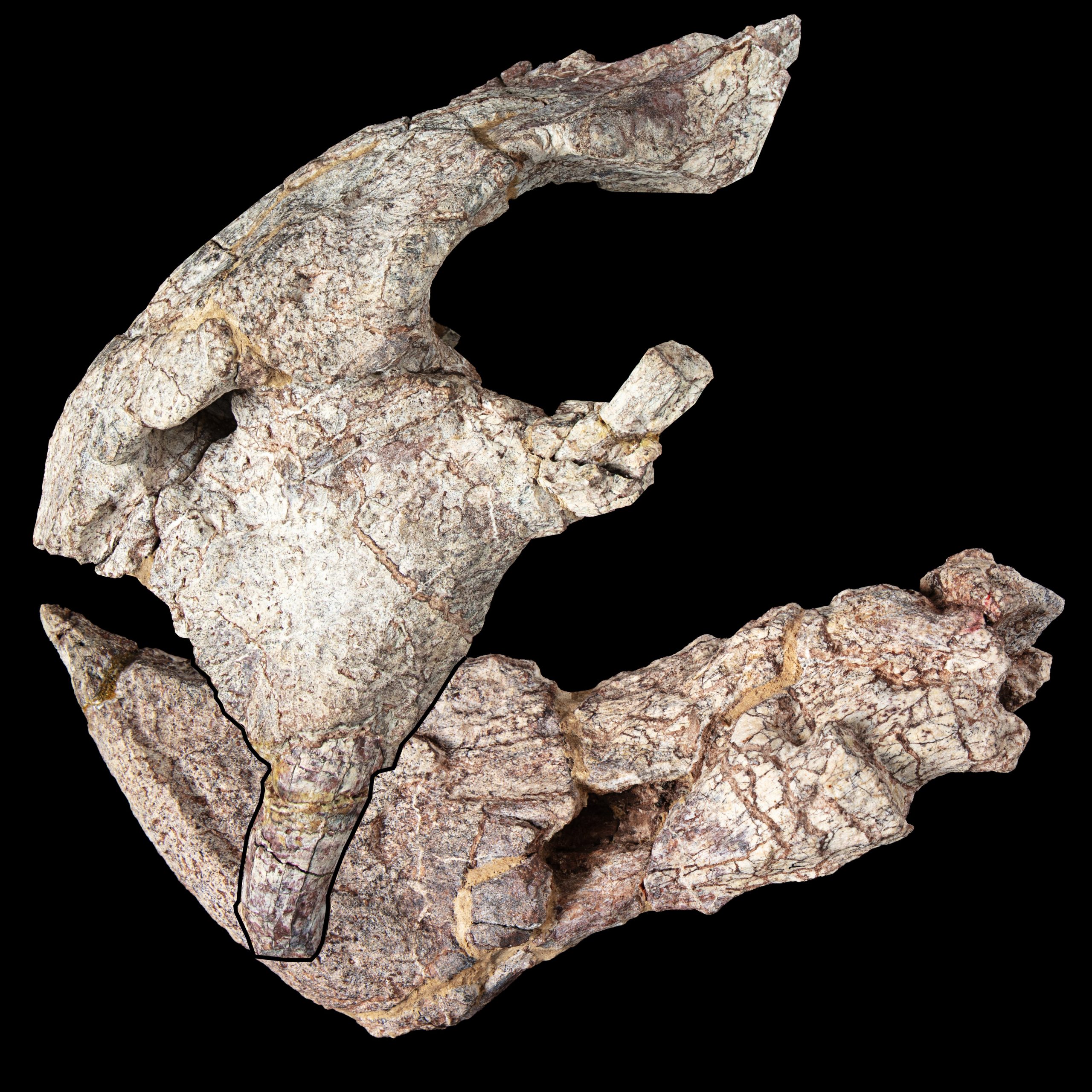
The Tanzanian rocks, in East Africa, have produced fossils thought to represent the oldest possible dinosaurs, and were believed to be of a similar age to rocks found in South Africa.
But new radiometric dates from South America suggests that its rock sequences containing dinosaur fossils are up to 10 million years younger than that of South Africa.
“This helps confirm that the oldest dinosaur candidates from Tanzania are probably no older than those from South America, refining the timeline of dinosaur origins,” explains George.
But for one of the study’s co-authors, the findings have finally solved one outstanding mystery.
“I studied this dicynodont skeleton for my MSc thesis in 1994 and judged it to be a species new to science – but it took me nearly 30 years to start the process of writing it up for publication,” explains Nigel Larkin, a visiting research fellow at the University of Reading, UK.
“I’m glad I waited, as the international team we put together, headed by Hady George, has done an amazing job of fleshing-out this story in much more detail and depth than I could have achieved on my own.
“Techniques have improved vastly over the last 30 years too – we can do so much more with micro-CT scanning to examine such specimens than we ever could have imagined, and international collaboration is so much easier. And what’s 30 years? It’s the blink of an eye compared to the age of this prehistoric specimen.”
Read the full paper here.
Top image: illustration of Dinodontosaurus isiyavamanda. Credit: Gabriel Ugueto


