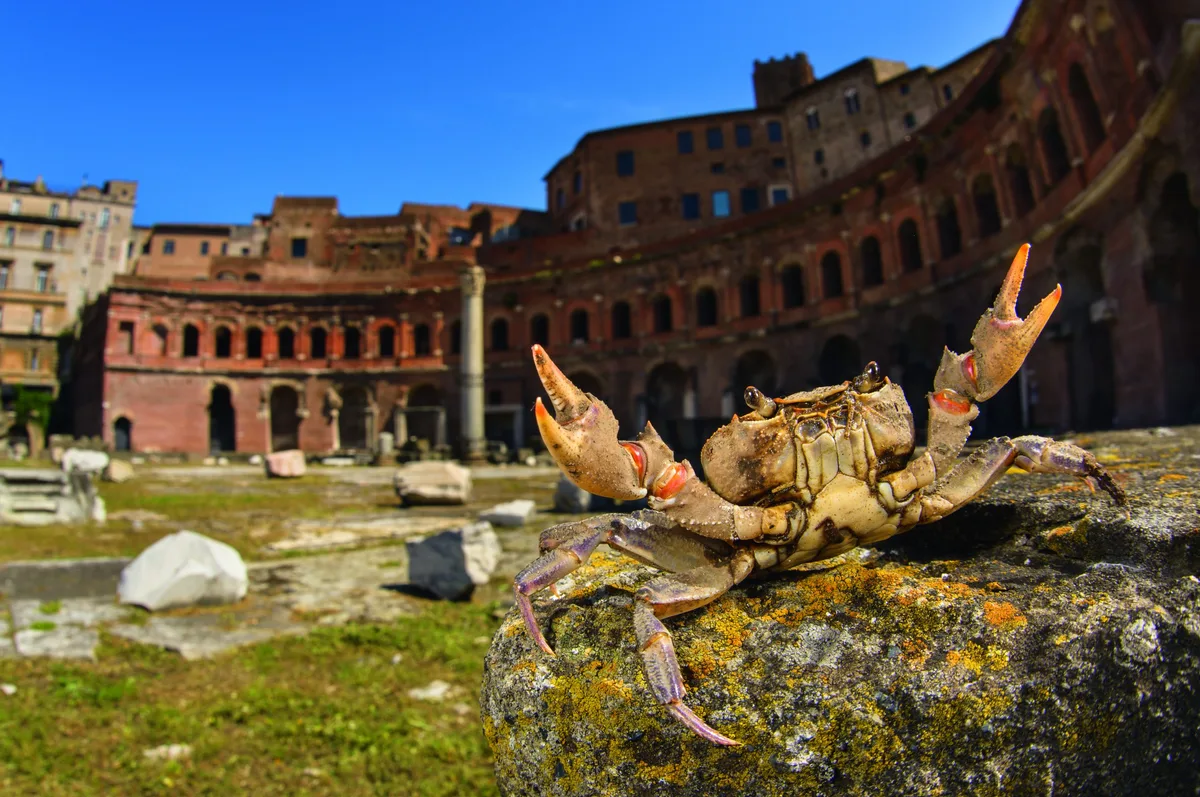
There are a few notable things about blue crabs (Callinectes sapidus): their bright blue claws (with nail varnish-like red tips on mature females), their value to fisheries in the USA’s Chesapeake Bay, and their alarming tendency for cannibalism.
In a new study, published in Proceedings of the National Academy of Sciences, scientists reviewed 37 years of data and found that the leading cause of death for juvenile blue crabs in the region’s mid-salinity waters was cannibalism. Adult blue crabs were the cause of 97 per cent of injury and death of juveniles examined in the study.
“Blue crabs are notoriously cannibalistic,” says the study’s author Anson “Tuck” Hines, director emeritus of Smithsonian Environmental Research Center (SERC).
During the study, the researchers attached individual juveniles to a small spike in the water using a one-metre tether, which allowed the animals to move around and hide from predatory fish by burying themselves in the sediment. After 24 hours, the scientists returned to see what had happened to the little crabs.
“We were amazed to find that over our 37-year study, cannibalism accounted for all of the predation, and we found no fish predation on tethered crabs,” says Hines. More than half of the crabs in the study survived but 42.2 percent were victims of cannibalism: 17.3 percent were injured while 23.6 percent were killed by a larger crab.
“We’ve recorded a few of the tethering experiments with a high-resolution sonar,” says co-author Matt Ogburn, a research ecologist at SERC. “In the sonar videos, most fish didn’t show any interest in the tethered crabs, and only adult crabs attacked them.”
- 11 cannibal animals: discover the surprising creatures that feast on their own kind
- “A colossal crab the size of a car tyre was pushing against my door"
- Claws vs talons: what's the difference?

- This creature has one of the mightiest, most lethal weapons in the animal kingdom – and he uses it to impress the females
- "Weird" poop crawling with parasites found on US riverbank. DNA analysis reveals exactly what's going on
A few things affected the crabs’ chances: the risk of being eaten by a larger crab was higher during the summer when hungry adult crabs were more active. And smaller crabs were much more likely to be preyed upon than larger juveniles. Young crabs measuring less than 5cm were often targeted but those who had grown over 12cm were safe from predation.
The young crabs could find safety in the shallow waters close to shore. Areas with water around 15cm deep provided a refuge and had much lower rates of cannibalism than deeper waters.
"The nearshore shallows of the mid-salinity zone provide juvenile crabs with a crucial refuge habitat from cannibalism by large crabs,” says Hines.
But these refuges are at risk. Construction to protect the shoreline from erosion is leaving young blue crabs with fewer places to hide. Non-native species, including blue catfish, may also pose a threat.
Protecting and restoring these shallow nearshore habitats will play an important part in keeping blue crab populations – and, so, blue crab fisheries – in the region healthy, the authors say.
Top image: Chesapeake Bay. Credit: Joesboy/Getty Images
More wildlife stories from around the world
- There’s a remote volcanic island off Brazil that’s home to scientists, the military – and a crab called John
- NASA officials sent over 2,000 baby jellyfish into space. Tens of thousands more came back to Earth
- Scientists looked beneath one of oldest trees on Earth. What they found is astounding
- US officials parachuted 76 beavers into the Idaho wilderness – then something astounding happened