
For many divers, the sight of a titan triggerfish will prompt a conflict of emotion. They are stunning fish to observe, being round-bodied, with bright yellow, grey and green scales, orange-edged fins and a white throat. But venture too close to a breeding female and she will defend her nest with fearless aggression.
The beak-shaped mouth, marked with a dark moustache that adds to the fish’s striking appearance, has powerful, chisel-like teeth. These are slightly human in appearance and designed for crunching through the shells of molluscs and crustaceans or biting off lumps of coral. There is plenty of power in the bite as more than one diver will attest.
Present across much of the Indo-Pacific Ocean, the titan triggerfish measures up to 75cm long and are one of 41 known species in the family Balistidae.
They are named after the trigger-like dorsal fin, which has three, sharp spines and acts as a defence mechanism. The first spine can be locked upright by the second, helping to prevent the fish being swallowed by a predator.
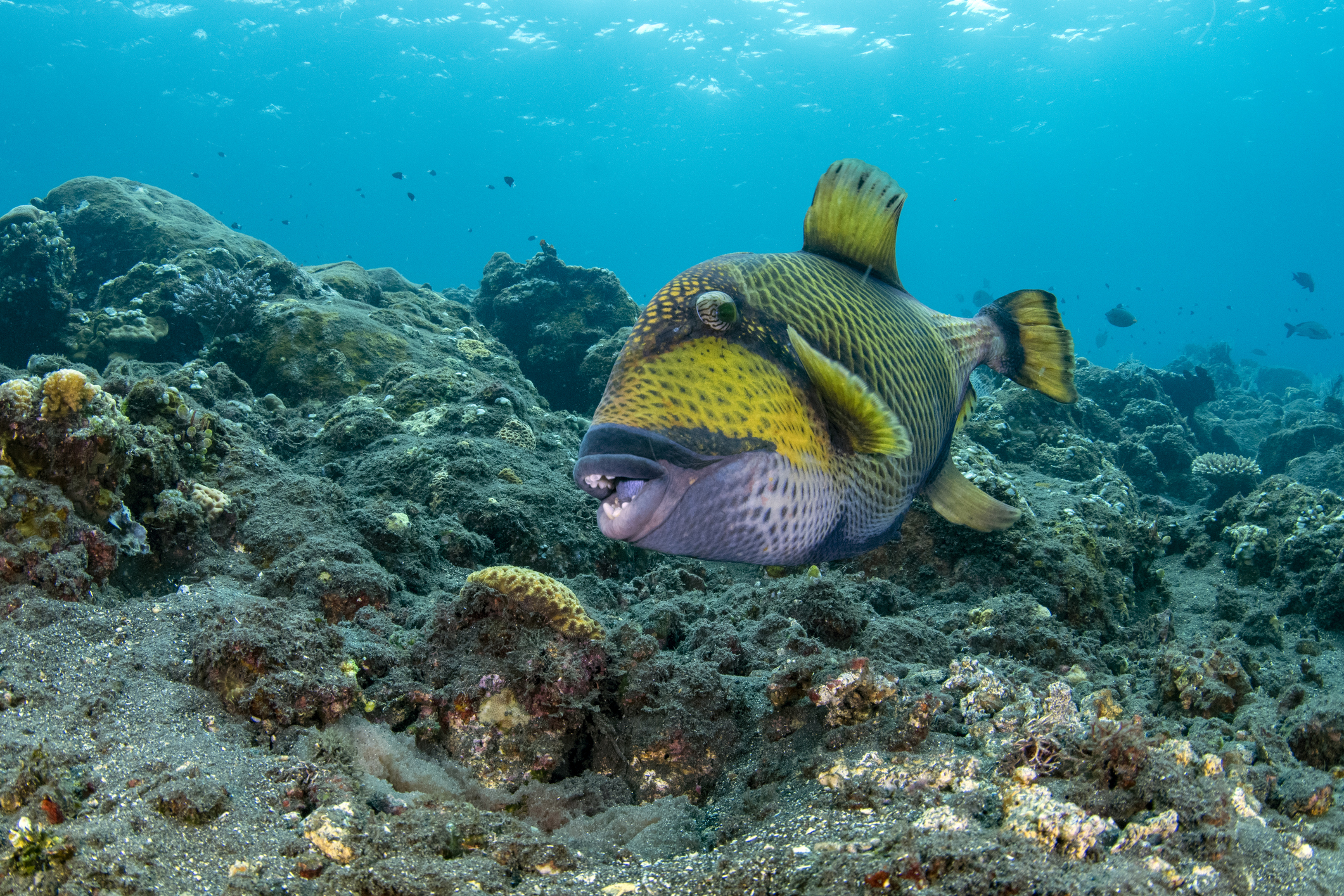
While coral forms part of their diet, they also feed on sea urchins and starfish, species that can cause extensive damage to coral colonies when present in large number.
- It strikes fear into swimmers around the world and sends people scrambling from the water – but what exactly is the point of a dorsal fin?
- "If some stop swimming they will suffocate..." Did you know fish can do maths, walk, fly AND pee? 15 fish facts that leave you scratching your head
The reproductive process of titan triggerfish is linked to the lunar cycle, with spawning usually coinciding with a full moon. The male and female dig shallow depressions into sedimentary substrate to form nests, into which eggs are laid and then fertilised. Both sexes will subsequently defend the nests, with the female normally more aggressive.
- "It's bigger than a full-size snooker table and has a 40cm-long stinging spine."10 most fearsome, deadly river monsters, including a grisly giant leech
- The Ohio River is full of tiny monsters that “resemble a vicious Pac-Man”
She will charge at any potential predator, only biting as a last resort, and divers are advised to swim away horizontally if approached. The territorial range is cone shaped, reaching up through the water column, so making for the surface may only encourage an attack.
Discover more wildlife stories from around the world:
- In 1941, a massive WWII ship sank off the coast of Albania. Divers just went down there – and found a rare mammal living among the wreck
- See the chilling moment this vampire squid turns itself inside out
- No one lives on this remote Russian island – but it does have a mysterious graveyard of gigantic, 600-year-old whale bones


