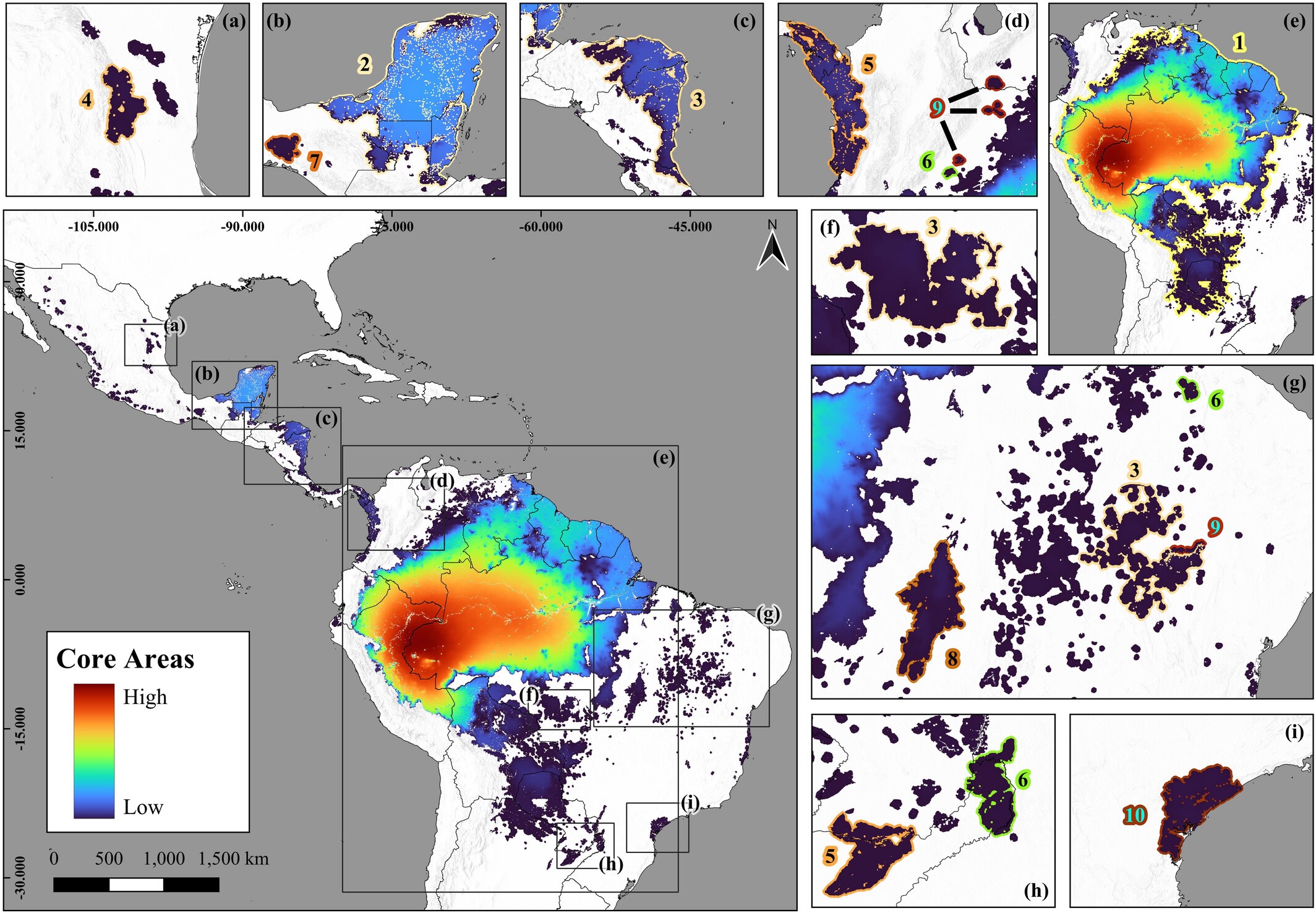
There’s a map of Central and South America in a new research paper that shows the core areas for the continents’ only big cats, jaguars, and it reveals much about how these apex predators are faring.
Western Brazil and parts of eastern Peru, in the heart of the Amazon Basin, are deep red, showing this to be the absolute stronghold for the species, and from here the colours go to orange, yellow, blue and dark blue, spreading out like the rings on an archery target.
The map has been modelled using the movements of 172 GPS-collared jaguars, and it’s both good and bad news.
The good news is that the largest and highest-ranked core area covers a massive 6.5 million km2 – an expanse almost as large as the whole of Australia – and includes the Amazon, the Llanos of Colombia and Venezuela, the Pantanal and the Chaco.
The bad news is that everywhere else, including most of Central America, northern South America and eastern Brazil, is increasingly fragmented.
“In general, I would say that our results are quite positive,” says Sam Cushman, the biology department’s chair of science at Southern Denmark University (SDU) and a joint senior author of the paper published in Global Change Biology.
“The main population is concentrated in the Amazon, but when we exclude that and look around at other populations, the situation is not great, and lots of them are at high risk of becoming locally extinct.”
- Jaguar experts camera-trapped the Amazon – and discovered a dark secret
- Pumas are saving human lives in Washington State. Camera-trap footage reveals how
Another key contributor to the paper, Carol Sartor, a postdoctoral ecologist also at SDU, says these other, more vulnerable populations are important, not just because jaguars are top predators and therefore have a profound impact on all ecosystems, but also because jaguars outside of the heartlands represent significant genetic diversity.
That genetic diversity is manifested in the way jaguars are able to live in these different biomes, from the wetland-dominated Pantanal where caiman are their main prey, to the flooded forests of the Amazon where they climb trees and hunt monkeys and sloths.
They also inhabit Brazil’s caatinga, a dry, scrubby biome where they predate peccaries, brocket deer and armadillos.
“If we let these small populations, such as those in the Atlantic Forest, go, we lose all that genetic information,” Sartor says.
Cushman says the research will be useful for conservationists to take to funders such as governments or the World Bank because it shows empirical data on which potential projects, such as improving habitat corridors that provide connectivity, can be based.
The overall jaguar population is extremely difficult to assess, but a 2018 paper put it at somewhere between 138,000-208,000 – considerably larger than those of other big cats such as lions (20-25,000) or tigers (less than 6,000).
Top image: Jaguar in the Pantanal. Credit: Uwe-Bergwitz/Getty Images
More wildlife stories from around the world
- Puma DNA found deep in Guatemalan rainforest. Analysis reveals the cats are eating something unexpected
- Wild jaguar cub spotted in Argentina's Gran Chaco for first time in decades
- Scientists tracked these mountain lions in Los Angeles for seven years – now they've discovered something crucial
- Why 8 Texan pumas were released in Florida – and what happened next