
Small enough to sit comfortably in a human hand, the pygmy marmoset is the world’s smallest monkey, weighing around 100g.
But do not let its diminutive dimensions fool you. Look beyond the cute exterior and you will discover an impressive Amazonian primate with remarkable climbing abilities (thanks to specialised nails), a cooperative social life, and an unusual way of feeding that involves gouging holes in trees to tap their sticky contents.
Is there more than one species of pygmy marmoset?
Yes. Pygmy marmosets were once classified as a single species, of the family Callitrichidae, with two subspecies, but genetic and anatomical research supports recognising two species: the northern pygmy marmoset (Cebuella pygmaea) and eastern pygmy marmoset (Cebuella niveiventris).
What do pygmy marmosets look like?
They are extremely similar in appearance. Eastern pygmy marmosets generally have distinctive whitish underparts, though coat colour varies considerably within the species and is not a reliable way of telling the two apart.
Genetic research indicates that their ancestors diverged about 2.5 million years ago. Major Amazonian rivers have helped separate their populations, though the precise boundaries between them are still being studied.
- What are the smallest monkeys and primates in the world? Meet the tiny creatures of the monkey world
Where do pygmy marmosets live?
They inhabit the western Amazon Basin in South America, including parts of Brazil, Colombia, Ecuador, Peru and Bolivia. Northern pygmy marmosets occur mainly north of the Napo and Solimões-Amazonas rivers, while eastern pygmy marmosets are principally found to the south.
They favour dense lowland forest close to rivers and floodplains, particularly where the trees and vines on which they feed are plentiful. Much of their time is spent in tangled vegetation in the lower levels of the forest, and they can live up to 12 years in the wild.
Are they really the world’s smallest monkeys?
Yes. An adult pygmy marmoset has a head and body length of only about 12–16cm and typically weighs about 85–140g. Its tail, at roughly 17–23cm, is considerably longer than its body.
There are smaller primates: Madame Berthe’s mouse lemur of Madagascar weighs only about 30g. However, lemurs are primates, not monkeys, leaving the pygmy marmoset with its record intact.
What do pygmy marmosets eat?
Tree gum and sap form a major part of their diet, supplemented by insects, spiders and other small animal prey. Fruit and nectar may also be eaten.
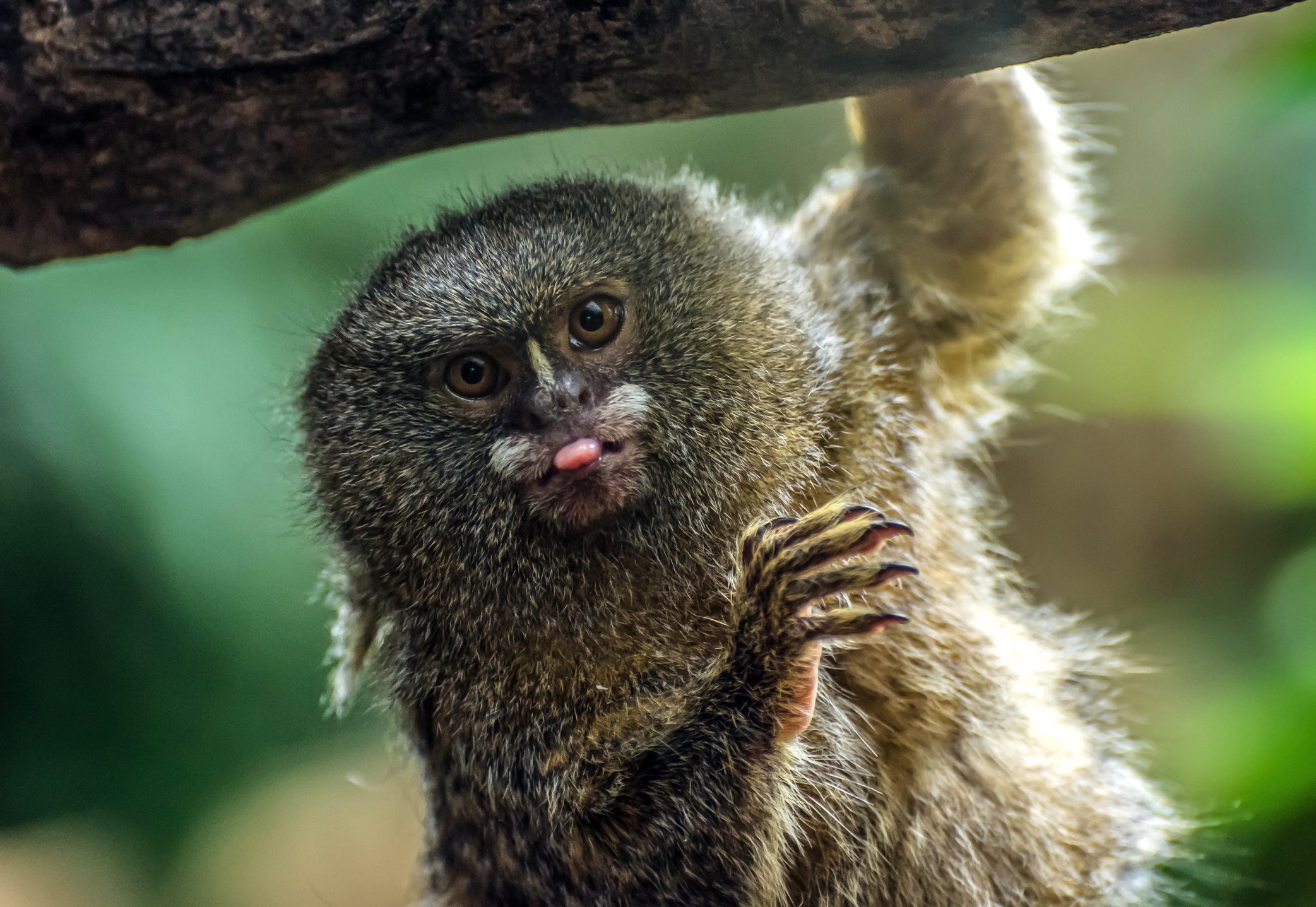
Rather than waiting for a tree to release gum or sap naturally, pygmy marmosets create their own feeding sites. They anchor themselves to the trunk and use specialised lower incisors to gouge holes through the bark, returning repeatedly to favoured trees to lick up the liquid that oozes out.
How are they adapted for life on tree trunks?
Most primates have flat nails, but pygmy marmosets have curved, claw-like nails (called tegulae) on every digit except the big toe. These give them an excellent grip on vertical trunks while they gouge bark and feed.
Long and narrow lower incisors allow them to chisel into wood, while the digestive system is adapted to allow a longer time for processing gum. It is thought that the white markings either side of their mouth and on their nose may help other group members see their facial expressions in the reduced light of dense forests.
- 8 smartest primates on Earth – Just how do they measure up against us humans?
- 10 deadliest, most ruthless, savage primates on the planet – "Their hunting expeditions involve intelligence, cooperation and utterly brutal violence."
Are pygmy marmosets social?
They usually live in small family groups centred on a breeding female, her mate and offspring from several previous litters. A long-term study in Peru found stable groups containing two to nine animals, with six the most common number.
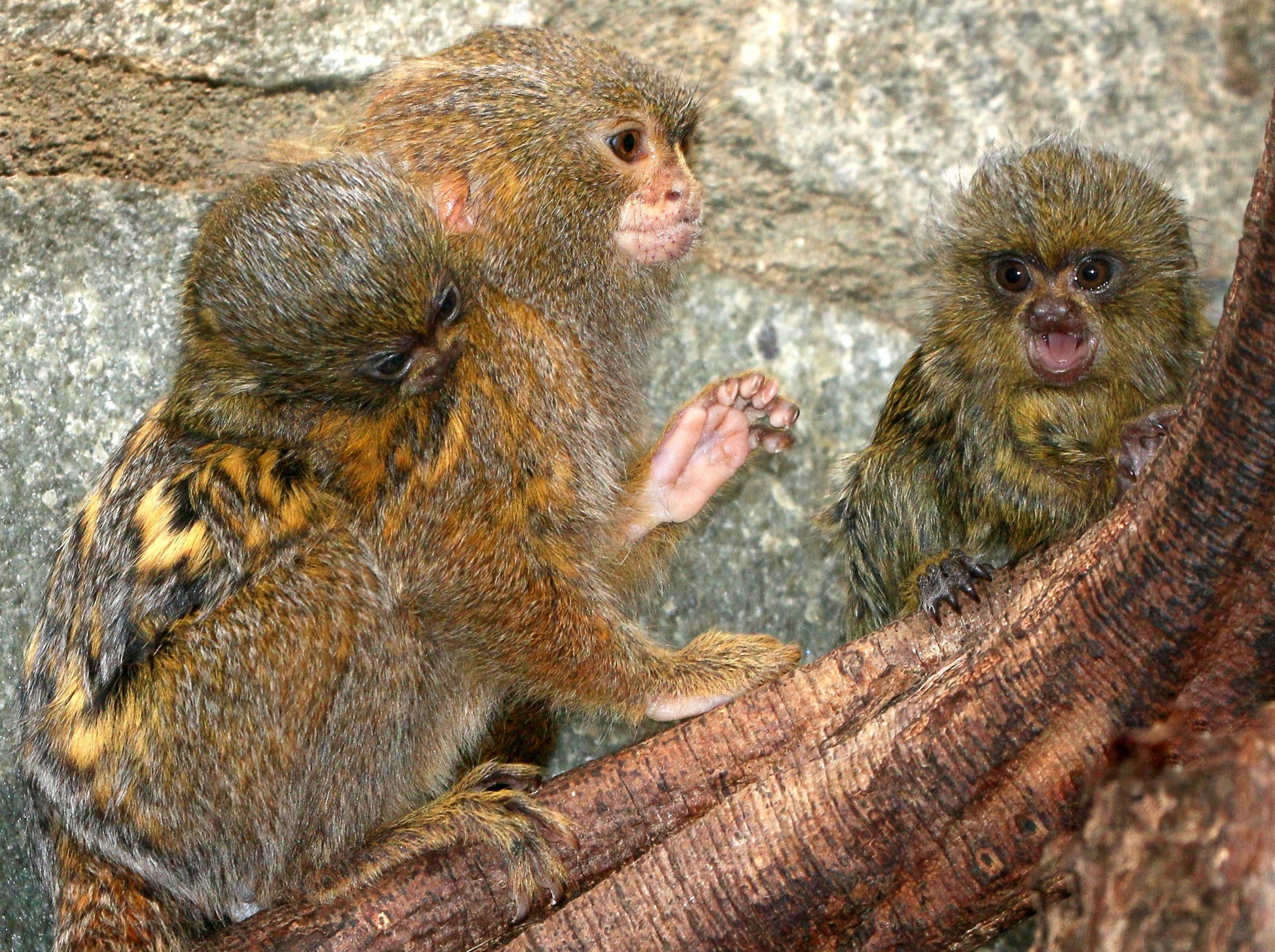
Family life is cooperative. Older siblings and other adults help to carry and care for infants, an important contribution when a mother may be raising twins whose combined weight is substantial compared with her own.
How do they communicate?
Pygmy marmosets use varied high-pitched trills used to maintain contact with one another. Researchers have found that individuals can take turns exchanging these calls, creating vocal sequences that resemble a rudimentary ‘conversation’. Alarm calls also warn the group of predators, which include birds of prey, snakes and small cats.
- Mysterious new monkey species with orange lips discovered in the Congo rainforest
- Can chimpanzees and other great apes breed with monkeys?
How do pygmy marmosets breed?
Females usually give birth to twins after a gestation of about 4.5 months, though singletons and triplets also occur. A litter may be produced every five to seven months.
The mother nurses the infants, but the father undertakes much of the care, along with the help of other family members. As the youngsters grow, their helpers also search for food while they learn to forage for themselves. This cooperative system spreads the considerable energetic cost of raising the young across the family.
Are pygmy marmosets under threat?
Yes. Both species are currently listed as Vulnerable by the IUCN. The river-edge and floodplain forests on which they are reliant have been severely affected by deforestation for human settlements, as well as mining, oil extraction and palm and coca plantations.
- “I spent five days in hospital after a bite from a monkey you could buy for a child”
- “In the blink of an eye, 6 of them hurtled towards me. Out of nowhere 1 landed on a branch just 5m away. I tried to back away, but I was easy prey…”
Pygmy marmosets are also captured for the wildlife trade. Their tiny size and appealing appearance may make them seem suitable pets, but they are highly social wild primates with specialised diets and behavioural needs.
top image: The pygmy marmoset (Cebuella pygmaea) on a tree. Credit: nastasic/ Getty Images
More wildlife stories from around the world:


