
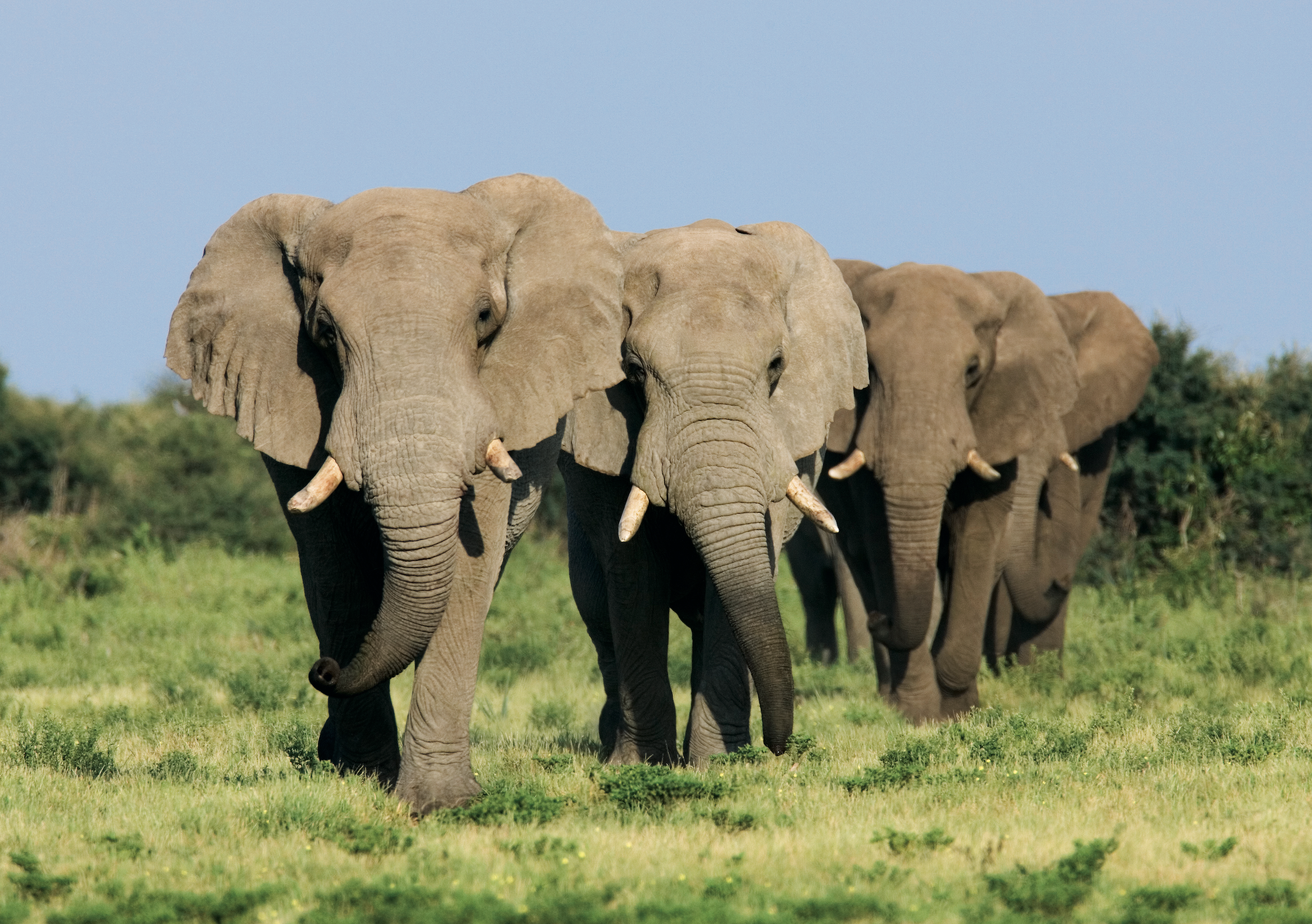
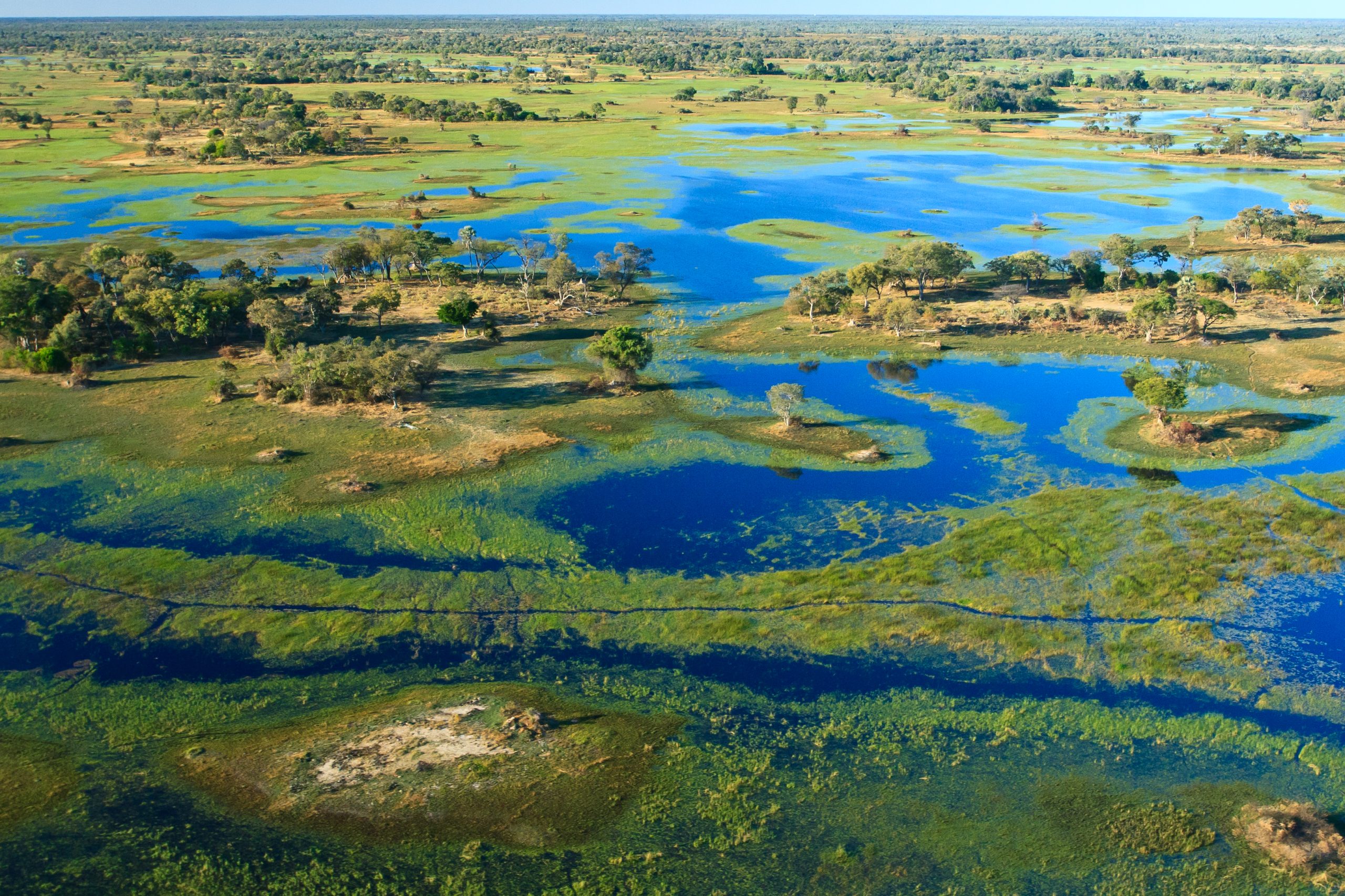
Eleven grey giants drink from the floodwaters of the Okavango Delta, neatly lined up at the water’s edge like soldiers at a parade. I juggle notebook, binoculars and camera, trying to record the clues that will enable me to put names to faces.
But I’m so busy concentrating on the details of notches, holes and veins that I forget I started with 12
animals. I have also failed to notice that I am parked on an elephant trail – the path that one
of the elephants, Darwin, will use to reach the water’s edge and some human is rudely blocking.
- 10 animals that can kill an elephant: Which animals are able to take on this majestic giant?
- "A bull elephant appeared from the bush. Ambling over to the carcass, the immense creature used his tactile trunk to gently caress the bones of his fallen comrade"
I don’t see or hear him approach, but sense his presence long before his colossal form casts a shadow over me. Suddenly, I feel vulnerable. Darwin could easily crush my 4x4, or pluck me from the open vehicle and toss me aside like a rag doll. Hoping he won’t choose either of these options, I turn my head gingerly. There he is, peering haughtily down his trunk at me.
- Can a person outrun an elephant?
- "His small trunk and ears were free, but his rear-end was stuck fast in the dark, oozing mud. He looked exhausted and must have been struggling for hours"
He doesn’t look very pleased. What’s more, his temporal glands (near the eyes) are swollen and secreting a thick goo – during periods of heightened sexual readiness, known as musth, male elephants produce a testosterone-rich fluid. Darwin is pumped full of sex hormones: he is not an elephant you want to upset.
As I sit there, nervously watching his wise, old face, I wonder what he has experienced in his
50 years of life, and whether he deems me to be worth bothering with. The answer comes
with a headshake, and then he ambles around my vehicle and down to the water. The smell
of musth lingers as he walks past, dribbling urine from his penis sheath, which has turned a
mouldy shade of green.
This was my first encounter with Darwin, and I felt intimidated with good reason: he is 5 tonnes of African savanna elephant at the peak of his dominance. I stepped out of line that day – I don’t think he would have treated me quite so kindly if I had been a young male elephant, because he and other old bulls have an important part to play in disciplining and teaching these youngsters.
It is the intricacies of the poorly understood male elephant society that I am here to study.
Though I had been in Botswana for only a few months, it was beginning to dawn on me that bull society is much more complex than previously thought. Old males are traditionally seen as solitary creatures, only joining with female herds to breed, and individuals past their prime are classified as surplus by humans and thus often hunted as trophy animals.
But I now realised that they have a vital role in the continued development of younger males. Unlike females, which remain with their natal herd, living among cousins, aunts and sisters, male elephants leave during adolescence to join an all-male society.
This ‘boy’s club’ is ruled by a strict hierarchy with the strongest, largest bulls at the top. They compete to win the attention of the ladies and thus for the chance to pass their genes on to the next generation.
When a male leaves his natal herd, usually at 10–19 years of age, he weighs a mere 2 tonnes; by the time he is mature and has opportunities to mate, in his late 20s or early 30s, he will have bulked up to a staggering 5–7 tonnes. This protracted period of adolescence is when male elephants start to assert themselves among their peers.
While female elephant society relies on the close companionship of related individuals, males live in a ‘fission-fusion’ society – that is, their social groups change on a daily, if not hourly, basis. Upon independence from their natal herd, they frequent ‘bull areas’, separate from the home ranges of female herds, where most of the other males they meet are likely to be new to them. It is a highly social age of greeting and sparring, when they establish who’s who in their new social network.
Despite their size, adolescent male elephants can fall prey to prides of lions that specialise in bringing down these huge herbivores. It used to be thought that the ever-changing male groups did not provide as much security as the more stable female herds, so I was astounded one day to witness the protective herding behaviour of adult bulls encircling smaller youngsters.
I was watching a group of 12 males – a motley crew of various sizes, including two very small ones of 8–10 years of age – when the dominant bulls felt threatened by something. They immediately gathered round the younger males with their trunks and tusks facing outwards, creating a formidable wall of muscle and ivory. I had only seen this in female herds before. Was it purely altruistic behaviour?
Or were the bigger males related to the smaller ones (older brothers, cousins or fathers, perhaps) and therefore driven by their genes? It will take more long-term studies to find the answer. As for a fully grown male, he has little to fear, except a hunter's or poacher’s bullet.
So male and female elephants live fairly separate lives. The main exception is when they meet to mate, drawn together by the chemical and audible signals of their respective sexual states. Prior to this, the males feed intensively to bulk up in preparation to win battles and maintain the physically draining state of musth, which may last for several months.
A female elephant in oestrous is a powerful magnet – wandering males follow the sound of her rumbling, infrasonic calls and soon pick up the smell of oestrogen in her urine, which advertises her readiness to mate.
Since a female elephant has an extremely long, 22-month gestation period, investing a lot of time and energy in the development of her foetus, she naturally wants the cream of the crop to father her calf to ensure that her effort is not wasted. Older males fit the bill – they have proven their strong genes by surviving the harshness of the savannah for more than 30, and sometimes well over 50, years. But it is not just males in musth that are attracted: any male in the neighbourhood will come along to try his luck. It is like sweet nectar to bees – they can do little to resist.
This is where the male hierarchy comes into play. Big males strut their stuff, warning off young whippersnappers with a swift flick of the head and an earth-shaking rumble. But the randy adolescent males sometimes hang around on the sidelines undeterred, waiting patiently for two large bulls to have a face-off so that they can move in for a sneaky mating, if the female will allow. They had better be swift, though, as they will not go unnoticed for long.
My research has shown that young males spend a great deal of time socialising and sparring
with males their own age. This you might expect – rather more surprising was my discovery
that they prefer to be closest to the big old bulls if possible. But why? What do they gain from
being hangers-on?
- "There's a brutal ritual called 'phajaan' where the animal is kept caged until its spirit breaks." It may make you think twice about riding elephants
- "They're more closely related to woolly mammoths than they are to African elephants…" Just how different are African, forest and Asian elephants?
The answer is simple: knowledge. When they abandon their natal herd and birthplace, adolescent males lose familiarity with local resources such as food and water, and this can mean the difference between life and death. Old female elephants store a vast encyclopedia of knowledge, which has been gathered over decades of roaming their homeland, so they know exactly where to go when times are hard, such as during droughts.
For young males, this library of information vanishes overnight when they become independent and roam through tracts of land as large as 10,000km². I have observed young males on the verge of independence hesitate on the boundary of the area they know, weighing up the costs and benefits of leaving home.
Many turn back to familiarity, not quite ready to take that plunge into the unknown. The safest, most energy-efficient way of learning about a new region is to follow someone who already knows – a big
bull that has explored the territory for 50–60 years or more.
Old bulls have another, more subtle role to play: they are also disciplinarians, keeping the young males in check. This first came to light during the 1980s, as farmland in South Africa was turned into wildlife refuges.
Orphaned male elephants were translocated to areas with no older bulls, came into musth prematurely and went in search of females – but there were none to be found. Maddened with lust, the sexed-up adolescent elephants tried it on with the only other big, grey mammals in the area – white rhinos.
When the startled rhinos did not display the expected receptive behaviour, the teenage elephants turned on them aggressively, resulting in the deaths of more than 40 white rhinos. What was missing from the equation was the steady hand (or should that be trunk?) of older male elephants.
Sure enough, the subsequent introduction of some big bulls suppressed the youngsters’
musth and ended their unusual behaviour. How this ‘musth suppression’ works is not known,
but it is likely to be a mixture of physical and chemical persuasion. The threat of being
tusked by a male 2.5 times heavier than you is probably rather effective at curbing youthful
indiscretions.
Big bulls are clearly vital to the success of elephant conservation and management plans:
we cannot put a group of male elephants together and simply expect them to behave. A
structured society is needed to maintain order and control the unruly young boys. The old
bulls, which have often been seen and treated as surplus, are actually the anchor to the
stability of bull society. If we eliminate these wise old men, then we do so at our own peril,
because the laws that govern bull society will go with them.
As for Darwin, he is still wandering the Okavango swamplands, passing on his genes,
knowledge and common sense to the next generation of male African savanna elephants.
Learn more about the Okavango elephants at elephantsforafrica.org
About the author
A founder of the charity Elephants for Africa, Kate Evans has been studying elephants in the swamplands of the Okavango Delta, Botswana, since 2002.
- "The elephant crashed into the vehicle again, trying to roll it. I shouted to get out and the students slid out of the tilting car."
- From a tender family group hug to a cheeky, adorable baby elephant wanting to play – 14 beautiful 'ele' photographs from the book 'Remembering Elephants'
- "The elephant crashed into the vehicle again, trying to roll it. I shouted to get out and the students slid out of the tilting car."
