
They might be distantly related to our fluffy, domesticated furballs, but sabre-toothed cats aren’t the kind of cats you’d ever consider petting - unless you fancied losing a hand. These formidable predators were among the most diverse and widespread carnivores of the past few million years; some even lived alongside our early ancestors, inspiring a fear that has endured to this day.
What are sabre-toothed cats?
The term ‘sabre-toothed cats’ refers to an extinct subfamily of cats (i.e. Felidae) known as Machairodontinae. While they’re sometimes called ‘sabre-toothed tigers’, this is considered somewhat of a misnomer as they’re not technically tigers. Instead, they belong to a lineage that evolved long before tigers appeared.
- Mummified sabre-toothed cat cub found in Siberian permafrost stuns scientists
- How deadly, prehistoric sabre-tooth cats developed their lethal, bone piercing fangs
As a group, sabre-toothed cats - or machairodonts - were incredibly diverse, ranging in sizes comparable to lynxes, to those exceeding lions and tigers. They lived all over the world too. After originating in Eurasia during the Middle Miocene, they ultimately spread to every continent except Australia and Antarctica.
Based on their diversity and widespread range, palaeontologists consider them the most dominant group of cats from the Middle Miocene to the Early Pliocene. There were other cats living during this time, including the ancestors of modern cats, but they were mostly small and couldn’t compete with their sabre-toothed cousins in hypercarnivorous niches.
How many sabre-toothed cats are there?
There are approximately 50 recognised species of sabre-toothed cats, spread across nearly 15 distinct genera.
This includes well-known forms like Smilodon, Homotherium, and Megantereon, as well as lesser-known varieties like Amphimachairodus, which may have been just as large (and deadly) as Smilodon.
It’s worth noting this total only includes the ‘true sabre-toothed cats’. If the ‘false sabre-toothed cats’ are included, then the number of cat-like animals with sabre-shaped canines exceeds 70 and perhaps even reaches as many as 80.
- "Its vicious-looking, self-sharpening teeth were designed to slice effortlessly through tough meat." 10 deadliest, most ruthless prehistoric cats ever
- 10 petrifying, humongous prehistoric beasts that would have utterly terrified early man, from a 3-metre tall primate to massive deadly eagles
The ‘false sabre-toothed cats’, or nimravids, aren’t actually cats - they instead belong to a distinct but closely related lineage of feliforms - but they’re often confused with sabre-toothed cats; no doubt thanks to their similarly deadly dental weaponry.
What did sabre-toothed cats look like?
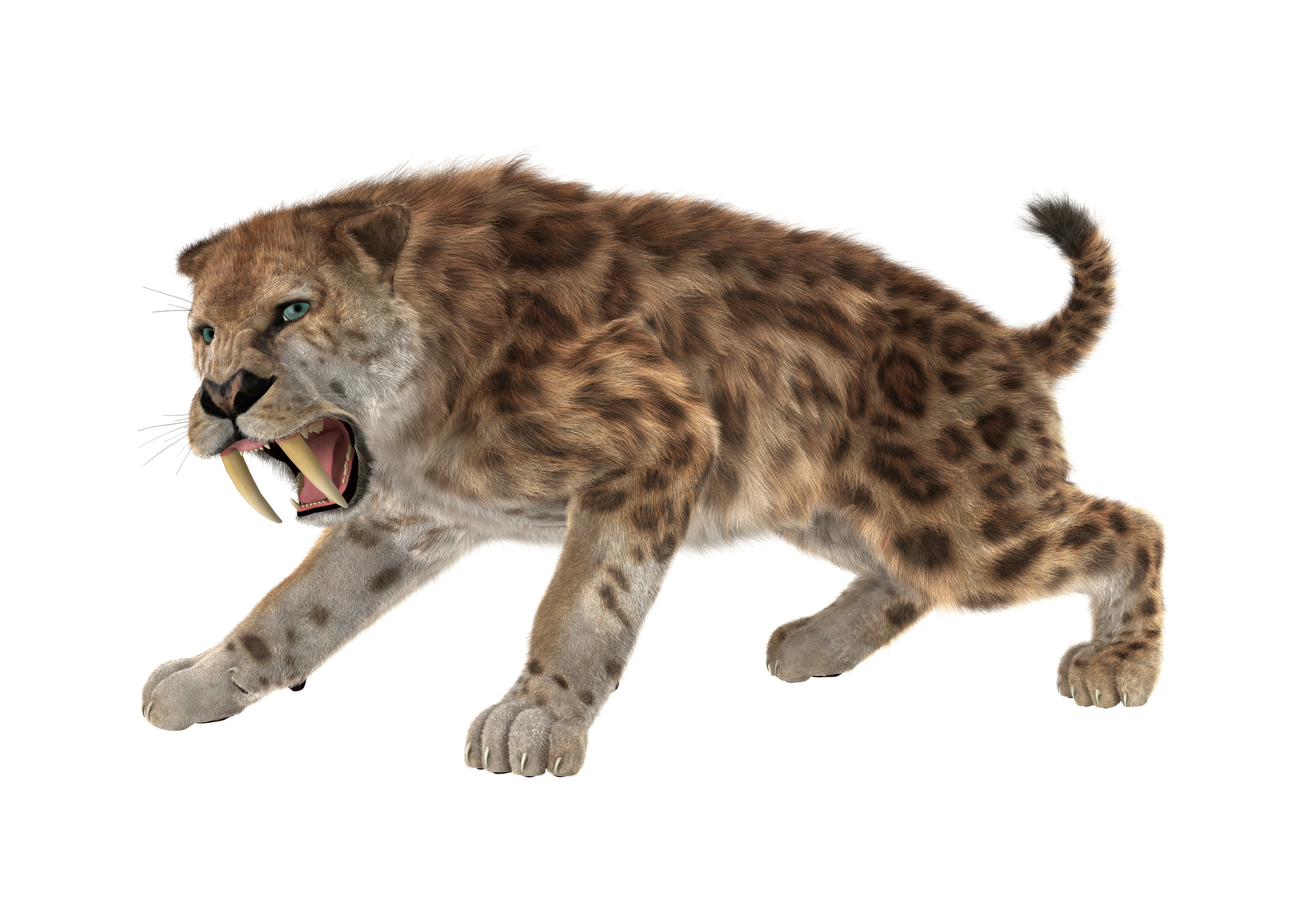
The machairodonts are united by several shared features, beyond their supersized canines.
Unlike today’s big cats, machairodonts were typically stocky, with hindlimbs that were smaller than their long and powerful forelimbs. Smilodon is a great example of this stocky sabre-toothed body plan - its forelimbs resembled those of modern bears and were anchored to muscular shoulders that allowed it to grapple with its prey.
Not all machairodonts were shaped like this, though. Homotherium, for example, had equally sized limbs and a slimmer build more reminiscent of modern lions. Its canines were also much shorter than those of Smilodon and may have even been hidden behind big, fleshy lips.
The largest machairodont is believed to be Smilodon populator, which stood 1.2m tall at the shoulder and weighed between 220 and 450 kilograms, making it roughly twice as bulky as modern lions. There are several other species that may have grown to similar sizes, including the aptly named Amphimachairodus giganteus.
Where did sabre-toothed cats live?
As a group, sabre-toothed cats are known from a range of different habitats. The majority of species lived in grasslands, river valleys, and forest margins, relying on low-lying vegetation to provide cover for ambush hunting.
These kinds of habitats were widespread across Earth from the Middle Miocene to the Early Holocene. They also supported a variety of other mammals, such as bison, camels, horses, and giant ground sloths - animals that sabre-toothed cats no doubt preyed on.
What did sabre-toothed cats use their canines for?
It’s clear the canines of sabre-toothed cats were deadly, but exactly what they were used for has been debated amongst palaeontologists for decades.
Some have suggested they might not have been used in hunting at all and were instead used for courting, sexual display, and projecting one’s social status. After all, similarly large canines are seen in male musk deer, which use their sabres to woo potential mates and fight other males attempting to steal the attention of females.
However, sexually selected traits, such as large canines, typically only occur in one sex. In all machairodont species, both males and females have large canines, suggesting they weren’t the products of sexual selection and did indeed have some use in hunting.
How did sabre-toothed cats hunt?
The hunting strategies of sabre-toothed cats were just as diverse as the cats themselves. The animals they preyed on also varied massively, ranging from mammoths and giant ground sloths to bison, horses, camels, and llamas.
Homotherium is distinct amongst other sabre-toothed cats in that it hunted more like modern lions do, relying on teamwork to bring down herbivores many times its size. Its longer limbs and slender build made it a more effective pursuit predator than its cousins, allowing it to chase down a larger variety of prey.
- "It could have weighed as much as 10 tonnes, more than double the weight of an African elephant and possibly as much as 14.3 tonnes!"
- Prehistoric giant ground sloths once roamed the Americas – including one colossus that weighed 4 tonnes and stood 3.5 meters tall - yet couldn't run
It’s believed Homotherium had a particular taste for baby mammoths. At Friesenhahn Cave in south Texas, Southern United States, researchers found the remains of nearly 400 juvenile Columbian mammoths alongside several Homotherium skeletons. Based on the marks observed on these bones, it’s thought Homotherium killed juveniles and dismembered them before dragging the meatiest parts back to their den.
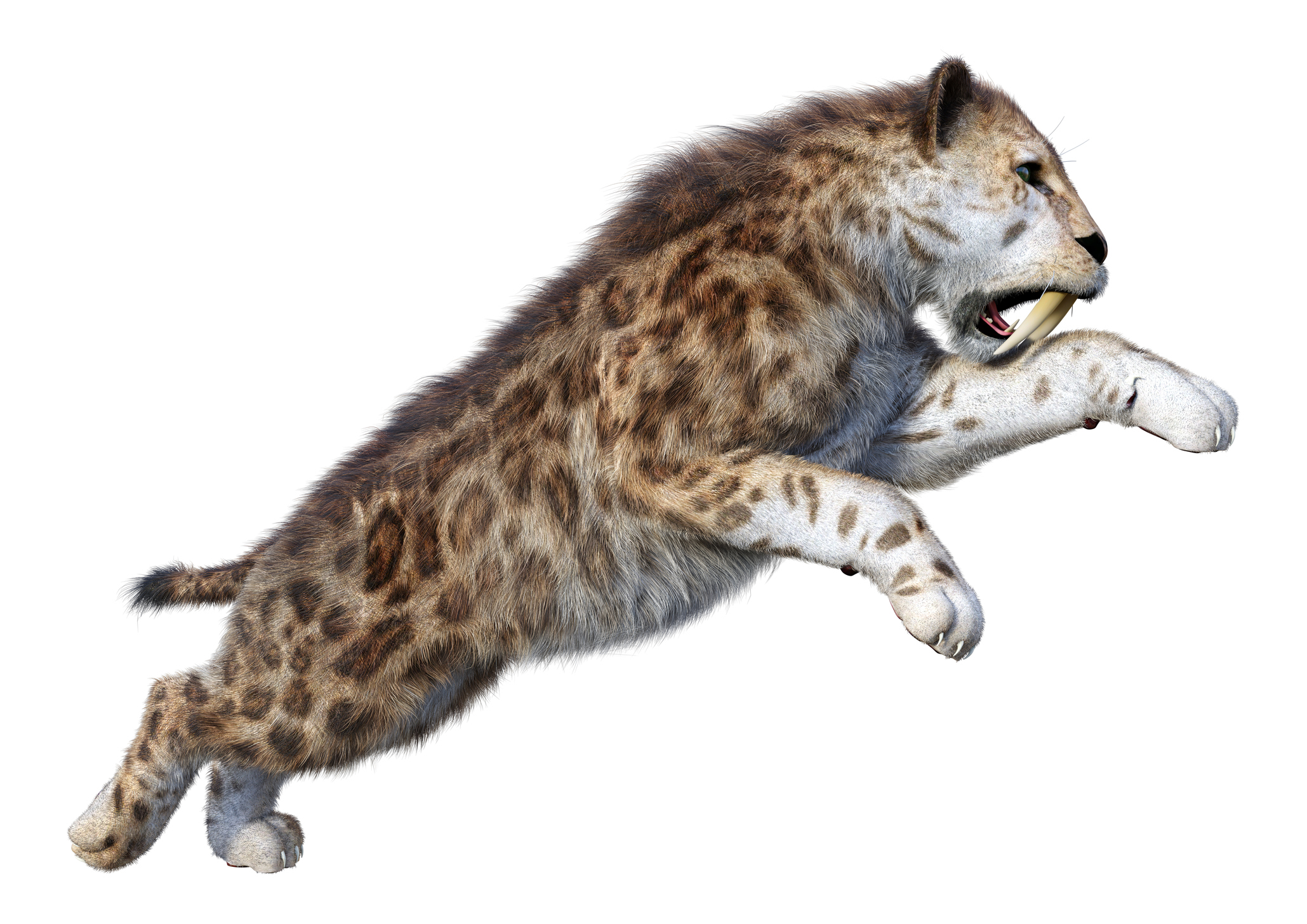
Smilodon and other, stockier sabre-toothed cats weren’t quite as social as Homotherium and are thought to have been primarily solitary hunters. Instead of pursuing prey, they specialised in the art of ambushing, using their robust hindlimbs to pounce from behind cover and their long, powerful forelimbs to pin down their prey.
- "While healthy adults were off the menu for most predators, the old, sick and young often faced grisly ends." 9 animals that could kill giant mammoths
- Woolly mammoth vs elephant:They look like giant, hairy elephants… but how different were woolly mammoths really?
It’s at this point of the hunt where palaeontologists debate exactly how they delivered their killing bites. Some suggest they sunk their 30cm-long sabres into their prey’s throats and held on, crushing their windpipes until they gave their last breaths.
Others suggest they delivered careful, shearing bites, slashing open the major blood vessels in their prey’s necks before retreating and waiting for them to bleed to death. Alternatively, they may have inflicted repeated ‘belly-shearing’ bites, opening huge abdominal wounds and leaving their prey’s intestines spilling onto the ground.
There’s also a theory that suggests sabre-toothed cats were capable of swinging their heads down with enough force to puncture tough skin and even armoured plates, similar to how rondel daggers were used in the Middle Ages to kill heavily armoured knights.
This theory has largely been ruled out on the grounds that it would have led to a lot of broken teeth.
Did early humans interact with sabre-toothed cats?
Our ancestors not only lived alongside sabre-toothed cats, they competed with them for food. In the Americas and Eurasia during the Late Pleistocene, humans regularly came across sabre-toothed cats as they tracked similar prey over an expansive habitat known as the Mammoth Steppe.
At a site near Schöningen, Germany, the remains of five fossil teeth and an arm bone from a Homotherium were found alongside several spears and dated to 300,000 years ago. The find not only suggested that humans and sabre-toothed cats lived in the same area, but that they may have regularly come into contact with one another.
Jordi Serangeli, the lead author of the study that described this spectacular find, wrote, “the wooden spears were not necessarily only used for hunting, but possibly also as a weapon for self-defence.” The arm bone also showed signs of having been worked into a rudimentary hammer, suggesting early humans were firm believers in ‘waste not, want not’ - even when it came to the aftermath of a life-or-death encounter.
Before our ancestors even left Africa they likely came face to face with sabretoothed cats. At Toros-Menalla in Chad, where the seven-million-year-old hominid Sahelanthropus tchadensis was discovered, palaeontologists found the remains of a giant sabretooth cat known as Machairodus kabir, which weighed in at nearly half-a-ton. The remains of two other species have been found in this area, suggesting Late Miocene central Africa was a particularly dangerous place.
Why did sabre-toothed cats become extinct?
The last surviving sabre-toothed cats were Smilodon and Homotherium, which both disappeared approximately 10,000 years ago at the end of the Pleistocene. It has long been debated what wiped out these sabre-toothed cats, but consensus is that their extinction was driven by two key factors: climate change and humans.
As the last ice age drew to a close and climate change shrank the habitats these cats lived in, their prey became more and more scarce. While some suggest they had diverse diets and may have been able to adapt to such changes, others believe they were too specialised - after their prey disappeared they slowly but surely starved to death.
At least, that was the hypothesis prior to a 2012 study, which analysed the teeth of 15 sabre-toothed cats (and 15 American lions) from the La Brea tar pits in Los Angeles, US - a site dated to the end of the Pleistocene and famous for its glut of carnivore remains. The authors of this study identified wear patterns that suggested sabre-toothed cats weren’t gnawing their prey to the bone, suggesting that prey wasn’t particularly scarce.
The sabre-toothed cats of La Brea have given us even more insights into the group’s decline in recent years. In July 2026, a study published in Frontiers in Veterinary Science found that as populations declined, rates of inbreeding increased, leading to a spike in spinal deformities and rare tumours that left many cats immobile. “Things might have been getting really bad in the end,” Emily Lindsey, a palaeontologist at La Brea who was not involved in the study, told Science.
It’s clear that sabre-toothed cats were already in decline before the end of the Pleistocene, even if the exact cause remains elusive. The final blow, however, may have come from humans. Growing human populations not only competed with sabre-toothed cats for prey, but also transformed - and in many cases destroyed - their habitats.
A changing climate may have set their decline in motion, but when it comes to what ultimately tipped them over the edge and made extinction inevitable, the finger may well point at us.
Discover more fascinating wildlife stories from around the world:


