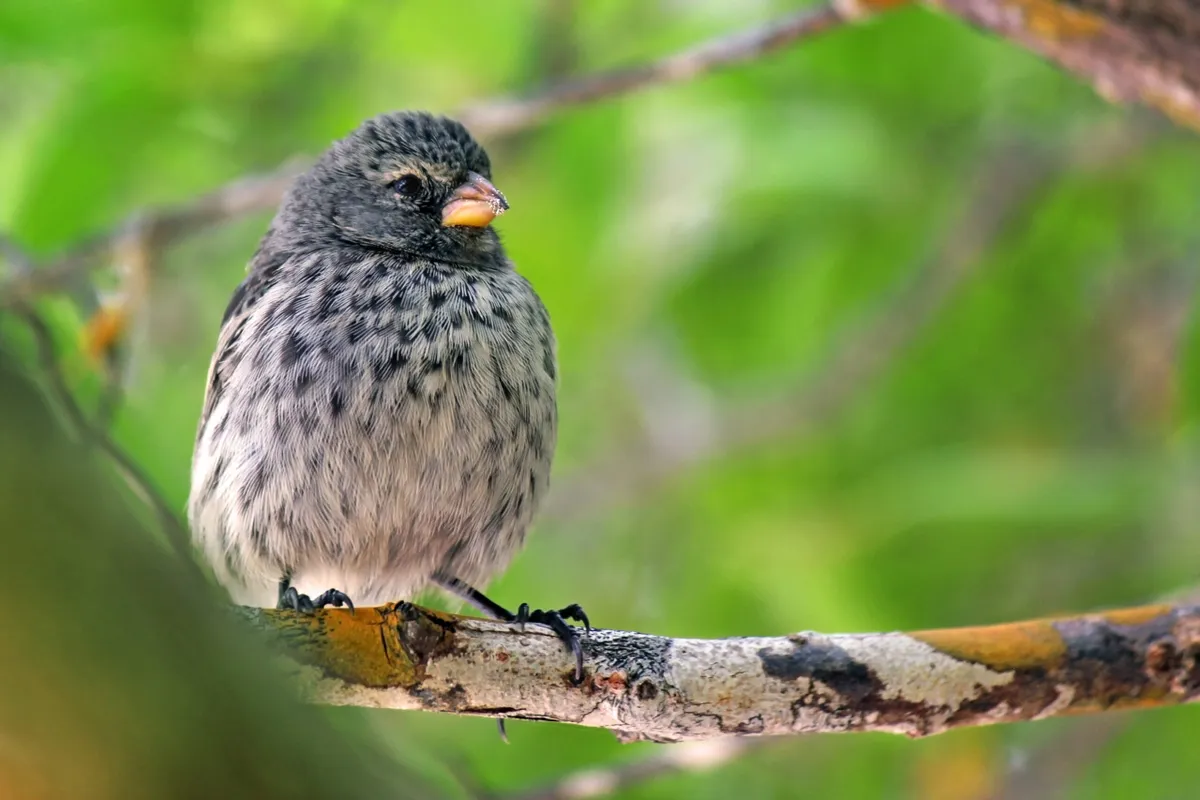
Our planet is home to many different forms of life, from the microscopic (e.g. fern spores) to the colossal (e.g. blue whales).
While these organisms may look vastly different from one another, they’re all related and can trace their roots back to a common ancestor that lived approximately 4.2 billion years ago in the deep, dark depths of an otherwise lifeless ocean.
- How old is life on Earth? Well, it depends on what you mean by 'life'
- What was the first animal on earth?
This ancestor is known as LUCA - the Last Universal Common Ancestor - and it’s believed to have given rise to the three major domains that make up the tree of life: Archaea, Bacteria, and Eukarya.
- Does the tree of life reflect evolution?
- Evolution explained: what evolution is, how evolution works - and how some dinosaurs turned into birds
These first two domains comprise billions of tiny, single-celled organisms that require a microscope to study, while the latter is made up of pretty much every living thing you can see with the naked eye: animals, plants, fungi, and (in a few select cases) protists.
What unites animals, plants, fungi, and protists in the same domain is the fact that they’re all composed of eukaryotic cells that have their genetic material (DNA) enclosed within a nucleus, surrounded by a nuclear membrane.
- Cells guide: what they are, the differences between prokaryotes and eukaryotes, and how they replicate
- Phenotype guide: what it is, it’s relation to the genotype and the effect on evolution
Contrary to popular belief, eukaryotes aren’t exclusively multicellular. In fact, the vast majority of eukaryotic species actually consist of a single cell. These unicellular eukaryotes belong to the protists, while the more familiar multicellular eukaryotes belong to animals, plants, and fungi.
To understand the difference between animals and plants - without doubt the most recognisable multicellular eukaryotes - it’s important we go back to the basics and establish what defines each group.
What is an animal?
Put simply, animals are multicellular, eukaryotic organisms that ingest organic matter for energy, breathe oxygen, possess specialised tissues, and are capable of movement - at least at some stage of their life cycle (more on that later).
Other key distinguishing factors include having cells without cell walls and developing from a blastula - a hollow sphere of cells that forms during early embryonic development.
There are more than 1.5 million living animal species currently known to science. At least one million of these species are insects. Molluscs make up another 85,000 species, while vertebrates (the group that includes us and everything else with a backbone) only comprise 65,000 species - the vast majority of which are fish.
What is a plant?
In contrast to animals, which must ingest other organisms for energy, plants make their own food via photosynthesis. This is a process in which chemical energy is produced from a combination of water, minerals, and carbon dioxide, with the aid of pigments (e.g. chlorophyll) and the radiant energy of the sun.
Not all plants photosynthesise - parasitic plants have secondarily lost the ability and obtain their energy from other plants or fungi - but the process is considered characteristic of the group.
Other distinguishing characteristics include essentially unlimited growth at localised regions, cells that contain cellulose in their walls, providing rigidity, the absence of nervous systems, and the lack of limbs for locomotion, which results in a primarily stationary existence.
There are roughly 380,000 known species of plants, 260,000 of which produce seeds. This group includes most of the familiar land plants, including the flowering plants (angiosperms) and the gymnosperms. The remaining species are made up of ferns, mosses, and some algaes - all of which reproduce using tiny, single-celled spores.
What are the main differences between animals and plants?
There isn’t just one straightforward difference that separates animals and plants. Instead, there are five major areas where these multicellular eukaryotes differ:
1. Nutrition: plants make their own food, while animals get their energy from ingesting other organisms.
2. Movement: plants generally stay in one place, while animals can move from place to place using their limbs.
3. Cellular structure: plants have cells with rigid walls (made of cellulose), while animals have cells with flexible membranes.
4. Growth and reproduction: plants grow through their lives in localised regions and reproduce via seeds, spores, or propagation. In contrast, animals stop growing after reaching adulthood and generally have more complex reproductive systems.
5. Gas exchange: plants take in CO2 for photosynthesis and release O2. At night, this process reverses and they consume O2 and release CO2. Animals, on the other hand, constantly consume O2 and release CO2 during respiration.
Are there some organisms that blur the lines?
Most animals and plants can be easily sorted into their respective groups using the rubric outlined above, but there are some that make you think twice.
Take sponges, for example. These strange, colonial organisms are largely immobile (like most plants) and grow in branching structures that resemble plants. They also lack a nervous system, brain, or nerve cells.
It’s no wonder, given these observations, that early naturalists classified them as plants. It wasn’t until the mid-18th century when scientists observed their water-current feeding mechanisms and flexible collagen skeletons that they were re-classified as animals.
Other distinctly animal traits that have since been recognised in sponges is that they produce sperm cells, lack cell walls, and have a mobile larval stage that allows them to move to new locations before settling down and becoming sedentary adults.
Based on both fossil and genetic evidence, sponges are believed to be among the earliest - if not the very earliest - animals, having evolved approximately 608 million years ago!
Like sponges, algae, slime moulds, and lichens also blur the lines between the kingdoms of life. However, while sponges are unequivocally animals, these organisms don’t fit neatly into any specific group.
Algae and slime moulds are considered polyphyletic, meaning they comprise a diverse group of organisms that don’t all share a single, exclusive common ancestor. Instead, they are grouped together based on similar characteristics, rather than any shared evolutionary history.
This means that some types of algae, such as green algae, are considered plants, while others, such as diatoms, are considered protists. It’s a similar case for slime moulds, which comprise species belonging to many different eukaryotic groups.
Lichens are a little different in that they’re symbiotic organisms composed of a fungus and an algae or cyanobacteria. While they're taxonomically classified within the kingdom Fungi, they’re a partnership of organisms from across the eukaryotic spectrum.
These examples go to show that the natural world doesn’t always fit neatly into our defined boundaries; often classification systems struggle to capture the complex, intermediate nature of living things.
How many kingdoms of life are there?
There are six widely recognised kingdoms of life. These include the four that make up Eukarya - Animalia, Plantae, Fungi, and Protista - plus Archaea and Bacteria. However, in January 2026 scientists announced they may have discovered a so-far-unknown kingdom.
This groundbreaking research suggests Prototaxites - a giant, 8m-tall organism that lived more than 400 million years ago was long thought to be a fungus - belongs to an entirely extinct eukaryotic lineage.
The ‘New Kingdom’ theory is based on the fact Prototaxites is structurally and chemically distinct from extinct and extant Fungi. Instead, it possesses a unique, complex, and sometimes parasitic structure that’s unlike any kingdom currently known.
If Prototaxites is representative of a so-far-unknown kingdom, it raises the question just how many other lost kingdoms there might have been throughout Earth’s multi-billion-year-long history.