
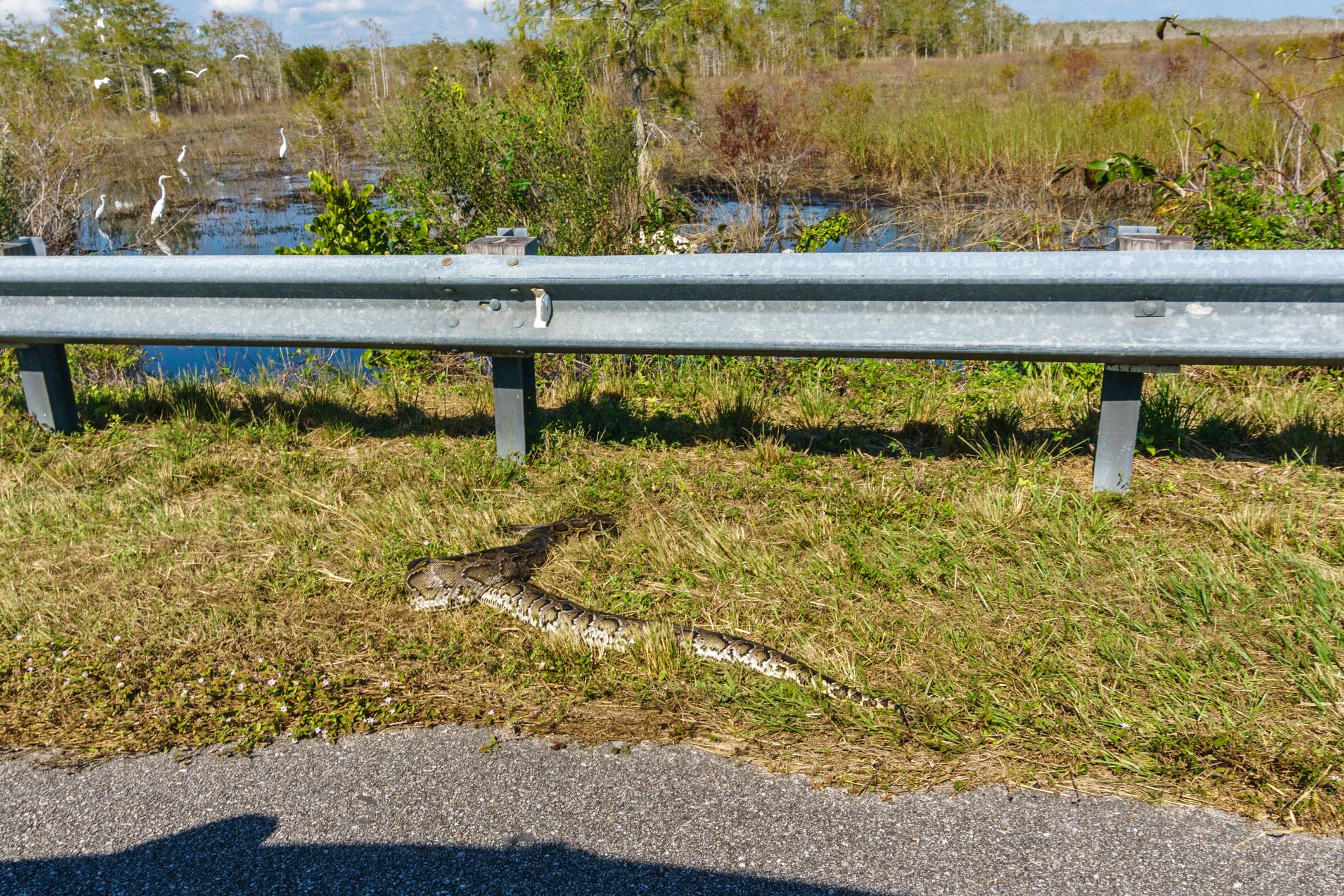
South Florida has a snake problem. The region is home to a significant population of wild Burmese pythons, an invasive species which preys on mammals and birds. Efforts to remove these pythons have mainly been focused on capturing as many as possible, rather than targeting specific snakes – but that might now change.
A new study by researchers at the University of Florida Institute of Food & Agricultural Sciences has developed a tool to help python-hunting contractors identify the snakes with the biggest influence on future population growth. The thinking behind it is that by removing high-breeding individuals, the longer-term effect will be far more impactful.
“Our previous work treated all Burmese pythons as contributing equally to the population but removing the biggest female we’ve ever caught is very different from removing a tiny snake that might not survive next year,” says quantitative ecologist Alex Romer, the study’s lead author.
- Burmese pythons are climbing trees in the swamps of Florida. These people tracked them to find out why
- A carnivore has moved into Florida's Everglades – and it's threatening native crocodiles and alligators
Florida’s population of Burmese pythons stems mainly from the 20th century boom in the exotic pet trade. Many either escaped or were released by owners unable or unwilling to care for them. Today, an estimate from the US Geological Survey suggests there are tens of thousands of Burmese pythons in the Greater Everglades region alone. The snakes are nonvenomous but can grow to lengths of 4.5m (15ft) or more and often eat native species of conservation concern.
To combat this situation, researchers on the study have developed a Weighted Removal Index (WRI) tool, which assigns an ecological value to each python captured. “The idea is that a big female might be worth 100 arbitrary ecological points, while a little snake might be worth five,” explains Romer. “That tells you how many little snakes you would need to catch before you’ve had the same impact as removing a large female.”
- "That’s the length of a double decker bus!" 33ft monster tops biggest snakes in the world list
- Python vs viper: what's the difference between these two heavyweight snakes?
The hope is that Florida’s contracted python removal programs will benefit from using the WRI tool to measure the impact of each removal, with their work becoming more structured and effective in the process.
The study also found that removal efforts can be more fruitful at certain times of year. Fewer snakes are generally caught in January and February, for example, but those that are have a higher likelihood of being mature males and females. “If you just count how many pythons contractors catch, January and February don’t seem that important,” continues Romer. “But when you add in the demographic weighting, suddenly those months look a lot more important.”
Find out more about the study, published in Ecological Applications.
More wildlife stories from around the world
- There is only one place on Earth where crocodiles and alligators live together in the wild – and it's here
- More than 1,000 rattlesnakes caught in Michigan wetlands. What scientists find in their DNA is concerning
- Remote camera catches bobcat attacking biggest rattlesnake species on Earth
- This US shoreline hosts one of Earth's largest shark gatherings. Aerial images just revealed something worrying
Top image: Everglades, Florida. Credit: Kevin Fleming/Getty Images


