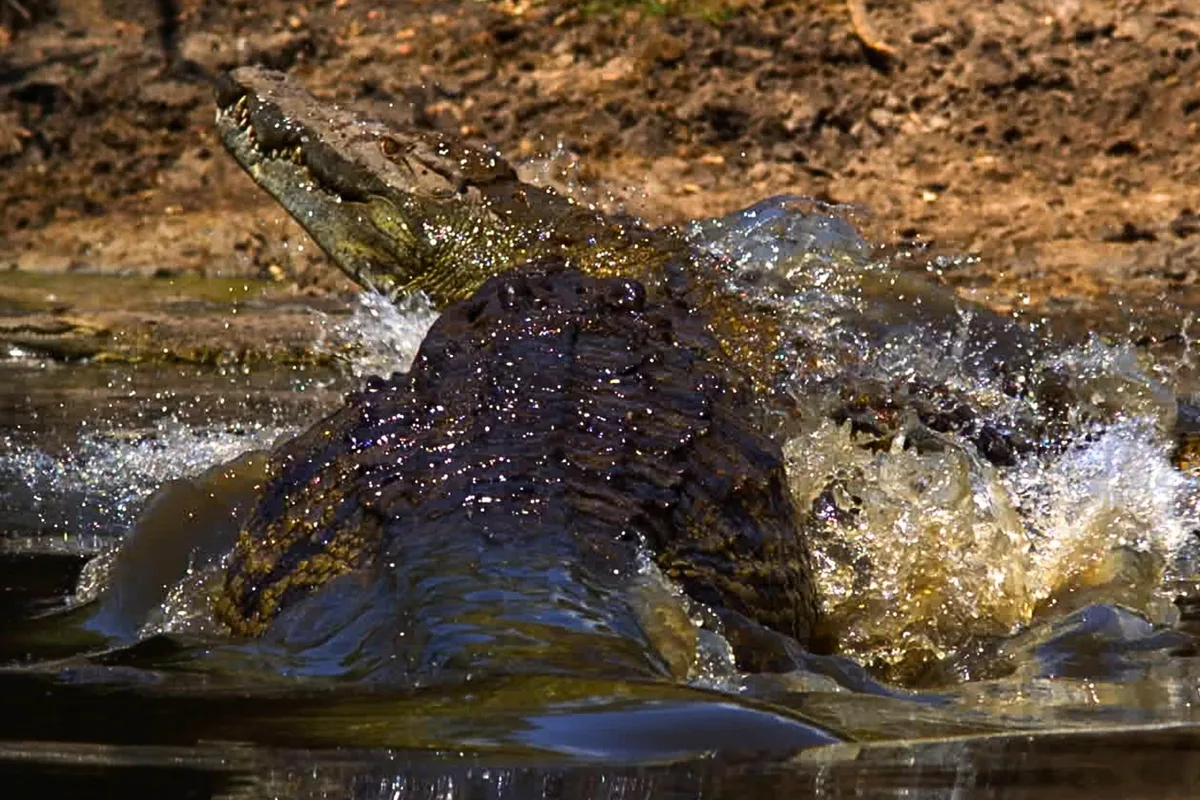
When captive-reared saltwater crocodiles are released into the wild, they stay in the local area and don’t wander back to their former home. The finding, revealed in Wildlife Research, can now be used to assist with conservation practices.
They say home is where the heart is, but it’s also often a place of safety and resources. Most animals show small scale homing behaviours, like returning to a nest or burrow after a foraging trip, whilst others undertake long journeys that can last months.
Crocodiles are particularly good at finding their way home. When wild caught individuals are translocated from their original habitat to a new location, they make great strides to return. “What we still don’t fully understand, though, is how this behaviour plays out in individuals that have been bred or kept in captivity for long periods before being released back into the wild,” says Ru Somaweera from Murdoch University.
- Staggering crocodile photos reveal just how ferocious these apex predators can be
- There is only one place on Earth where crocodiles and alligators live together in the wild – and it's here

To find out, the team studied the fate of five tagged saltwater crocodiles who were released into the Sundarbans mangrove forest in Bangladesh (one of the world's largest mangrove forests) and tracked over several months.
Three of them – Juliet, Madhu and Potia – had been kept in captivity for over eight years before they were released into the wild more than 25km from their former homes. The reptiles showed no evidence of trying to go back to their breeding facility. Instead, they settled into small, local, well-defined areas.
The animals moved in a similar way to a fourth crocodile, Harbaria, who was captured from the Sundarbans at night and then released back into the same spot in the morning. Because the movement patterns of captive and wild crocs were similar, it suggests that captive crocs could “adapt to their new environment seamlessly,” Somaweera says.

The fifth crocodile was more of a mover. Jongra was captured from a village in Shariatpur in 2022, held in semi-natural conditions for 16 months, and then released into the Sundarbans, 130km away from his original capture location. As expected, this translocated individual covered a lot of ground, even recording single-day movements of over 30km. These are typical signs of homing behaviour.
So, the study hints that whilst translocated crocodiles retain the urge to head home, captive-reared crocodiles are more likely to settle into carefully chosen release sites. “The findings suggest that releasing subadult and adult captive-reared crocodiles can be a viable strategy to strengthen wild populations,” says Somaweera.
Top image: Khulna District in the Sundarbans, Bangladesh, where the study took place
More wildlife stories from around the world
- Extraordinary footage shows female tiger carrying newborn cubs up a cliff in India
- A venomous pit viper has been hiding in China's misty mountains
- Staggering drone images show three colossal 'whales' rising from a forest in Thailand
- Black wolf snake discovered on remote Indian island. It's over a metre long and eats other reptiles