
Like gold, diamonds, and other gemstones, fossils are a hot commodity amongst the obscenely rich. These prehistoric relics sell for millions at auctions, and it’s those belonging to iconic dinosaurs like T.rex, Stegosaurus, and Triceratops that typically fetch the highest prices.
When did the fossil trade begin?
Even before fossils were recognised for what they are - preserved animal/plant remains - they were traded. From prehistoric peoples to Ancient Greeks and Romans, humans throughout history have collected fossils, incorporated them into jewellery (and tools), and traded them.
After the discovery of dinosaurs in the early 19th century, this fascination in fossils evolved into a global commercial enterprise.
From 1877 to 1892, palaeontological rivals Edward Drinker Cope and Othniel Charles Marsh paid fossil hunters top dollar to uncover new species - not to mention sabotage each other’s digs in the process. This period of palaeontological history became known as the ‘Bone Wars’ and it fueled both public and commercial interest in dinosaurs. It also helped drive continued fossil excavation across North America throughout the following century, cementing the region’s status as the epicentre of dinosaur discoveries.
A long history of excavation in this part of the world has unearthed some truly breathtaking specimens, many of which are known by affectionate nicknames and have ultimately found their way onto the fossil market. In fact, the 10 most expensive fossils ever sold were all discovered in the United States!
- Fossil poo, fossil vomit, fossil penis... World's 10 weirdest fossils that will have you scratching your head
- How many species of dinosaurs were there on the planet?
What are the most expensive fossils ever sold?
“293 Trinity” - T.rex - $6.2 million

In 2023, a 50% complete skeleton of a T.rex was sold to a private buyer at an auction house in Zurich, Switzerland. This marked the first time that a T.rex had ever been auctioned in Europe, and selling for $6.2 million (or £5 million) it became the 10th most expensive fossil ever sold.
The name of this particular specimen is derived from the fact that it’s made up of 293 bones. However, unlike other specimens on this list, “293 Trinity” is a composite composed of bones from three different individuals. These individuals were found at sites in Montana and Wyoming, Northern United States, between 2008 and 2013.
- 7 animals that could kill the deadliest predator that ever lived - the infamous T.rex
- T.rex had absolutely tiny arms. We may finally know why – and it's all to do with its massive head
“Vulcan” - Apatosaurus - $6.4 million
The largest dinosaur ever auctioned may not have come with the biggest price tag attached, but selling for $6.4 million dollars it makes this list as the 9th most expensive fossil ever sold.
“Vulcan” is a 150-million-year-old Apatosaurus that is remarkably complete - as much as 80% of its skeleton has been preserved! This 21m-long, 22 ton behemoth was discovered in 2018 in Wyoming and was later sold in 2024 at an auction house just outside of Paris, France.
After purchasing “Vulcan”, the anonymous buyer lent its skeleton to the Pairi Daiza zoo in Brugelette, Belgium, where it’s currently on public display and remains accessible for researchers to study it.
- Could we have farmed dinosaurs? Meet the tastiest dinosaurs that could have ended up on our plates – had we lived alongside them…
- “It’s extraordinary”: Australia’s oldest ever dinosaur fossil found in Brisbane
“Big John” - Triceratops - $7.7 million

Named after the owner of the private ranch where it was found in Mud Butte, South Dakota, “Big John” is the most expensive Triceratops ever sold. It’s also considered one of, if not the largest Triceratops ever found, measuring 8m in length - 2.62m of which is made up by its giant skull!
The skull of “Big John” bears a keyhole-shaped gouge that has been interpreted as a wound inflicted by another Triceratops, likely during a fight over territory or mates. A close examination of this wound during a 2022 study revealed that it showed signs of healing, suggesting “Big John” lived to fight another day after this feisty encounter with a rival.
- T.rex vs triceratops – who would win in a fight between these two prehistoric giants?
- Millions of years old and still here... What exactly is a living fossil?
“Sue” - T.rex - $8.3 million

Most dinosaur fans have heard of the T.rex known as “Sue”. As well as being one of the largest, most complete specimens of its kind ever found - with more than 90% of its skeleton preserved - it’s also famous for being at the centre of a legal dispute that lasted nearly a decade, involved the FBI, and resulted in a palaeontologist being sentenced to two years in prison.
In 1997, following a lengthy civil case that ultimately ruled landowner Maurice Williams was the rightful owner of “Sue”, rather than the paleontologists who discovered her, the skeleton was put up for auction.
- Imagine if dinosaurs hadn't gone extinct. Here's what scientists think may have happened next
- Were dinosaurs actually good parents – and how do we know? The astonishing clues they left behind
With financial help from the California State University system, Walt Disney Parks and Resorts, and McDonald’s, the Field Museum of Natural History in Chicago placed a winning bid of $7.6 million. The final cost of “Sue” reached $8.3 million, making it the most expensive fossil ever sold at the time.
“Sue” is now a permanent feature at the Field Museum and one of the only specimens on this list not under private ownership.
Unnamed Allosaurus - $10.6 million
At an auction hosted by Christie’s in London in late 2024, businessman Su Binghai purchased two well-preserved Allosaurus skeletons - one adult and one juvenile - for a combined sum of $10.6 million. He also purchased the skeleton of a Stegosaurus for $5.4 million at the same auction.
These Jurassic-aged fossils, discovered at the same site in Carbon County, Wyoming, were later confiscated by UK authorities under the Proceeds of Crime Act after a civil recovery investigation.
The National Crime Agency gave no details of the allegations against Su Binghai, though they have clarified the skeletons are currently being held in a secure London storehouse while the agency prepares to sell them.
- "It stood nearly 20m tall, measured 40m from head to tail, and tipped the scales at a whopping 80 tons..." Could humans live alongside dinosaurs?
- 10 deadliest, death-dealing dinosaurs to have ever roamed the Earth: we rate these ultimate killing machines
“Hector” - Deinonychus - $12.4 million
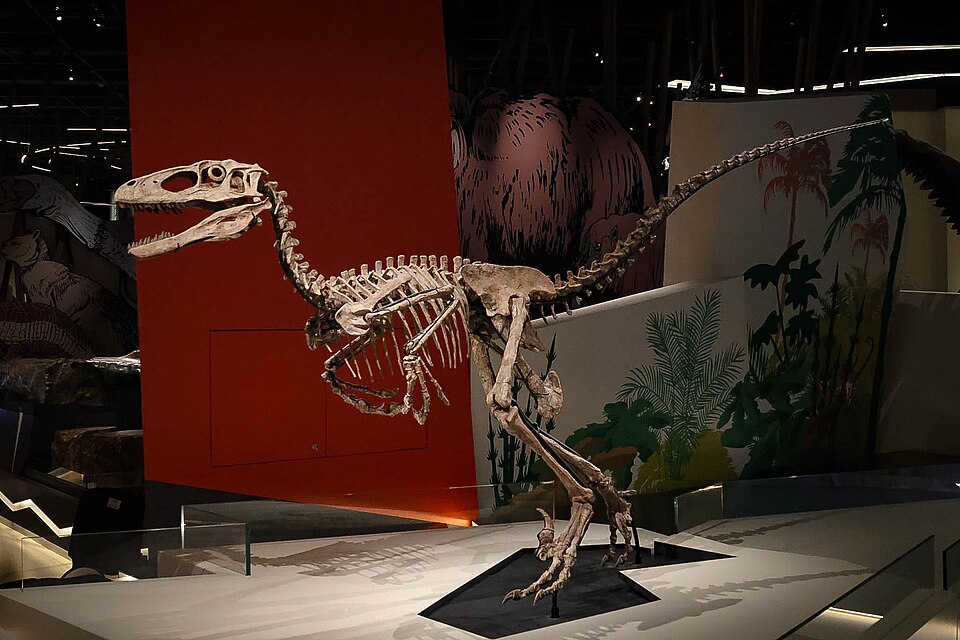
Deinonychus is a larger cousin of Velociraptor and widely regarded as the inspiration behind the oversized Velociraptorsthat serve as the cunning antagonists in Jurassic Park.
In 2022, a 50% complete Deinonychus known as “Hector” was sold at an auction in New York for $12.4 million. It was excavated from private land in Wolf Creek Canyon, Montana, from 2012 to 2014 and has been held by private parties since its discovery.
From 2020 to 2021, “Hector” was on display at the Natural History Museum of Denmark as part of an exhibition titled King of Dinosaurs.
Juvenile Ceratosaurus - $30.5 million
Only four Ceratosaurus specimens are currently known to exist, which no doubt contributed to the highly inflated price fetched by the only known juvenile specimen when it went to auction in New York in 2025. The unnamed specimen consists of 139 original bones, making it one of the most complete Ceratosaurus specimens ever discovered - if not the most complete.
- It weighed less than 1kg yet remarkably could reach terrifying speeds of 65km/h: Meet 10 fastest, speediest dinosaurs on the planet
- 10 weirdest dinosaurs ever, from a crazed two-legged hedgehog look-a-like to one that resembled a cross between a duck, camel and giant sloth
From 2000 to 2024, this exceptionally preserved Ceratosaurus was on display at the Museum of Ancient Life at Thanksgiving Point in Lehi, Utah. However, it was later de-accessioned and sold privately to Brock Sisson, a former museum employee who mounted and prepared the skeleton for auction.
Despite facing fierce criticism, the museum defended the sale, stating the funds were necessary to protect their remaining collections.
“Stan” - T.rex - $31.8 million
While not quite as large nor as complete as “Sue”, “Stan” is still one of the largest and most complete T.rex specimens known, with more than 70% of its skeleton preserved.
In 2020, it was sold to a mysterious buyer at an auction in New York for $31.8 million - a then record-breaking fee. This sale sparked a lot of concern amongst palaeontologists, who were worried the exceptionally preserved specimen had been snapped up by a private buyer and was soon to be removed from the public eye.
These worries were eased in 2022 when it was revealed “Stan” was on its way to Abu Dhabi, United Arab Emirates, to be put on display at the city’s Natural History Museum, which opened to the public in late 2025.
“Apex” - Stegosaurus - $44.6 million
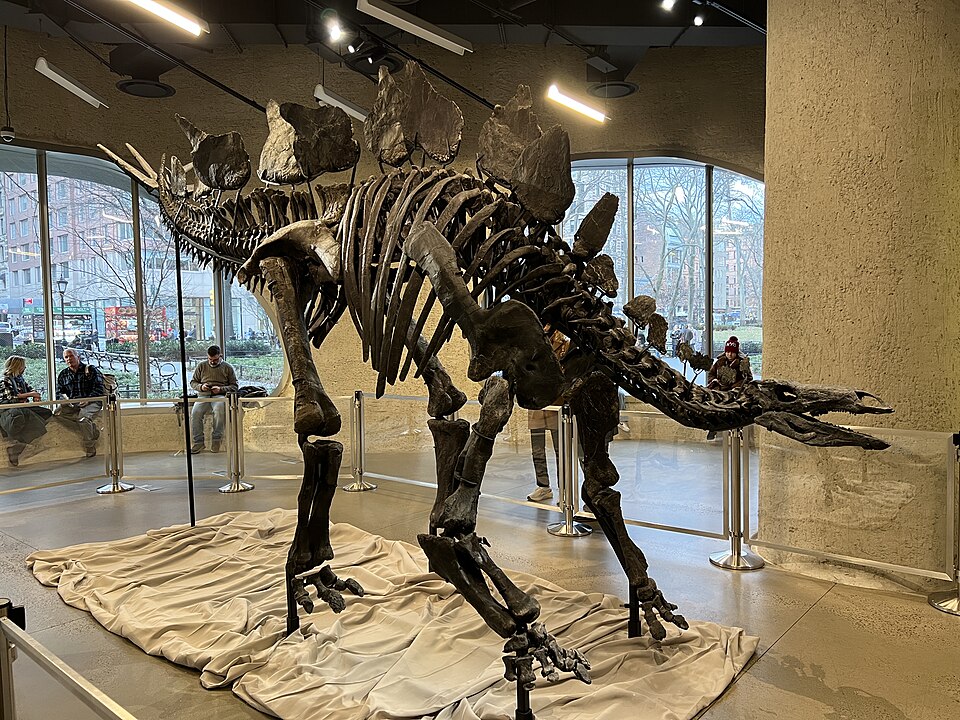
Not long after “Stan” was sold for a record-breaking fee, a Stegosaurus known as “Apex” set a new record as the most expensive fossil ever sold.
The skeleton is amongst the most complete of its kind ever found, with 254 out of approximately 319 bones preserved. It measures 3.4m in height and 8.2m in length, making it roughly the size of a single-decker bus!
- Not all dinosaurs laid the same type of egg – here’s how we know
- Why did dinosaurs have horns and spikes?
“Apex” was bought by billionaire Kenneth Griffin, founder and CEO of the hedge fund Citadel. After purchasing the remarkable skeleton, Griffin lent it to the American Museum of Natural History where it has been displayed since late 2024. “Apex” will remain on display and be accessible to researchers until late 2028.
“Gus” - T.rex - $50.1 million
In July 2026, a new record was set when a T.rex specimen known as “Gus” went under the hammer for an eye-watering $50.1 million - more than a luxury penthouse on Billionaires' Row in New York!
This skeleton is reportedly one of the largest and most complete T.rex specimens ever discovered, similar in size and preservation quality to “Sue” and “Stan”.
“Gus” was excavated in 2021 in Harding County, South Dakota. It’s named after Gary “Gus” Licking, the owner of the land where the bones were discovered.
The winning bidder is yet to be disclosed, so it’s unknown whether “Gus” went to a private collector to be kept behind closed doors, or whether it will eventually be loaned to a museum for public display.
Why are many palaeontologists against private ownership of fossils?
While the high-end commercial trade of dinosaurs may increase public interest in a long-extinct group of animals and encourage landowners to open up their land for researchers to excavate, most palaeontologists are against the selling of scientifically important fossils to private collectors.
There are several different reasons for this, chiefly that science requires reproducibility.
If a privately owned fossil disappears behind closed doors, previous studies on it cannot be verified by other institutions. It also can’t be re-examined using new, emerging technologies. For this reason alone, many leading scientific journals refuse to publish studies on privately owned specimens, including those that are ‘on loan’ to museums for a limited time.
The rising price of dinosaurs is also putting them increasingly out of reach for museums, which have historically acquired specimens from private collectors, ensuring they are properly stored and made accessible to researchers and the public.
Another reason why many palaeontologists object to private ownership is because of commercial excavation practices. These are often motivated by profit, with little to no consideration for the geological and environmental context surrounding a fossil - information that can be just as valuable as the fossil itself.
This is not to say that palaeontologists oppose all private fossil collecting, though. In fact, collaboration with ethical amateur collectors has led to many scientifically significant discoveries, and palaeontologists generally encourage cooperation between members of the public and academic institutions.
Some palaeontologists also recognise that commercial excavation can have several benefits, such as recovering specimens from land that would otherwise erode and be lost to nature forever.
top image: Detail of a fossil Ichthyosaurus. CorbalanStudio/ Getty Images.
Discover more wildlife stories from around the world:


