
Sperm whales and pygmy sperm whales are known for their unusually shaped heads – but a study of a fossil skull from a long-extinct species of pygmy sperm whale has now revealed something far more unusual.
- Experts tested whales’ teeth for nuclear fallout – and accidentally found the oldest killer whale on record
- Whale experts studied the noises of this isolated population – and discovered something incredibly human-like about them
The fossil, dating from between 6.3–5.6 million years ago, was found in the mid-1990s in the Pisco Formation of southern Peru. It belonged to a newly described species of whale – Scaphokogia huachafo. It measured around 2.7 metres long and shows the most extreme facial asymmetry known in any cetacean, and possibly any mammal, according to the findings published in the journal Communication Biology.
Unlike most vertebrates, toothed whales have asymmetrical skulls to accommodate for their highly specialised organs used for echolocation and sound production. But in S. huachafo, this asymmetry goes further, making for a truly bizarre animal.
“Both bony nostrils are shifted entirely to the left side of the skull, while the facial bones differ dramatically in size and position. The skull looks completely crooked,” says Aldo Benites-Palomino, lead author of the study and assistant professor at the University of Erlangen-Nuremberg in Germany.
When Benites-Palomino first started studying this strange fossil, the suspicion was that the specimen might have been flattened or twisted by sediment pressure over millions of years, resulting in the ‘crooked’ skull.
“But the sutures are fully closed, and there are no fractures, pathologies or deformations elsewhere on the skull. This was genuine biology, not a result of poor preservation,” he says.
- Why the sperm whale's head is built for ramming - and why ramming doesn't give them headaches
- "Balloons don’t get much bigger than a gas-filled whale": Just why do whales explode?
Anatomical adaptation
Living sperm whales hunt squid in the deep ocean – but the specialised anatomy of S. huachafo suggests this prehistoric species hunted in shallow coastal environments instead.
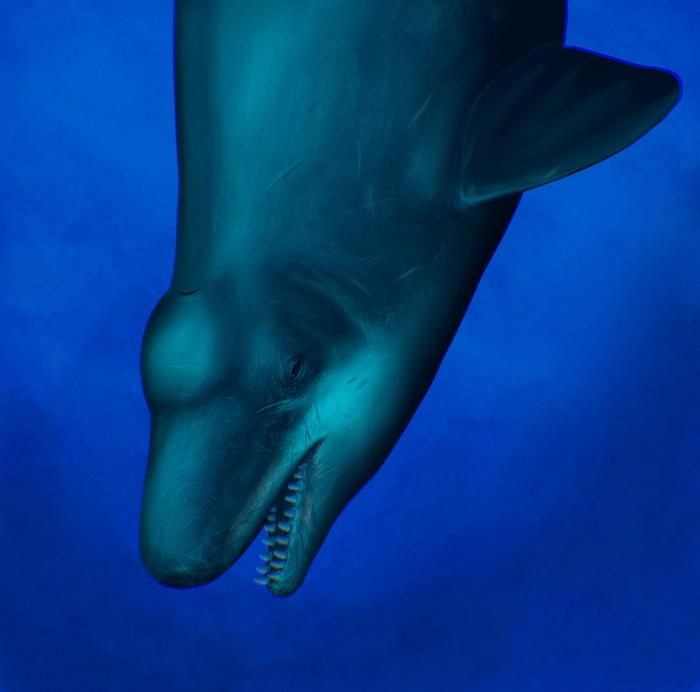
“The entire cranio-cervical complex is modified to point the snout directly toward the bottom,” explains Gabriel Aquirre-Fernandez, co-author of the study and doctoral advisor at the University of Zurich, Switzerland.
The whale’s snout, a thick and tubular structure reinforced with dense bone and cartilage, acted as a natural ballast, shifting the animal’s centre of gravity forward and downward. It was also angled downward by 31 degrees relative to the rest of the skull, and reconstructions of the neck joint showed that S. huachafo could bend its head down by as much as 55 degrees.
Most bottom-feeding marine mammals rely on vision and specialised facial structures to detect and acquire food – and since S. huachafo appears to lack those structures, the scientists propose that it evolved this unique combination of traits instead in order to move directly above the seabed and feed close to the sediment.
Read the full findings here.
Top image: the entire structure of the skull and neck of Scaphokogia huachafo was designed to point its snout directly toward the seafloor. Illustration credit: Jaime Bran Sarmiento


