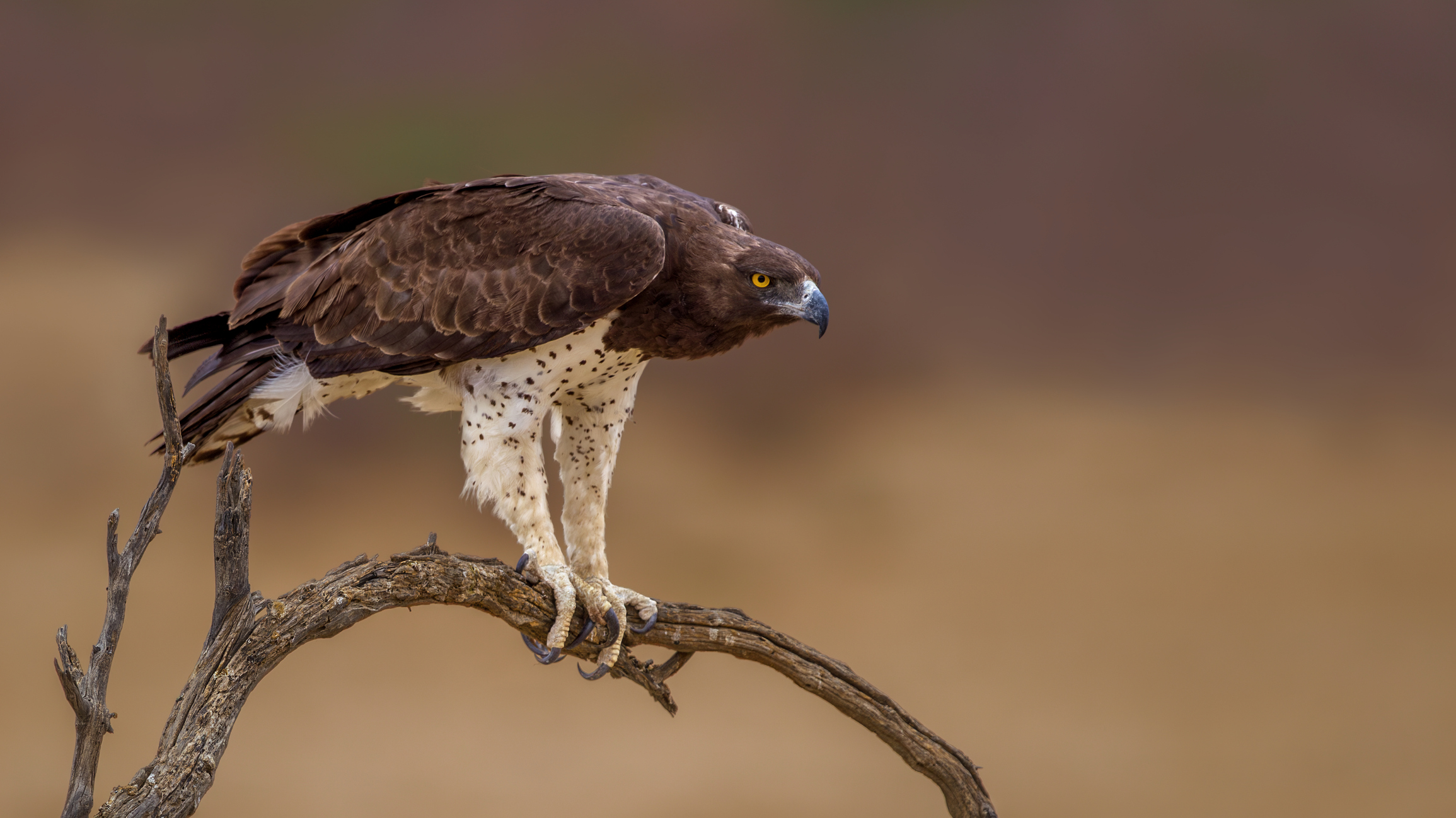
High above the African savannah, a formidable predator scans the landscape below. With piercing yellow eyes capable of spotting prey miles away, enormous wings and talons powerful enough to bring down a young antelope, the martial eagle is a master of the skies.
Africa’s largest eagle, this magnificent bird can tackle prey many times its own size, from monkeys and hares to young gazelles, swooping down with astonishing speed and precision. But despite its fearsome reputation, the martial eagle is fighting for survival.
- "Its talons are as long as a grizzly bear's claws and its legs are as thick as a child's wrist." 10 most formidable, powerful eagles on the planet
- Its legs are as thick as wrists and it's able to rip monkeys from branches with its deadly talons: Meet the world's most powerful bird
Where are martial eagles found?
Martial eagles range across more than 40 countries in sub-Saharan Africa, from Senegal and Ethiopia to South Africa. They favour open grasslands dotted with large trees, wooded savannas and scrubby, semi-arid landscapes, although they can also be found in forests along rivers.
These powerful hunters need wide, open spaces to search for prey, along with tall trees for perching and nesting. In areas where trees are scarce, they sometimes perch or even nest on electricity pylons. Despite their enormous range, martial eagles occur at low densities, with pairs occupying vast territories, and their populations are declining across much of Africa.
How big are martial eagles?
They are between 78–96 cm long, with a wingspan between 188–227cm. They weigh between 3–6.2 kg.
What do they eat and how do they hunt?
Martial eagles are formidable hunters with an astonishingly varied diet, from hares, snakes and monkeys to mongooses and young antelopes. Birds are also on the menu, including guineafowl, bustards and even other birds of prey. In Kenya, researchers discovered the remains of six spotted eagle-owls beneath a single martial eagle nest.
Armed with powerful talons and exceptionally sharp eyesight, these aerial predators soar high above the savannah, scanning for unsuspecting prey. Once a target is spotted, they may hover briefly before plunging into a spectacular, high-speed dive, reportedly reaching speeds of around 143 miles per hour before seizing their victim in their enormous talons and killing on impact.
- The world's deadliest-ever eagles, including a 18kg mighty, powerful raptor that terrified New Zealanders until its extinction in the 15th century
- Fierce, majestic – and built to kill – The world's biggest and mightiest birds of prey
- It weighed more than 2 tonnes and holds the record for the largest bird nest on the planet…
What is the life cycle of a martial eagle?
Pairs mate for life building enormous stick nests up to 1.5 metres wide, usually high in tall trees. Females are considerably larger than males and typically lay just one egg, incubating it for around 50 days while the male helps provide food.
Once the chick hatches, the male does most of the hunting while the female feeds and protects their offspring. The youngster takes its first flight at around 100 days old but remains dependent on its parents for several more months and remains in its territory for 8 to 12 months before heading out on its own. Breeding is slow, with pairs often raising just one chick every two years from the age of four or five.
Why are female martial eagles bigger than males?
Female martial eagles can be up to 50% heavier than males, a striking example of reverse sexual size dimorphism, where females are larger than their male counterparts. Scientists aren't entirely sure why this occurs in birds of prey but several theories exist.
One suggests that larger females are better equipped to defend their nests and protect vulnerable chicks, while smaller, more agile males are efficient hunters, particularly during breeding when they provide much of the food. The size difference may also allow pairs to target different prey, reducing competition for food and helping them raise their young successfully.
- 10 petrifying, humongous prehistoric beasts that would have utterly terrified early man, from a 3-metre tall primate to massive deadly eagles
- Dolly Parton helped save endangered bald eagles. Here’s how…
- Forest eagle finds goose eggs in nest. What happens next is staggering
Are Martial Eagles under threat?
Despite being among Africa's most powerful predators, martial eagles are fighting for survival. Classified as Endangered on the IUCN Red List, their numbers are declining alarmingly across much of sub-Saharan Africa. Scientists estimate that populations have fallen by more than 50% over three generations. One of their biggest threats is persecution by farmers who shoot or poison them in the mistaken belief that they pose a major threat to livestock. Others die after eating poisoned carcasses intended for predators such as lions and hyenas.
Habitat loss, expanding agriculture and collisions with power lines are also taking their toll. Even protected areas are not always safe, as these wide-ranging birds frequently venture beyond reserve boundaries. Their exceptionally slow breeding rate, with pairs typically producing just one chick every two years, makes recovery particularly difficult. Conservationists are calling for stronger protection, reduced poisoning and greater efforts to safeguard their habitats.
top image: Martial Eagle Clutching Monitor Lizard Prey, Zambia. Credit: Paul Souders/ Getty Images
Discover more bird stories from around the world:
- Purple is nature's rarest colour but purple animals do exist: 9 beautiful, incredible purple animals that look like they've been painted
- Against all odds, a quiet miracle has unfolded in the shadow of industrial chimneys
- ”It grabbed one from a stall, then wandered down the street – tentacles dangling from its beak”