
Shuffling through the damp leaf litter of Madagascar’s forests, the falanouc is one of the island’s strangest and least-known carnivores.
It looks a little like a mongoose but belongs to a different subfamily called Euplerinae, which also consists of the fossa and Malagasy civet. With long claws and an endearingly pointed snout, the falanouc is perfectly adapted for grubbing about for earthworms and other invertebrates under the cover of darkness.
- Meet the animals brave enough to hunt and devour the world’s deadliest, most venomous snakes
- This tiny, brave carnivore battles rival groups. Now researchers have discovered something astonishing about their defences
How many species are there?
There are two: the eastern falanouc (Eupleres goudotii) and the western falanouc (Eupleres major). Until fairly recently, the genus Eupleres was usually treated as containing a single species, Eupleres goudotii, with the western form classed as a subspecies, Eupleres goudotii major. In 2010, however, researchers Steve Goodman and Kristofer Helgen presented morphological evidence that the eastern and western forms are distinct, geographically separated species. This two-species treatment is now followed by the IUCN.
How big is the falanouc?
The falanouc weighs about 2–4kg and has a head and body length of about 45–65cm and a tail length of 22–25cm, making it larger than some people might expect for such a secretive and rarely seen animal.
What does the falanouc look like?
It has a small head with a pointed muzzle suited to nosing through leaf litter. The teeth are unusual for a carnivore: they are short, simple and uniform across the jaw, suited for munching on insects rather than slicing and crunching through flesh and bone. Its claws are long, strong and useful for digging. A wide, cylindrical tail stores fat for use during times of food scarcity.
The eastern falanouc is generally fawn-coloured above, with a paler underside. In the western falanouc, the male is usually brownish and the female greyer.
Where does the falanouc live?
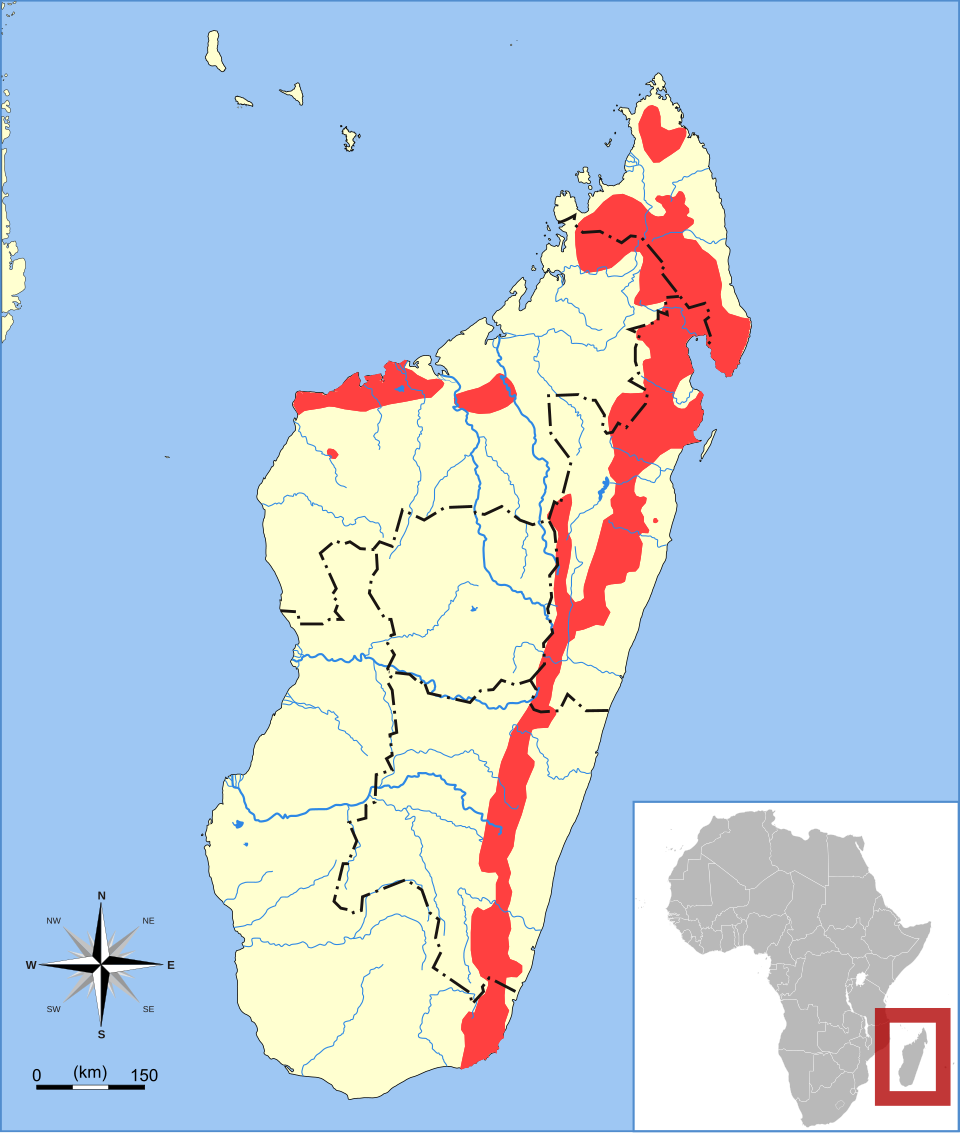
The falanouc is found only in Madagascar, an island famous for wildlife that occurs nowhere else. The eastern falanouc lives in eastern Madagascar, from Montagne d’Ambre in the far north to Andohahela and the banks of the Mandrare River in the south-east. It is mostly recorded living below 500m, although it has occasionally been found at elevations as high as 1,000m.
- These 14 incredible photos reveal the extraordinary diversity of wildlife in Madagascar
- “Complete intoxication.” Lemurs in Madagascar are licking millipedes – and it’s sending them into a “trancelike state”
The western falanouc has a smaller and less well-known range in north-western Madagascar. It occurs from near Baly Bay National Park north through the Ankarafantsika and Analalava forests to the Sambirano region, with possible records near Montagne d’Ambre. Its exact eastern limit is still uncertain.
What habitat does it prefer?
The eastern falanouc is associated with rainforest, as well as adjacent degraded, marshy or overgrown areas. The western falanouc is known to reside in dry deciduous forest, as well as the edges of wetlands and flooded palm savanna near dry forest. Both species are understood to be mostly solitary and defend large territories, the boundaries of which they mark with scent.
What does it eat?
Unusually among the order Carnivora, the falanouc specialises in feeding on small invertebrates – and in this way is similar to the aardwolf and sloth bear, for instance. Its diet consists largely of earthworms. It uses its elongated snout to search through soil and leaf litter, then digs for prey with its claws.
When is it active?
The eastern falanouc seems to be mainly crepuscular (active during the twilight period at dawn and dusk), although its activity can become more variable during the hot-dry season. The western falanouc is largely nocturnal, with some crepuscular activity.
How does it breed?
Relatively little is known about the falanouc’s breeding behaviour in the wild. Available accounts suggest that mating occurs in July and August, with young born between November and January. The female gives birth to one or two well-developed young, each weighing about 150g. The newborn’s eyes are already open, and within two days it can follow its mother as she forages. It is weaned at around nine weeks.
Does the falanouc face any threats?
Yes. The eastern falanouc is listed as Vulnerable by the IUCN, while the western falanouc is Endangered. Both are thought to be declining.
In eastern Madagascar, deforestation, illegal settlements, artisanal mining and rosewood logging have increased pressure on forest habitats. The eastern falanouc is also hunted for meat, and competition with and predation by feral cats and dogs poses another threat.
- It’s millions of years old, larger than California and home to creatures that exist nowhere else on Earth
- "First-of-its-kind event." Whale shark swims "astounding" 1,200km from Madagascar to Seychelles
For the western falanouc, information is scarcer, but the species occurs over a smaller area and much of its range is fragmented, degraded and densely occupied by people. It is exposed to hunting, charcoal production, logging and forest fires, as well as hunting with dogs.
The IUCN posits that hunting has increased as a result of reductions in governance and increased social instability following the coup d’etat in 2009.
Top image credit: Joseph Smit, Public domain, via Wikimedia Commons


