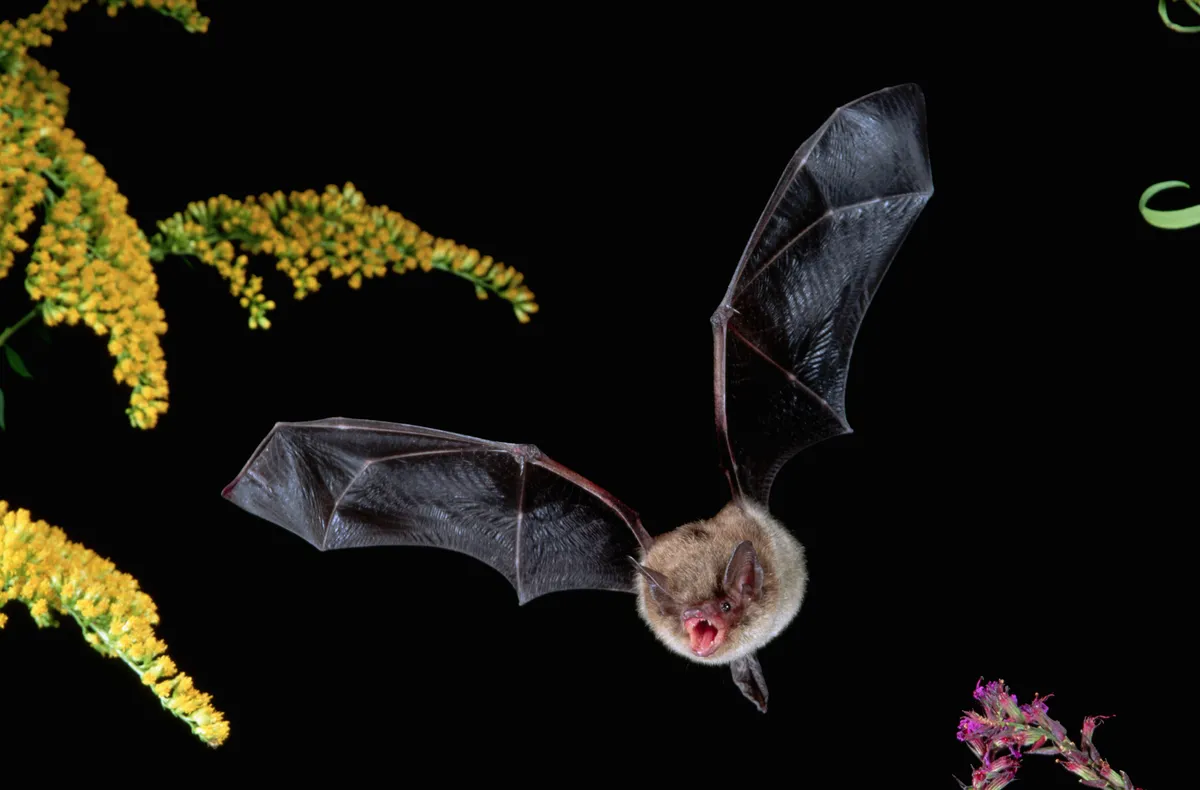
Deep in the cloud forests of Ecuador lives the tube-lipped nectar bat. Its claim to fame? It has a tongue that measures 1.5 times its body length – that’s the equivalent of a 3m tongue on a 2m-tall human.
- 20 meat-eating bats fitted with hi-tech backpacks. Scientists stunned to record them hunting like lions
- "It can carry Ebola, a nasty virus that causes bleeding from every orifice and is usually fatal." Meet the world's 7 deadliest bats, famous for carrying lethal diseases
Amazingly, the bat stores this massive organ inside its ribcage, thanks to years of evolution rerouting
its internal anatomy.
Why this extra-long appendage? The bat feeds on the Centropogon nigricans flower that hides its nectar at the bottom of a long, funnel-like bloom. Over time, the flower has evolved to be deeper to force the bat to press its face firmly against the petals and transfer more pollen to its fur. The bat’s tongue has evolved to keep pace.
This kind of mutual evolutionary pressure, where two species sculpt each other over time, is called coevolution, and the tube-lipped bat is one of the most dramatic examples. However, while the flower entirely relies on this bat species to reproduce, the bat is a generalist, also snacking on other types of flowers whenever it pleases.