With their large brains, whales are incredibly intelligent and many are highly skilled hunters. Some show their prowess by overpowering the largest fish in the ocean while others gobble down staggering volumes of prey at a time. Here are some of the whales that are among the most skilled predators in the ocean.
- Ocean's most powerful, ruthless killers: The world's top 9 marine predators that rule the waves
- 10 deadly, mind-blowing and simply ingenious ways whales and dolphins hunt and kill their prey – from bubble net fishing to wave washing
10 most powerful whales on the planet – are these the ocean’s smartest killers?
Killer whales

The ocean’s apex predator is, undoubtedly, the killer whale – even though they are, technically, a species of dolphin. These intelligent hunters have no natural predators – even great white sharks are no match for their cunning.
Offshore killer whales
Although orcas are classified as one species (Orcinus orca), there are various different forms, known as ecotypes. These distinct types of orcas have different appearances, genetics, vocalisations and diets. Because they specialise in different prey, they’ve each developed unique hunting abilities.
As their name suggests, offshore killer whales tend to be found far from the coastline so they’re less commonly seen by humans. These mysterious mammals eat a range of fish, including sharks. Some individuals even have worn down teeth from biting tough shark skin.
These killer whales have found an ingenious way to hunt the biggest fish in the sea – plankton-eating whale sharks – and even finish off great white sharks, slicing out their livers with incredible precision. Their secret? They flip these enormous sharks upside down to put them into a coma-like state called tonic immobility so they can consume their nutrient-rich livers without facing any resistance.
Transient killer whales
Transient orcas (also sometimes called Bigg’s killer whales) eat mammals. These crafty predators create waves to wash seals off the safety of the ice, toss them into the air, or drown them. One pod has even been seen gently tugging seals off the ice into the water, before letting it go, as a way of teaching their young how to hunt. Some mammal-eating killer whales have even learned how to beach themselves on purpose – in the hope of grabbing a sea lion on land – before letting the waves wash them back into the ocean. It’s a risky strategy and it doesn’t always work – if they time it wrong, they can be left stranded.
Transient pods have also been seen working together to kill humpback whales, blue whales and even trying to hunt sperm whales, which can be around twice their size.
Resident killer whales
Unlike the transients, resident orcas don’t eat mammals. Instead, their diet is focused on fish (but not typically sharks). Northern and southern residents – two distinct populations found in the northeastern Pacific and Pacific northwest, respectively – love Chinook salmon in particular, and find them using echolocation.
Scientists recently recorded northern resident killer whales teaming up with Pacific white-sided dolphins to hunt, something that had never been seen before.
Sperm whales

Another impressive hunter is the sperm whale. These enormous animals are the largest toothed whales on the planet so it makes sense that they target huge prey. In particular, they have a taste for the infamous creatures that inspired the legend of the Kraken: giant squid.
- Sperm whale guide: where they live, what they eat and why they are called sperm whales
- A moment of bliss: heartwarming drone footage captures sperm whale family playing in Mediterranean Sea
Brutal battles between these two foes take place in the darkness of the deep sea, sometimes well over 1,000m down where it’s almost impossible for sunlight to reach (the sperm whales use echolocation to find their prey in these inky black waters).
It’s hard for humans to know exactly what happens during these encounters. No-one has ever seen a sperm whale hunt a giant squid. But we can interpret the clues, like the overlapping circular shaped scars sometimes seen across sperm whales’ rostrum, which match up perfectly with the size and shape of giant squid suckers, or the squid beaks often found in the whales’ stomachs.
Grey whales

Gray whales take a different tack altogether. Rather than chasing down their prey and tearing into them (after all, like other baleen whales, they don’t have teeth), they dive face-first into their dinner.
- Gray whale guide: where they live, what they eat and why they're not named after the colour grey
- How do baleen whales eat so much when they don't have teeth?
When looking for food, grey whales sometimes do a headstand and hover in position while schmooshing their rostrum into the seafloor to suck up food from the mud (they like to eat small crustaceans, such as shrimp). Sometimes they also roll onto their side while slurping up their food from the substrate.
Narwhals
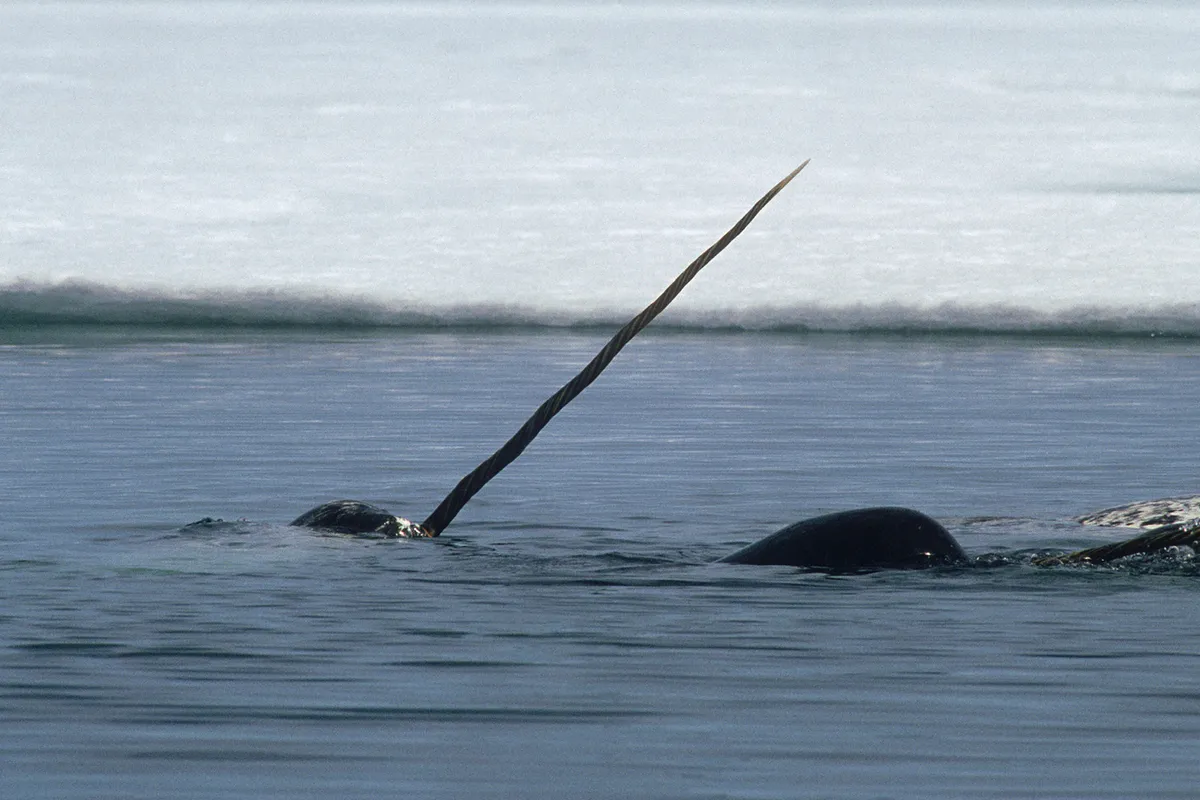
The narwhal’s iconic tusk might look like a unicorn’s horn (and did partly inspire illustrations of these mythical creatures) but it’s actually their only tooth. It twists around and protrudes through their upper lip.
These Arctic animals might use their tusk to sense the world around them or during play but it may also play a role in hunting. They’ve been seen sweeping their tusks through the water while foraging, probably to stun their prey so they can suck them up and swallow them whole.
Belugas
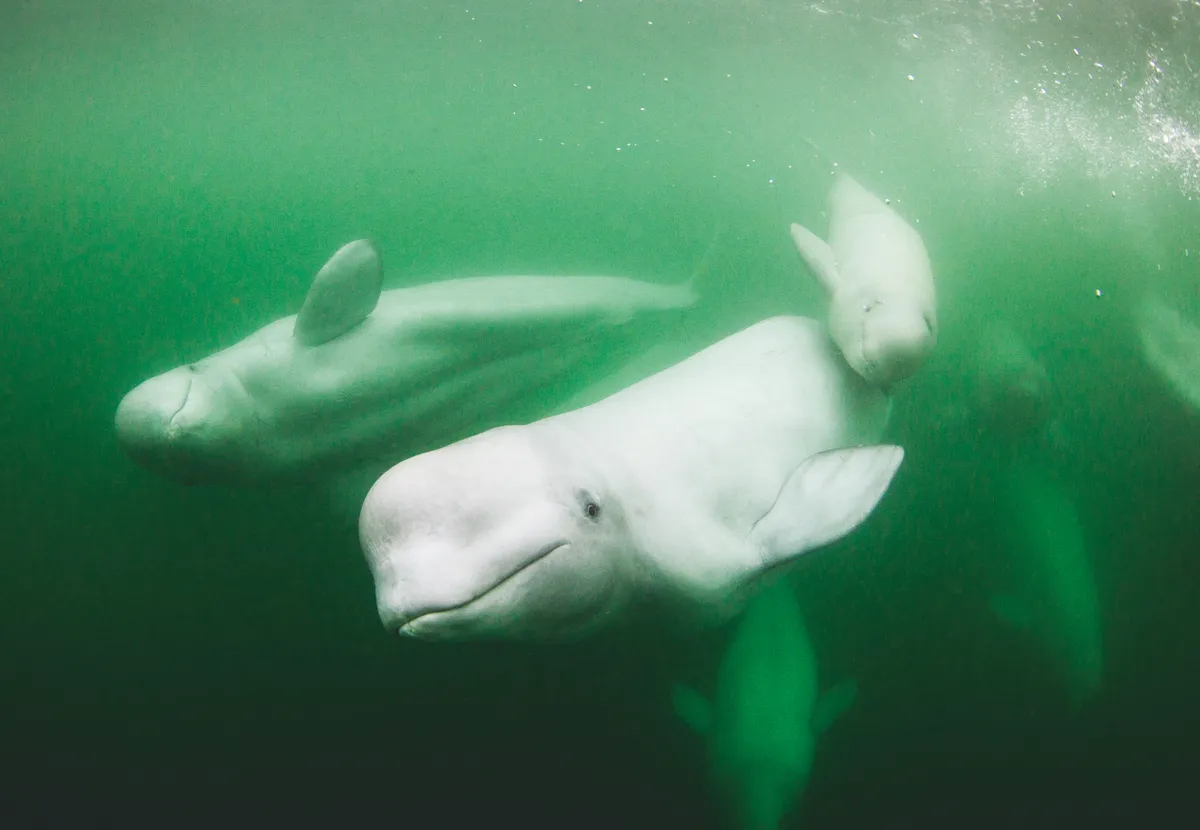
Like sperm whales and other toothed whales, belugas hunt using echolocation. They produce sequences of clicks and can work out what’s around them from the sound waves that return back to them after bouncing off other objects.
- It's weird looking, white, the length of a shipping container – and remarkably can swim backwards...
- “At 4am in the morning, the captain came to my door." What happened next blew this wildlife photographer away
But beluga whales have some other tricks up their sleeve. They have flexible necks because their vertebrae aren’t fused, which allows them to bend their head around in various directions while they’re hunting.
Although they do have teeth, belugas don’t chew their food. They use suction to gulp fish, such as cod or salmon, down whole while creating a seal with their tongue so they don’t swallow water with their meal.
Blue whales

If you judge predatory talent by the volume of food the animal eats, the winner has to be the blue whale. The shrimp-like krill they eat are shorter than a pen so they have to eat lots of them to get enough energy. A blue whale can chow down on up to four tonnes of krill in one day.
- Can any animal kill a blue whale? At 33 metres long and heavier than a Boeing 737, it is the largest creature ever to have lived
- At a staggering 33 metres long it's not only the biggest animal in the world today, it is the biggest animal to have ever lived...
Humpback whales

Another whale that uses its smarts to catch lots of food is the endearing humpback. Like other baleen whales, these animals eat plankton, krill and tiny fish. They take in huge mouthfuls of seawater then push the water out through their baleen plates, which act like a sieve and keep their prey inside their mouths so they can swallow them.
- Humpback whale guide: where they live, what they eat, how big they are and why they are called humpback
- Scientists stunned to see humpback whales trying to send messages to humans
Humpbacks use several clever strategies to get as much food as they can, such as lunge feeding when they put on a burst of speed and swim with their mouths open to catch as much food as they can. Perhaps their most famous tactic is bubble net feeding. This is when a group of humpback whales creates a curtain of bubbles to trap fish, herding them to the surface where there's no escape and all the humpbacks can feast.
Goose-beaked whales

Also known as Cuvier’s beaked whales, goose-beaked whales hold the record for the deepest diving mammal. In 2013, one individual was recorded diving to 2,992 metres, probably while hunting for deep-sea squid and octopus.
- Beaked whales are one of the strangest, rarest and deepest-diving marine mammals in the ocean - sometimes diving more than 2.5km down
- Whale vs dolphin: what's the difference between these mysterious denizens of the ocean?
- How does sound affect whales and dolphins?
- How do whales mate? For animals as big as whales, sex can be a tricky and lengthy affair - here's how they do it