Imagine an enclosed space the size of Wembley Stadium. Now imagine it underground with honey-coloured, 40-million-year-old limestone walls and roof and three natural skylights where sunshine pours in.
- It spans hundreds of kilometres underground, was completely unexplored until the 1960s and is home to a deadly fungal disease
- It’s large enough to swallow a skyscraper, wide enough to fly a jumbo jet through, and is filled with underground clouds and a river
That is Majlis al-Jinn, a cave in Oman with an enormous single chamber 310 metres by a 220 metres, with a ceiling rising to 120 metres, creating a space estimated at 4 million cubic metres, which is equivalent not just to the total capacity of Wembley but also to Swinsty Reservoir in North Yorkshire.
It was once regarded as the second-largest subterranean chamber in the world, but other discoveries have pushed it down the record list.
It’s also said you could fit 12 Boeing 747s within Majlis al-Jinn, though you’d have difficulty flying them in there because, according to this website, “the only evidence of [the cave’s] existence is a scant three openings that seem of no importance to the viewer.”
Where is the Majlis al-Jinn cave?
The cave is located in Oman’s Selma Plateau, mountains that rise to more than 2,000 metres above sea level.
How was the Majlis al-Jinn cave discovered?
It was discovered when American Don Davison was working as a hydrogeologist for the Omani Government and searching for underground bodies of water, which essentially involved exploring caves.
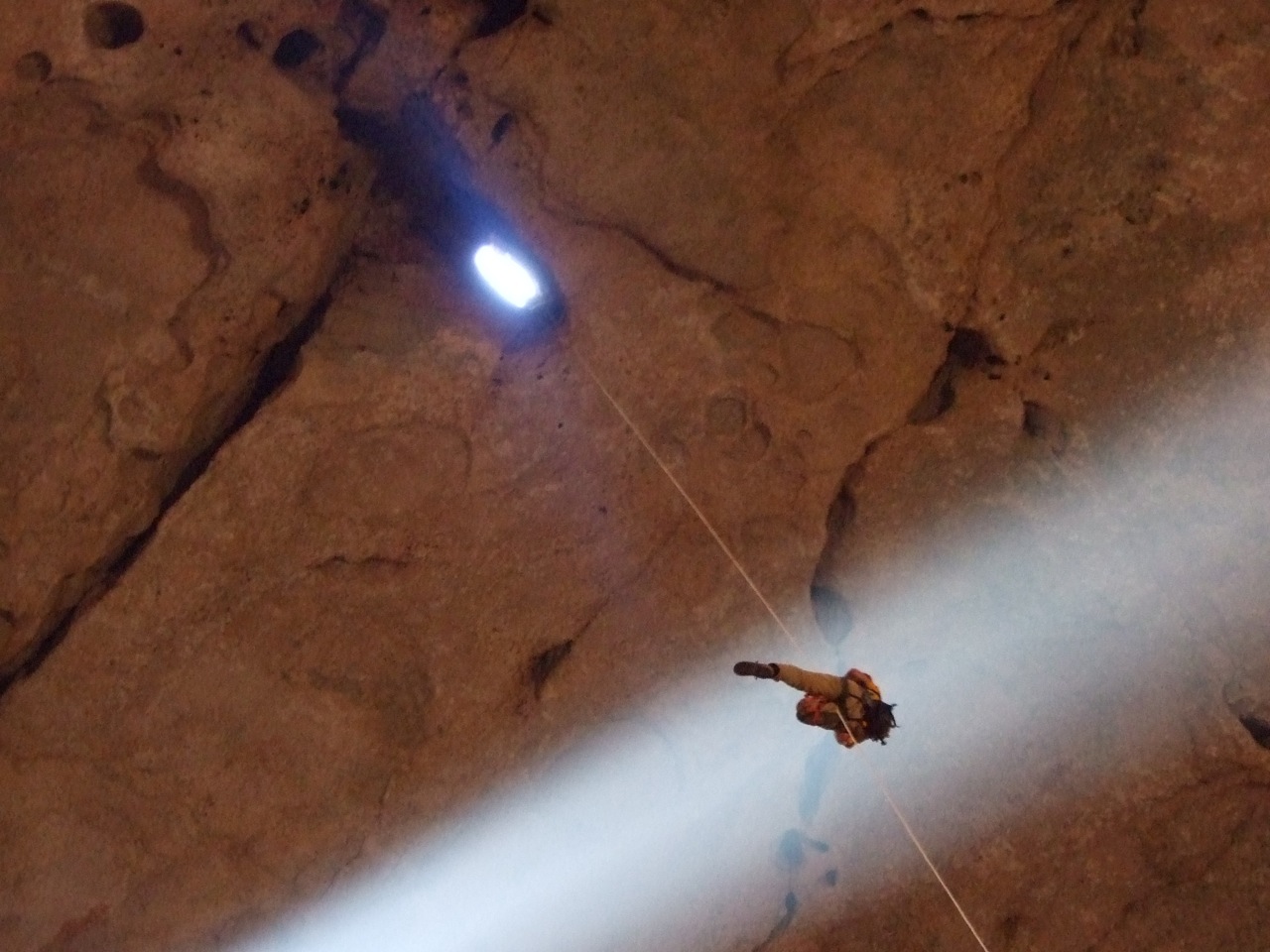
Entering Majlis al-Jinn involves abseiling a minimum of 120 metres down into the chamber, which means it is only accessible to experienced cavers, climbers or other people expert in rope work.
Don Davison describes his discovery of the cave in 1983 thus: “I pushed off from the overhang lip and began rappelling downward into the dark. A short distance down, the shaft opened out, and as I dropped lower, turning slowly midair on the rope, a stupendous panorama was revealed: this was by far the biggest cavern I had ever seen.”
Within the chamber, there is the bed of a shallow lake which is usually dry – the only time water collects in it is during rainstorms, which are rare. The temperature within the chamber is a constant and cool (compared to the desert heat above the surface) 17-18˚C.
It was Don and his wife Cheryl who gave the cave its name, Majlis al-Jinn, which means ‘The Meeting Room of the Spirits’.
If you wish to enter the Majlis al-Jinn, you will not only need suitable caving equipment and know how to use it, but also a 4WD vehicle to get you there and a permit.
What wildlife lives in the Majlis al-Jinn cave?
Unlike many other cave systems, there’s little in the way of interesting or unusual wildlife down here. Caver Jan Schreurs recalls seeing the cadavers of “unlucky goats, rather smelly” that fell through one of the entrance holes, while tracks indicate the presence of lizards and insects.
On his first descent, Davison landed at the bottom of the chamber besides the skeleton of a large snake, and later he describes how he found a piece of decaying wood, and turning it over revealed some white translucent pill bugs (wood lice).
He also came across a dry stream bed composed of sand and gravel and “mixed with myriad large and small bones... mute testimony that many other animals had not made the entrance drop quite as slowly as I.” Another track indicated a snake had passed that way, and there was also the carcass of a dead pigeon.
Another discovery made by Don Davison were “cave pearls” – small balls of calcite or calcium carbonate that form around sand grains or pieces of gravel. They grow steadily until reaching a maximum size of about 4cm in diameter. They are very similar to the pearls that form in oysters but they’re not shiny and have no economic value.
Top image: Majlis al Jinn - Climbers peer into the cave. Credit: Michaelmcandrew, CC BY-SA 3.0, via Wikimedia Commons