Once upon a time, one of America's great rivers was completely blocked by fallen trees. But this wasn't just a minor obstruction, the logjam was at least 250km long and lasted an incredible 900 years.
It was known as the Great Raft and it posed a challenge to pioneers and politicians in North America. But when it was finally removed in the 19th century, the unintended consequences were drastic and are still being paid for today, not least by the native people who had learned to live with the Great Raft and depend on it for their livelihood.
The Great Raft formed on the Red River, which was historically a tributary of the mighty Mississippi River. It was an incredibly dense, intricately entangled mass of timber including cottonwood, cypress and cedar and other debris many metres deep that blocked the entire river creating a massive natural dam.
Though the older organic matter at the downstream end of the Raft would decay and disintegrate, the entire structure was constantly replenished at a faster rate by fresh material arriving at the top end.
Historical and geological evidence suggests that the Great Raft began forming around 1100-1200AD – around the time of the Crusades. It may have begun due to an 'avulsion', a sudden change in the river's course due to climate change . This caused uprooted trees and chunks of riverbank to fall into the river and become the Raft's building blocks.
Over time, the Raft became so dense it was possible to walk across it in any direction without getting your feet wet. The dam effect caused water levels to rise and silt to build up above and around the Raft, creating raised river banks, slow-moving creeks and streams called bayous and Caddo Lake and Cross Lake – collectively the Great Raft Lakes.
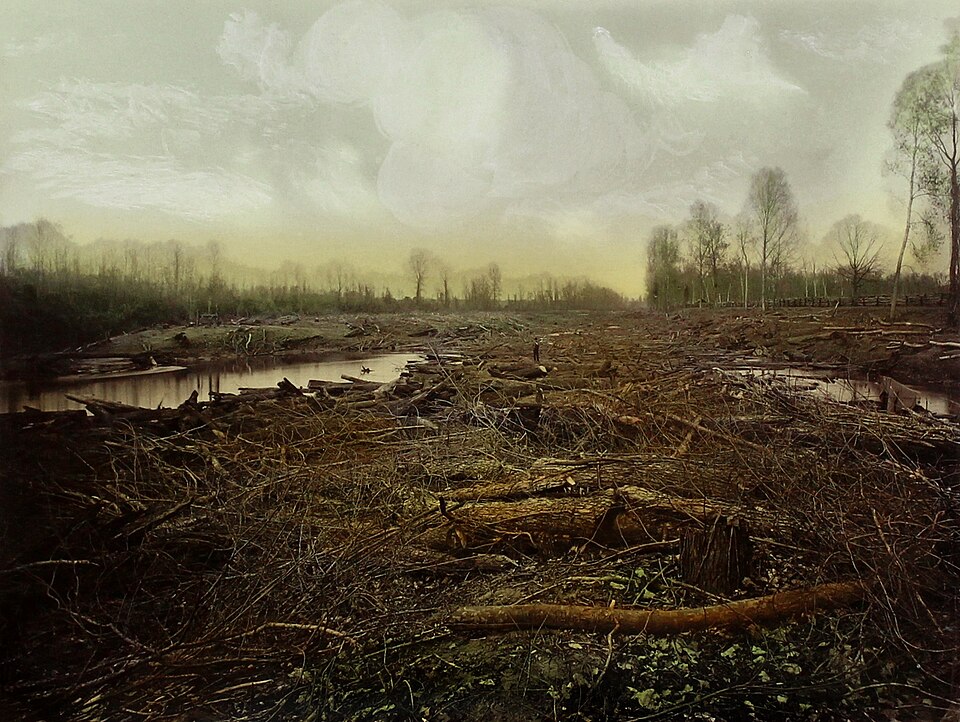
Instead of a single course, the river became a braided web of channels with vegetated islands. All of this created refuges for insects, amphibians and fish — especially salmon. It was also home to innumerable wetland birds.
For the native Caddo people, the Raft was viewed as a positive living entity that had a huge impact on their lives. They lived by its rhythms and could navigate pathways through it. They also understood its role in flooding land and replenishing natural soil fertility for their crops of squash, corn and beans. Much of what we know of the Raft's early history comes from its significance in the Caddo's oral history.
The dam was viewed less favourably by European explorers and settlers. In 1691, centuries before American independence, the Spanish governor of Texas, Domingo Terán de los Rios, was among the first to report on the logjam as a barrier to exploration and trade. French explorer Bénard de la Harpe led an expedition up the Red River in 1718 and also noted the presence of the Raft and the difficulties it posed.
- The Colorado River vanished for 5 million years. Scientists may have just figured out where it went
- This river contains around 500 deadly saltwater crocodiles. It’s just been approved for the rowing and canoeing events at the Brisbane Olympics
By the early 19th century, the Raft had become a pressing national issue for the new United States where rivers were vital arteries for development and colonisation. President Thomas Jefferson dispatched explorers to report on the logjam but it wasn't until the 1830s that something was done. Visionary river engineer Captain Henry Miller Shreve was tasked with improving navigation and, despite delays in funding, began work in 1833.
To remove the logjam, he invented the Snagboat, a powerful double-hulled steam-powered vessel with massive lifting apparatus in its bow, like a huge metal jaw. Dubbed 'Uncle Sam's Toothpullers' the snagboats worked at the bottom end of the logjam and, by 1838, had removed much of the Raft from the lower part of the river.
It was hard, grim work and Miller's team of 150 men were decimated by malaria, dysentery and yellow fever. The town of Shreveport grew up around this time as a base for the work.
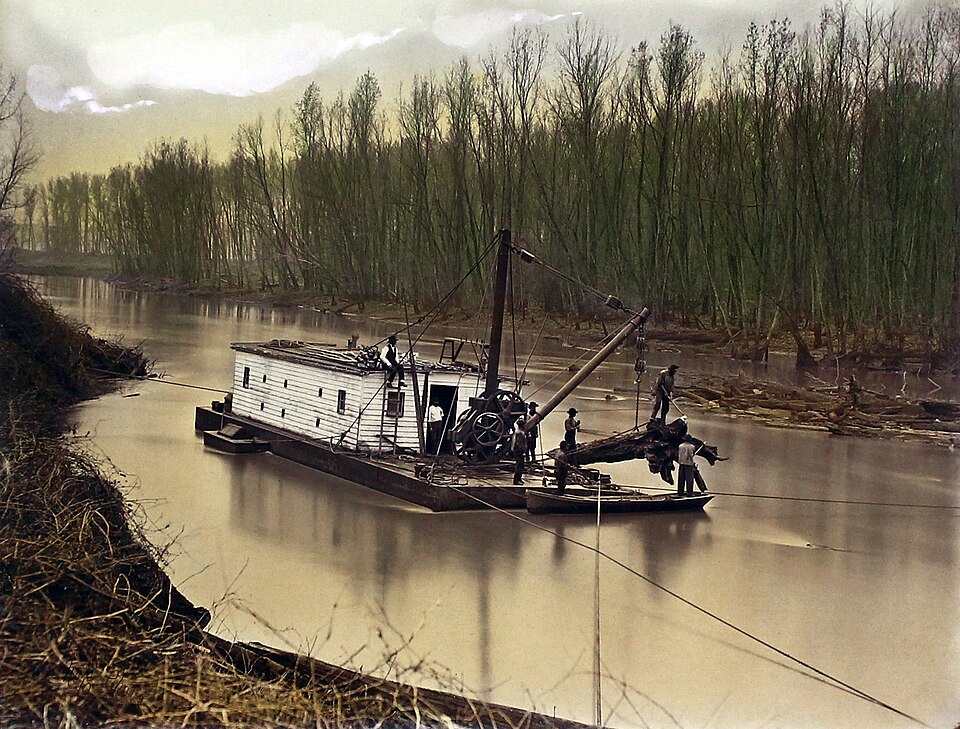
Despite Shreve's succees, Congress failed to fund ongoing maintenance and within a few years the logjam in the upper river had grown considerably. It became known as the Second Great Raft and was only removed in the 1870s by workers led by Lieutenant Eugene Woodruff who deployed a new technology: dynamite.
Woodruff's work was decisive and the Red River became fully navigable. But the unforeseen consequences were dramatic and costly. Firstly, the loss of the Great Raft deprived the Caddo people of their livelihood and many settlements were abandoned. The Great Raft Lakes shrank and the communities that had built up around them, including Jefferson, Texas, were no longer economically viable. Vast intricate wildlife-rich wetlands were lost.
- Could a 2m river monster with an enormous head, fearsome teeth and a body shaped like an 'elongated pig', have started preying on humans?
- The 'Great Texas Freeze' killed thousands of beloved songbirds. Scientists are worried about what might happen next
- East River DNA reveals secrets of life (and death) in New York
Worse still, the massive increase in overall waterflow from the Red River to the Mississippi meant that the Atchafalaya River, which acts as an outflow of the Mississippi and an aquatic shortcut to the Gulf of Mexico, began to receive more and more water. Soon it was feared the great Mississippi would perform an avulsion and change course to the Atchafalaya, with devastating consequences for millions living downstream, such as in the city of New Orleans.
To combat this, Congress approved the building of the Old River Control System (ORCS) in the 1950s, a massive series of dams and sluices, which control the flow of water between the Atchafalaya and the Mississippi – maintaining a steady 30-70% division of water respectively. But ORCS cost billions and, despite opening in 1963, continues to cost the American taxpayer a vast sum on a daily basis to battle the river's immense power.
The removal of the Great Raft and the various negative outcomes reveals the expensive consequences of interfering with a complex natural system. More recently, scientists have found that rafts of debris and logjams were once common on many major river systems, including throughout Europe, and may be an entirely natural element of a river's life.
While most these are thought to have been removed by prehistoric communities, modern river management often includes adding woody debris to rivers to add ecological complexity and help control water flow and flooding.
top image: View of the Mississippi river from town of Natchez in Mississippi. Credit: BackyardProduction/ Getty Images
More wildlife stories from around the world:
- It's over 75 million years old and like something out of a fantasy video game with outlandish giant mushrooms, fairy chimneys and an alien throne.
- Drowned at the end of the Ice Age: The flooded abyss longer than the Grand Canyon and teeming with hundreds of creatures, from mammals to reptiles
- It’s taller than the Statue of Liberty, older than the Roman Empire –and faces a deadly threat