
Here’s proof that lessons can be learned from a load of pants. In 2021, a group of volunteers buried more than 2,000 pairs of cotton underpants and 12,000 teabags in 1,000 locations around Switzerland, to monitor how quickly the items decomposed in different soil types. The newly published results contain valuable data about soil health, showing that private garden beds tend to hold the most biologically active soil of all.
- Scientists looked beneath one of oldest trees on Earth. What they found is astounding
- 10 strange underground animals that live beneath our feet
Life is all around us – but mostly under our feet. It’s estimated that more than half of all global biodiversity exists underground, although some soils are considerably more organism-rich than others. The aim of citizen science project Beweisstück Unterhose (Proof by Underpants) was to show the relative biological abundance of different soil types, on the basis that cotton breaks down more quickly in soil where the organisms (earthworms, fungi, bacteria etc) are most active.
The 1,000 volunteers involved in the study – which was run by the University of Zurich and a Swiss federal agricultural research body – dug holes of roughly 60 x 30 x 30cm, each burying two new pairs of organic men’s white briefs and twelve nonwoven polypropylene teabags. The chosen sites were mainly in well-populated, non-mountainous areas. One pair of the interred pants and six teabags were taken out after 30 days, with the second pair and the remaining six teabags removed after 60 days.
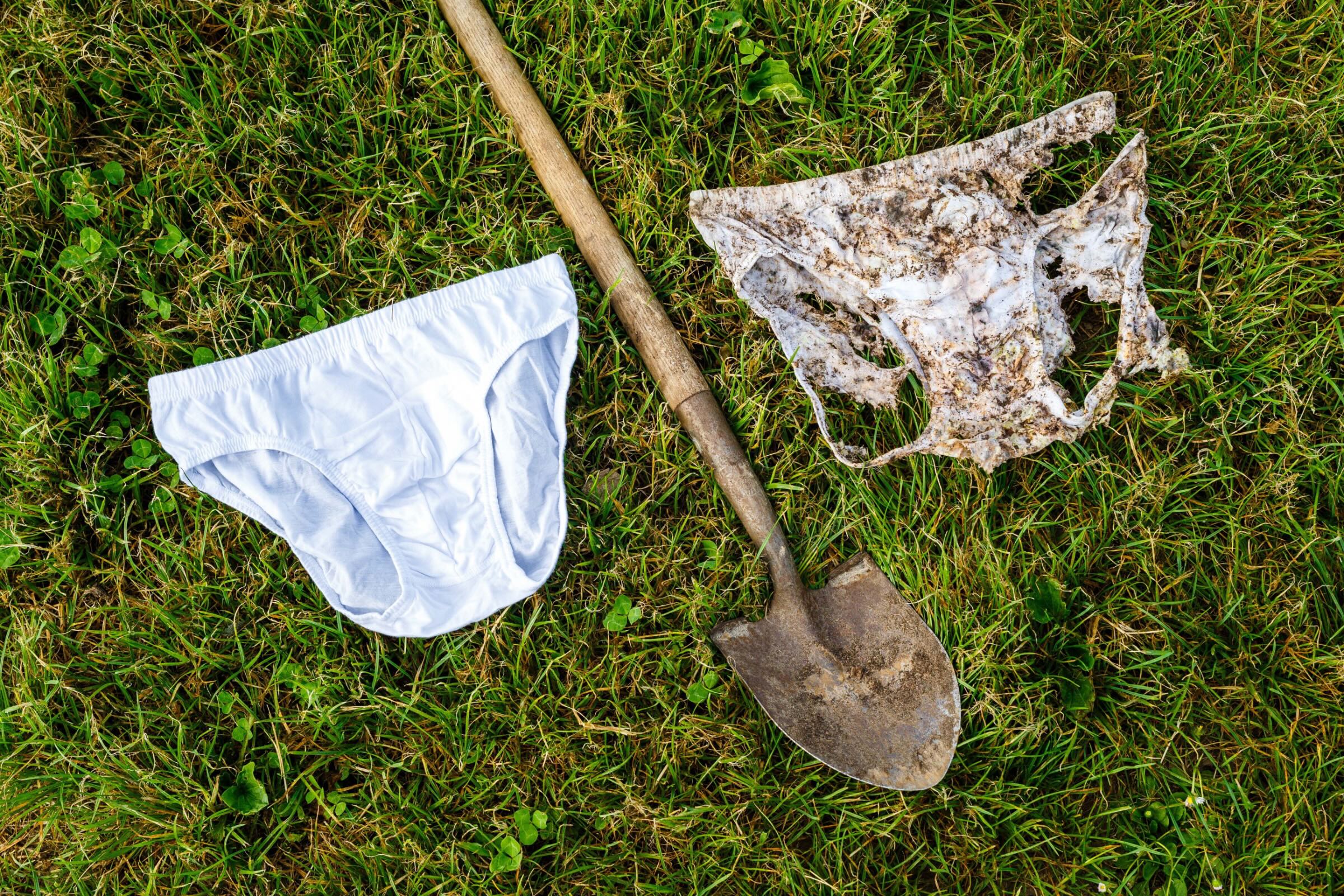
The results showed how land use affects soil health. The underwear generally decomposed most rapidly in private garden beds such as allotments, flowerbeds and vegetable patches – all of which tend to have high soil fertility and a good supply of nutrients – and least rapidly under lawns. Arable land, crop fields and grasslands fell somewhere in between.
“Our results show that how soil is managed can significantly affect both soil life and soil quality,” says the study’s co-leader Marcel van der Heijden. “Healthy, biologically active soil is crucial for fertility, nutrient cycling and many other ecosystem services.”
The researchers also pointed out that while soil with high nutrient levels is ideal for things like food production, an oversupply of nutrients in near-natural soil habitats such as forests can be a sign of imbalance. They propose an 'underwear index' as way of boosting public understanding of different soil types and raising awareness around the importance of protecting soils.
Top image: a pair of cotton underwear – one slightly decomposed and one heavily decomposed – in front of the ground profile of a meadow. Credit: Priska Koller, Agroscope
More wildlife stories from around the world
- People started building artificial beaver dams in California. Now something "mind blowing" is happening
- Scuba divers went into a tidal cave in Bermuda and found a segmented creature lurking in the darkness
- Chernobyl Exclusion Zone: When humans fled the worst nuclear incident in history, animals moved in. This is what happened next
- Mount St. Helens erupted in 1980, then a team of gophers were helicoptered in to bring it back to life
- Ichthyosaur pregnant with almost a dozen babies discovered in China – and they were nearly ready to be born


