
Off the coast of a Japanese island so far west that it’s actually closer to Taiwan, it’s possible to see hundreds of hammerhead sharks battling ripping currents around 35 metres deep. That is, if you’re a very experienced diver visiting between November and early May.
But not everyone comes for the scalloped hammerheads. Some divers visit this remote destination to swim through the inky blue waters past mysterious blocks of towering rock that look like they could have been plonked there by a giant playing with Lego.
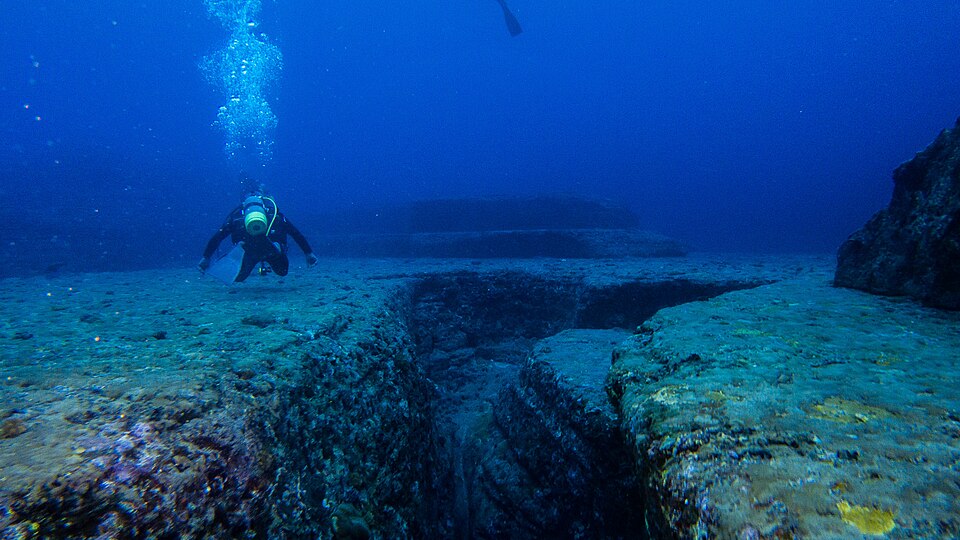
This underwater spectacle is known as the Yonaguni Monument. At around 25 metres tall, it’s higher than Antony Gormley’s Angel of the North sculpture. It doesn’t just stretch up. This strange rock formation extends over an area of around 100 metres by 60 metres – around the same size as a field hockey pitch.
- The same size as Casablanca, this arid landscape holds over 15 staggering 300m rock towers older than the dinosaurs – and America’s deadliest snake
- Staggering drone images show three colossal 'whales' rising from a forest in Thailand
Although fishes and sea turtles sometimes pass by to add a little extra excitement, the curious monument is the main draw for visitors. It looks like an underwater megalith or ruin, with chunks of rock that seem to form paths and even stairs around the monument.
“The mysterious 100-metre-long stretch of topography appears to be a series of steps and stone pillars, but debate still rages as to whether these are a man-made relic of a lost civilisation or a natural occurrence,” says Visit Okinawa Japanon its website.
People still can’t fully agree on what this eerie phenomenon is and how it came to be. “With other angular structures around it, the monument certainly looks man-made, but there is a problem,” writes the Japan National Tourism Organisation on its website. “Scientists estimate that the formation is many thousands of years old, created before human beings would have had the means of making such a structure.”
Marine geologist Masaaki Kimura thinks this was once a part of a 5,000-year-old city that sank after an earthquake around 2,000 years ago.
Other geologists argue that the surprising shapes created within the formation are just a result of currents wearing away the rock and that it’s an ancient natural wonder.
- A huge ancient predator is lurking in Japan’s rivers – and it’s eating frogs and crabs
- Yellow brick road found at bottom of the ocean stuns scientists...
- These 50-million-year-old giants are taller than the Statue of Liberty – and there are thousands of them
And there are certainly intense currents in this area. Although the baffling structure is relatively shallow – around 25 metres deep at its lower sections – the conditions can be challenging.
The site is known for its powerful currents so this is only recommended for experienced divers. According to Dive Planit, “there can sometimes be very strong currents ripping past (so strong you just get to wave as you pass by) and even in perfect conditions it will be surge-y.”
Luckily, non-divers can also get a glimpse of the peculiar sight as semi-submersible tourist boats also visit during good weather.
However you get there, it’s a good idea to be prepared for seasickness. Lots of travellers warn that there’s often large swell during the boat journey, making the travel to the site pretty nauseating.
- There’s a Japanese island where feral cats outnumber humans – and scientists discovered something interesting about their genetics
- It's over 75 million years old and like something out of a fantasy video game with outlandish giant mushrooms, fairy chimneys and an alien throne.
Yonaguni Island is around 69 miles from Taiwan and 316 miles from the main island of Okinawa. Although it’s much closer to Taiwan, it’s Japan’s westernmost inhabited island. The tourism even issues certificates to prove you made it this far west for 500 yen (around £2).
Travelling here requires a four-hour ferry from Ishigaki Port (they go twice a week) or a short flight (30 or 90 minutes depending if you’re departing from Ishigaki or Naha airports, respectively). Both can be either cancelled or rescheduled if there’s bad weather.
top image: A part of Yonaguni Monument that is called the Main Terrace, underwater near Yonaguni Island, Japan. Credit: Melkov, CC0, via Wikimedia Commons.
Discover more incredible environmental stories:
- From New York to Mexico City, some of Earth's biggest cities are sinking, say scientists
- It cost an eye-watering $40,000 to sink this ship and turn it into a reef – and the costly reason weighed less than a pineapple
- "The idea was that they would inhale the spores and become infected. And they did — most died within days. The island was then burned to kill the spores"


