
For most of Earth’s history, 'giant' wasn’t the exception – it was the rule. Long before modern ecosystems took shape, our planet teemed with supersized animals that would dwarf today's creatures.
From sloths that towered over people like living bulldozers and penguins heavier than an ostrich, to snakes longer than a bus, prehistoric landscapes were shaped by creatures so massive they almost sound mythical.
- Before they shrunk: 6 huge prehistoric ancestors of animals you know today
- Prehistoric Pompeii: "Truly astounding" fossil discovery in remote Moroccan mountains sheds new light on extinct animals
11 animals that used to be bigger
Sloths
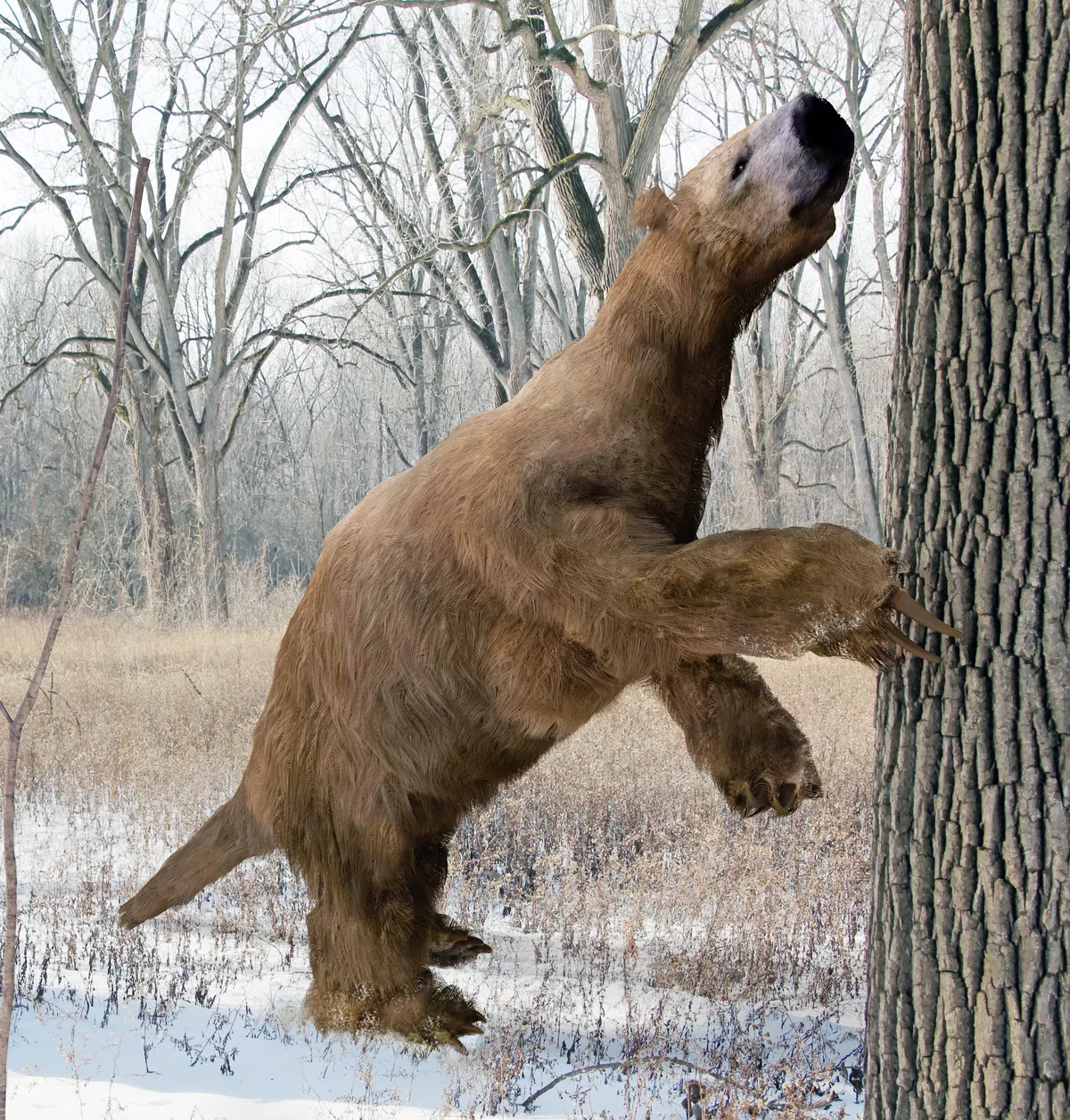
These beasts were very different to the sloths we know and love today! Standing at a whopping 3.7m when up on hind legs and weighing up to four tonnes (as opposed to the 5kg of a modern sloth), they were truly colossal.
With its ability to walk on its hind legs, it was in fact the largest bipedal mammal of all time. They lived in the woodlands and grasslands of South America, and fossils have been found dating back from around 400,000 years ago to 10,000 years ago. Despite its huge fearsome claws, it was actually a vegetarian, feeding on leaves and grasses.
Penguins

Tipping the scales at nearly 160kg and standing 1.7 metres high, Kumimanu is by far the largest penguin that has ever lived and heavier even than today’s largest living bird, the common ostrich…
- The biggest-ever penguin was a prehistoric monster that weighed as much as a sumo wrestler
- Meet 10 deadly prehistoric birds, including one that could swallow human babies and a 1.5m-tall penguin
By carrying a few extra pounds, these giant penguins were able to hunt larger prey than other, smaller penguins, save energy when diving, and better insulate themselves in cold water. This particular advantage may have helped early penguins spread from warmer environments in New Zealand to colder environments further south and closer to Antarctica.
Apes

The fictional King Kong was based on the giant prehistoric ape Gigantopithecus. Going by the size of the fossils, Gigantopithecus probably stood about 3m tall and weighed between 200-300kg. That would make it taller and heavier, on average, than any other known species of ape, alive or dead. It would even have been taller than the tallest human on record.
- At a staggering 3 metres tall the extinct prehistoric Gigantopithecus is the biggest ape ever, but it wouldn't be the heaviest...
- What's the difference between humans and apes? And when did we first appear?
Crocodiles

Think today's crocodiles, particularly the saltwater croc, are fearsome? They are nothing compared to the massive Deinosuchus, which lived between 83-72 million years ago. It was 11 metres long and weighed 6–7 tonnes – and it makes today's crocs look pretty minuscule and was the largest predator in North America at the time.
- 9 animals that could take on (and probably kill) a saltwater crocodile
- Who would win in a fight between two of the world's most fearsome predators – a saltwater crocodile or a great white shark?
- Saltwater crocodile guide: diet and where they live in the wild
Eagles

The largest eagle ever was Haast’s eagle (Hieraaetus moorei), an extinct raptor that cast terror-inducing shadows over New Zealand’s South Island up until its extinction in 1445. This 18kg monster weighed twice as much as the extant harpy eagle, today’s heaviest eagle, and had a wingspan that measured almost 3m.
- Meet the world's deadliest-ever eagles
- Fierce, majestic and deadly: your ultimate guide to the world's biggest birds of prey
From the Pleistocene (around 1 Mya) up until its eventual extinction in 1445, Haast’s eagle was endemic to the South Island of New Zealand.
It primarily hunted giant, flightless birds known as moas that, at 230kg, were twice as heavy as today’s largest flightless birds, ostriches. It’s thought that by overhunting moas, the Māori may have inadvertently driven Haast’s eagle to extinction.
Sharks

The largest shark currently known to science is Otodus megalodon, or ‘big tooth’.
At around 20m in length, or 24.3m according to a recent reconstructive study, megalodon was roughly twice the size of today’s largest species of shark, the whale shark.
Megalodon translates as ‘big tooth’, which is an apt name: just one of its gnashers can more than fill the palm of your hand. In contrast, a tooth of a great white shark is more or less the size of your little finger.
- Was Megalodon the world's most fearsome, largest apex predator ever? Meet the super-shark that could swallow killer whales whole but didn't like the cold
- 10 horrifying, prehistoric sea monsters: Discover menacing, deadly creatures that once ruled our oceans – and be glad they don't live today...
Living it quite so large requires vast amounts of fuel. Megalodon was by all accounts a ferocious predator – a ferocious super-predator in fact – able to take substantial prey such as whales, seals, turtles and other sharks. It probably approached its quarry from behind, seizing it with those powerful jaws and chomping it down in a few mouthfuls.
Its bite-force was phenomenal, ranging from 100,000-180,000 newtons. “T-Rex could bite with a force of 64,000 newtons, enough to crush a car, Jurassic Park-style,” write Tim and Emma Flannery in their book, Big Meg. “But a bite of 100,000-180,000 newtons would not just crush a car, but dismember it, possibly atomise it.”
Geese

Few animals have more of an attitude than geese. They may be relatively small, but these birds are fearless and are known to pick fights with animals many times their size, including humans. It’s likely their extinct, flightless ancestors known as Garganornis had the same brazen attitude.
Garganornis lived in Gargano, Italy, during the Late Miocene (9-5.5 Mya), back when this upland area was an island, isolated from the European mainland and surrounded by the Mediterranean Sea.
As a result of this isolation, the animals that lived on Gargano – including Garganornis – were subject to an effect known as island rule. This was an evolutionary process where small animals typically grow larger and large animals shrink in size.
Garganornis was one of several animals that grew in size. It weighed roughly 22kg, making it 30% larger than today’s largest waterfowl, the mute swan.
However, unlike mute swans, Garganornis couldn’t fly. Its wings were small and instead adapted for fighting. They were robust and sported small, bony knobs on their tips that were used like maces to break the bones of other Garganornis.
Miilipede

At 2.5m in length, Arthropleura is widely considered the largest invertebrate to ever walk the Earth. This giant ancestor of today’s millipedes is not an insect but a myriapod – an adjacent yet distinct group of invertebrates (or rather arthropods) that includes millipedes and centipedes.
Arthropleura lived across Europe and North America for more than 50 million years between the Early Carboniferous and the Early Permian. Like many bugs, living and extinct, it was a detritivore that fed on pretty much any rotting biological material.
- What's the biggest centipede in the world? Meet the stuff of nightmares, venomous enough to kill a bat - and possibly a small child
- Centipedes vs millipedes: what's the difference?
Cave bears

Slightly more modest in size, though still pretty massive, was the cave bear. Weighing in at between 400-1,000kg, the largest cave bears were comparable in size to modern-day polar bears. They could be found across Europe and Asia – including in the UK.
We have a very good idea of what they looked like, as in 2020 a perfectly preserved specimen was found in the Russian Arctic, its remains revealed by melting permafrost. Even its teeth and nose were intact.
The specimen was dated to between 22,000 and 39,500 years old, living towards the end of the time of the cave bears, who are thought to have gone extinct 24,000 years ago. It is thought that hunting by humans, as well as competition with them over caves, may have contributed to their disappearance.
Lizards

Megalania is a truly monstrous relative of today's largest lizard, the Komodo dragon, which lived during the Pleistocene period and disappeared about 40,000 years ago. This monitor lizard reached an estimated length of 7 metres and was a key land predator at the very top of the food chain.
It has been suggested that the loss of its mega-reptile predators has left the Australian ecosystem out of kilter, allowing introduced mammals to reign unchecked.
Snakes

Titanoboa was first discovered in the early 2000s in northeastern Colombia, but it wasn’t until 2009 that it was officially described and crowned the largest snake ever found at ~13m in length, taking the title from the previous record-holder Gigantophis (~11m).
Titanoboa lived during the Palaeocene (~60-58 million years ago) and just after the non-avian dinosaurs faced extinction at the end of the Cretaceous. It’s widely considered the largest terrestrial vertebrate of its time and similar in length to the biggest T-rexes.
Like a lot of other prehistoric snakes, Titanoboa wasn’t venomous and instead hunted like today’s boas do, constricting prey with their large, muscular bodies. It lived in wet tropical forests with large river systems and fed on huge freshwater fish like arapaima.
Dragonfly

Long before pterosaurs and birds evolved powered flight and took over the skies, insects dominated this ecological space.
The largest amongst them was Meganeuropsis, a dragonfly-like insect that’s part of a now-extinct group known as griffenflies, or meganisopterans.
- How do insects fly? The miracles of insect flight revealed
- What's the biggest dragonfly in the world?
- Prehistoric insects were absolutely massive. An entomologist explains why they needed to be so darn big
Meganeuropsis had a 71cm-wide wingspan, which is roughly the same as a common kestrel. It lived in what is now the US during the Permian (290-283 million years ago). It buzzed around ponds and slow-moving rivers as it hunted other flying insects and even some small, lizard-like vertebrates.
- This prehistoric arachnid monster was the size of a house cat with a deadly sting in its tail...
- Prehistoric Pompeii: "Truly astounding" fossil discovery in remote Moroccan mountains sheds new light on extinct animals
- 9 mythical monsters that may have been inspired by huge, real-life, prehistoric creatures


