
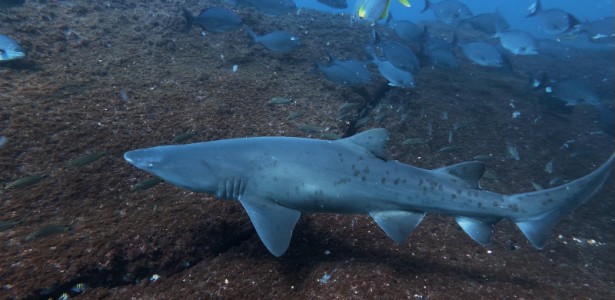
Scientists have revealed that a protected area in the waters off the coast of São Paulo, Brazil, is a year-round breeding ground for sand tiger sharks.
These critically endangered sharks – which can grown up to 2.3m long – are using the Alcatrazes Archipelago in southeastern Brazil for mating and reproduction, according to a study published in the Journal of Fish Biology.
Scientists previously believed the species mated in waters around Argentina, Uruguay, and southern Brazil then swam to southeastern Brazil – where the waters are warmer – to have their pups.
But the researchers recorded a female with fresh wounds from mating in the summer months as well as a pregnant female seen in winter, demonstrating that sand tigers are using these waters year-round for mating, gestation and giving birth.
“We’ve shown that they’re here not only in the winter as previously thought, but also in the summer, completing their entire reproductive cycle in Brazilian waters,” says the study’s author Ana Clara Athayde, a FAPESP scholarship holder at from the Federal University of São Paulo (UNIFESP)’s Institute of Marine Science (Imar).
- Drones capture lemon sharks hunting 'jaguar' fish in Brazil. It has never been recorded before
- This haunting shipwreck in North Carolina has its own 'shark ballroom'
The researchers used baited remote underwater video systems (BRUVs) to spy on the ecosystem and see what was happening under the waves. Between 2022 and 2025, the team put these cameras in the water 315 times at 38 locations between 2–50m deep across the archipelago.
The cameras are typically placed in the water for around an hour before being brought up to the surface for the scientists to review the footage. They also gathered recordings of sand tiger shark sightings filmed by citizen scientist scuba divers.
This species of shark is easy to identify because they look so different from other sharks found in the same area, according to the researchers.
"Sand tiger sharks have a very distinctive morphology, with fin size and position that set them apart from other coastal species in the southwest Atlantic,” says Fábio Motta, a professor at IMar-UNIFESP and coordinator of a project supported by FAPESP under the Research Program on Biodiversity Characterization, Conservation, and Sustainable Use (BIOTA-FAPESP). “That’s why we were able to identify them even when visibility wasn’t ideal.”
- Orcas filmed paralysing and eating great white sharks in the Gulf of California
- Sharks are attacking albatrosses in Hawai'i. And it's causing other apex predators to flee
- How do sharks mate? Shark sex is a rarely seen but lively business – here’s how they do it
- Tiger shark vomits up spiny anteater, shocking Australian scientists
From the sightings, the scientists counted and measured sharks caught on film, estimated whether they were sexually mature, and recorded any distinguishing features that could identify individuals. They also looked for swollen tummies in females – suggesting pregnancy – and the presence and freshness of bite marks to show how recently they had mated.
“By observing the healing of those wounds in captive females and comparing them with those in the wild based on citizen science records, those researchers were able to estimate when copulation occurred and consequently, the gestation period,” says Athayde. “Using this method, we showed that females on Alcatrazes are copulating.”
In sand tiger sharks, females tend to get pregnant every two years. Their gestation period is between nine to twelve months, at the end of which they give live birth to one or two large (around 90cm) pups.
- Colossal squid filmed alive in deep ocean for the first time ever
- Drone captures Greenland ice tearing open to reveal colossal animal beneath
Somewhat horrifyingly, sand tiger shark babies are known to cannibalise their siblings while still in the womb.
Their slow reproduction rates and small number of pups per pregnancy make this species highly vulnerable to threats, such as overfishing, pollution and habitat destruction.
But protected waters like those of the Alcatrazes Archipelago – which has been designated as an Important Shark and Ray Area (ISRA) – can help to keep these migratory sharks safe.
“Our findings underscore the importance of this particular conservation area, as well as other areas where fishing is regulated, for protecting coastal sharks,” says Motta, adding that by revealing when and where these sharks reproduce, “the study can inform conservation strategies.”
Find out more about the study.
Top image: sand tiger shark. Credit: moodboard/Getty Images
More wildlife stories from around the world
- Arctic bobtail squid seen alive in natural habitat for first time ever
- “Something I’d never even heard rumours of." Sea turtle emerges from water with strange creature clinging to its back
- Scientists collect tiny creatures 2,000m below ocean’s surface. What they find surprises them
- Epic footage shows the "largest great hammerhead ever filmed in the Bahamas"


