
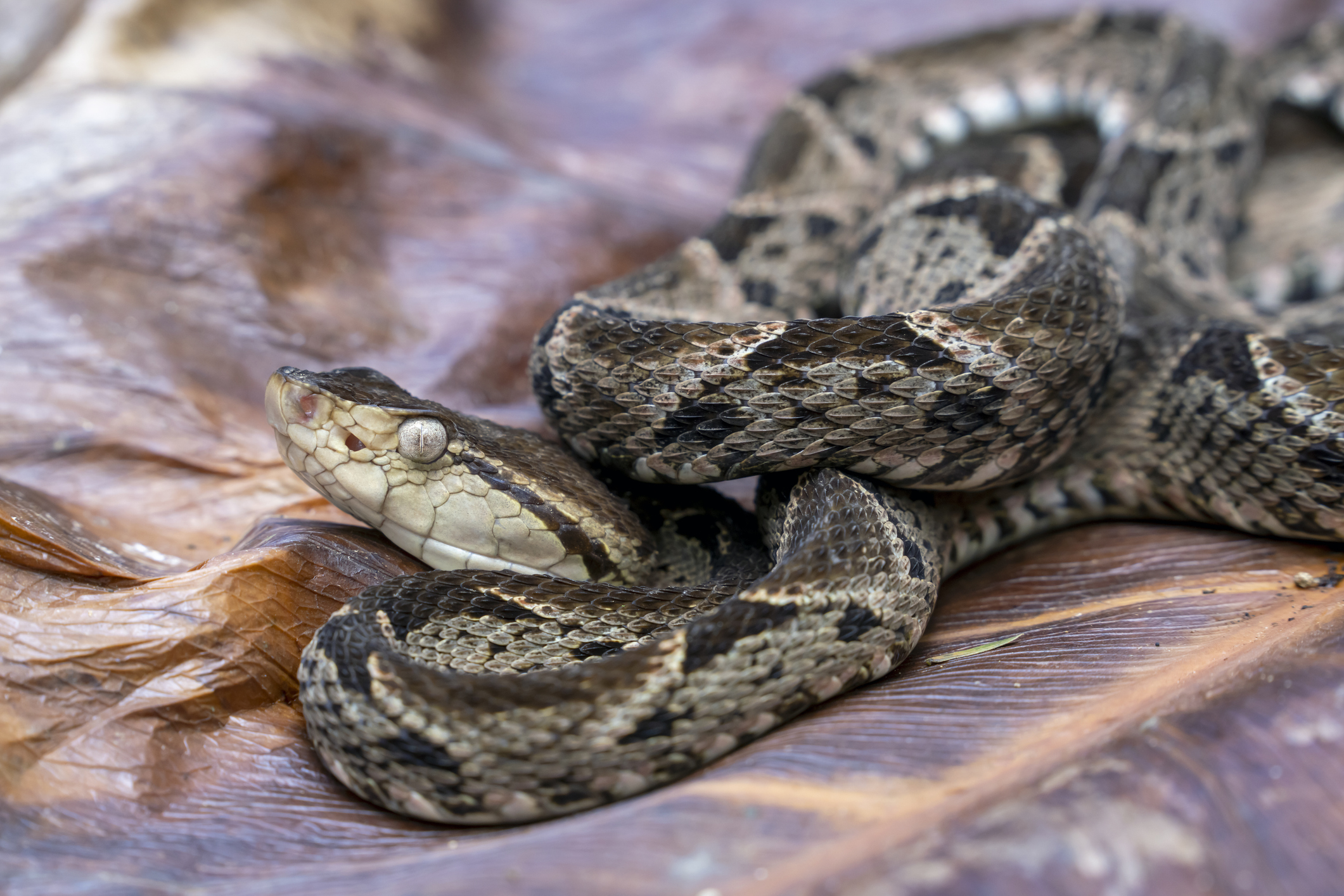
A patch of fallen leaves on the forest floor might seem an unlikely place to encounter one of the Americas’ most formidable predators. But the fer-de-lance is a master of camouflage, its patterned body blending into the undergrowth with remarkable effectiveness. The name, French for ‘spearhead’, is used for several related pit vipers, including Bothrops atrox and Bothrops lanceolatus. Here, we focus on Bothrops asper, also known as the terciopelo, whose ability to remain virtually invisible can have deadly consequences.
Where does the fer-de-lance live?
The fer-de-lance ranges from southern Mexico through Central America to parts of north-western South America, including Colombia and Ecuador. It favours humid tropical forests, particularly near streams and swamps. However, it is adaptable and can thrive in habitats disturbed by humans, too, including banana, coffee and cacao plantations, bringing it into frequent contact with farm workers.
- "It contains enough venom to kill 10 adult humans" 11 deadliest animals in South America, including a gigantic snake that can swallow a person whole
- Does Ireland have any snakes?
How does it find its prey?
The fer-de-lance is an ambush predator, relying on patience and concealment rather than pursuit. Primarily nocturnal, it can lie motionless for hours, waiting for unsuspecting prey to come within striking distance.
Like other pit vipers, it possesses heat-sensitive pits between its eyes and nostrils. These detect infrared radiation emitted by warm-blooded animals, allowing it to locate prey even in darkness. Its forked tongue also collects chemical particles from the surroundings, helping it track prey by scent.
The snake spends most of its time on the ground, although younger individuals are more inclined to climb into low vegetation, sometimes perching on branches above the forest floor.
- Python vs viper: What's the difference between these two heavyweight snake families?
- "Symptoms develop quickly and its venom can cause paralysis, respiratory failure and death. "6 most dangerous, deadliest sea snakes on the planet
What does it eat?
The fer-de-lance’s diet changes considerably as it grows. The juvenile feeds mainly on frogs, lizards and other small animals. It has occasionally been observed wriggling its conspicuous tail tip as if enticing prey closer, although how effective this behaviour is remains uncertain.
As it matures, its diet shifts increasingly towards warm-blooded prey, particularly rodents and other small mammals, although birds and amphibians also feature on the menu.
Like other vipers, when attacking larger prey, the snake may release its victim after delivering a venomous bite, reducing the risk of injury from a struggling animal. It can then locate its meal using chemical cues detected by its forked tongue.
How dangerous is its venom?
Extremely dangerous. The fer-de-lance has long, hinged fangs that fold against the roof of its mouth when not in use, swinging forward to inject venom into its victim. Its venom contains toxins that damage tissue, disrupt blood clotting and cause bleeding. A bite can result in severe pain and potentially fatal complications.
A study of six Costa Rican hospitals found that the fer-de-lance accounted for 84.5 per cent of snakebites where the species could be identified. Of the 475 patients treated in 2012–2013, only one died, reflecting the effectiveness of modern medical care, including antivenom.
Is the fer-de-lance aggressive?
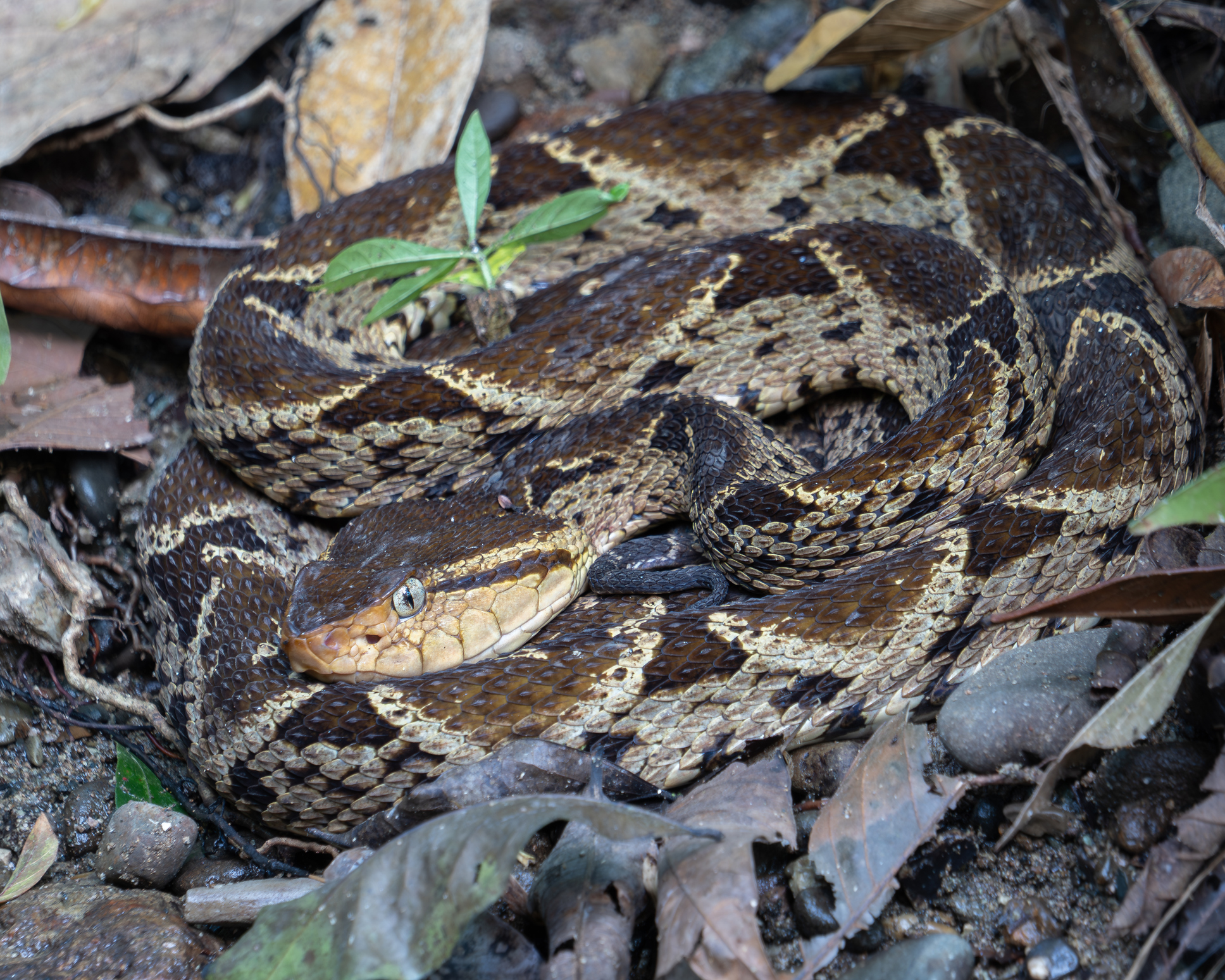
The fer-de-lance has a reputation for being particularly defensive when disturbed. If threatened, it may coil its body into an S-shape, ready to strike with considerable speed. However, it does not actively seek confrontation with humans. Its camouflage means people may approach or accidentally step close to it without realising it is there.
How does the fer-de-lance reproduce?
Following a gestation period of around six to eight months, the female gives birth to live young, typically numbering between 20 and 40, although litters of up to 86 have been recorded. Larger females generally produce more offspring. There is also evidence that females can store sperm, potentially delaying fertilisation until conditions are favourable.
The newborn snake, weighing just 6–20g, is already equipped with venom and capable of hunting independently. With no parental care to rely on, it must fend for itself from birth.
Does the fer-de-lance have any predators?
Despite its size and potent venom, the fer-de-lance has several natural predators, including the mussurana, a snake that specialises in eating other snakes and possesses resistance to certain venom components. Birds of prey, including the laughing falcon, also hunt it, while coatis and other mammals may prey on smaller individuals.
- A venomous viper, ‘psychedelic’ tarantula and a fish shaped like a guitar are on the brink of extinction, say experts
- "That’s the length of a double decker bus!" 10 metre monster tops biggest snakes in the world list
Is the fer-de-lance endangered?
The fer-de-lance remains widespread across much of its range. Nevertheless, deforestation, habitat degradation and deliberate killing pose local threats. Its reputation means it is often killed on sight, particularly near homes and farmland. But by helping to control rodent populations, the fer-de-lance performs an important ecological role, illustrating the complicated relationship between humans and this formidable predator.
A FER-DE-LANCE’S SPECIAL FEATURES:
- Family: Viperidae
- Weight: Up to 6kg
- Lifespan: Unknown in the wild; recorded at 15–21 years in captivity
top image: Fer-de-lance Viper, Bothrops asper, Tropical Rainforest, Costa Rica. Credit: Al Carrera/ Getty Images.
Discover more fascinating reptile stories from around the world:
- It's the length of a bathtub, can play dead and has a defensive spray that smells of rotten fish
- It has iron-coated razor-sharp teeth, weighs the same as a keg of beer and delivers its deadly venom by raking its teeth through its prey’s flesh
- “This was just one of two blue- tongues stuffed inside that DVD player. Another package was detected containing more blue-tongues bound with tape"
- Scientists analysed the DNA of world’s oldest land animal. What they found was staggering


