
Twice a year, this road in Shawnee National Forest in the United States' southern Illinois starts crawling with snakes (and other reptiles) – and they’re on a mission.
- A colossal 900 snakes on the loose, swimming through floodwaters after severe flooding in South China
- A snake hitched a ride to a remote Pacific island. This is what happened next.
Depending on the season, the animals migrate to a different habitat, and it just so happens that Forest Service Road 345 lies right in-between the wetlands and limestone cliffs they favour.
Appropriately dubbed Snake Road, this stretch of the forest closes to cars every spring and autumn for two months to ensure the snakes can complete their journey in peace.
“That protects animals from being incidentally killed by vehicles running over them,” U.S. Forest Service officer Anderson Harris told CBS News. “It’s the only road in the U.S., to my knowledge, that we close for migrations of the amphibians and reptiles.”
The snakes, as well as other reptiles such as frogs, toads and turtles, don’t just choose this route on a whim. Snake Road is situated between two important, but very different, ecosystems.
On the west side of the road lies the LaRue Swamp, part of the Mississippi River basin. To the east are the LaRue-Pine Hills, famous for limestone cliffs towering 46 metres over the landscape.
In the spring, when the weather starts to warm up and the animals stir from hibernation, they head towards the swamp to feed, mate and rest. Once autumn arrives and temperatures drop, they make the journey back to hide between limestone cliffs, which help protect them from the cold.
- It's the size of Los Angeles and simply crawling with deadly alligators, black bears and highly venomous snakes
- Craziest and most dangerous animal migrations: From tiny insects to giant whales, 10 reckless journeys that will blow your mind
It’s not just the fact that reptiles are slithering across the road that puts them in danger – it’s also that they often do so very slowly. In the early morning and evening hours, the black asphalt of the road can be relatively warm, making the snakes and other cold-blooded creatures move slower. They also tend to stop when approached – even if what’s approaching is a vehicle.
According to biologist Rich Seigel (as reported by National Geographic), almost one in four of the snakes he collected for a study had been killed by traffic.
The decision to close the road to allow for the reptile migration dates back to 1972, when the road was closed for three weeks in the spring and autumn. When Scott Ballard, biologist and herpetologist with the Illinois Department of Natural Resources, found that the migration took longer than that, the Forest Service extended the road closure.
Now, the Snake Road is closed from 15 March–15 May, and from 1 September–30 October.
Which species use Snake Road to migrate?
More than 23 species of snake have been spotted in the area, according to biologist Mark Vukovich (as reported by 5Chicago).
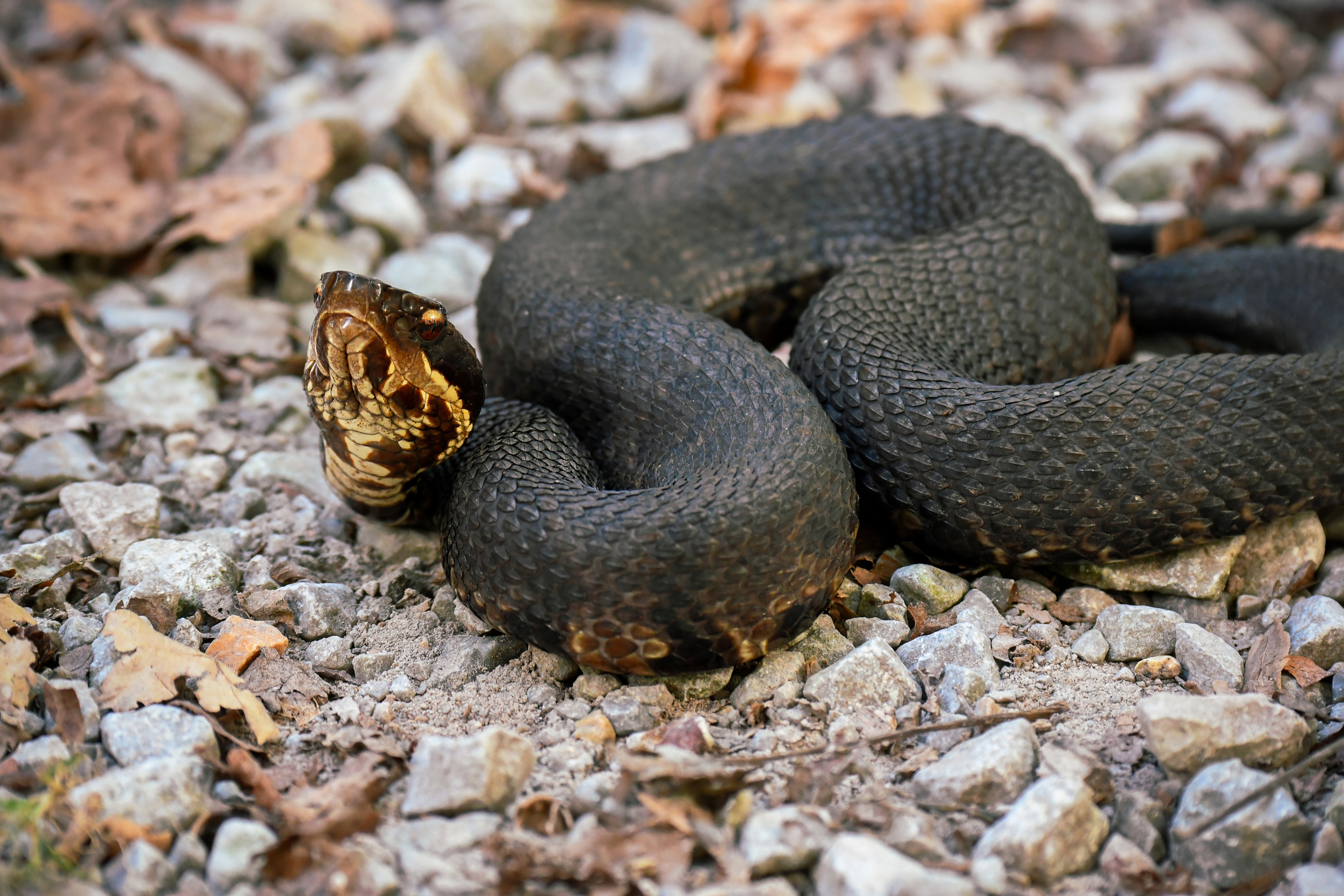
Three of the species migrating through Snake Road are venomous – the cottonmouth (Agkistrodon piscivorus), the copperhead (Agkistrodon contortrix) and the timber rattlesnake (Crotalus horridus).
You might also spot amphibians such as southern leopard frogs, various toads and salamanders, and different species of turtles and lizards.
- It straddles two US states, contains 15,000 alligators, and is home to a snake as long as a bed
- This is the largest migration on Earth (and it’s not what you think)
Can you walk across Snake Road?
During the seasonal closures, vehicles are prohibited, but people are allowed to walk the 4km stretch of the road to witness the reptile migration. But it’s not quite as much of a sight as one might expect.
“Contrary to popular belief, you won’t see a great river of snakes washing across the road,” Ballard told National Geographic. “If you see twenty snakes while you’re out here, that’s a good day.”
Visitors should not approach, handle or attempt to startle the reptiles. It’s advised to observe them from a safe distance and allow to pass undisturbed.
Collecting reptiles is also strictly prohibited under federal and state law.
Top image: A northern cottonmouth (Agkistrodon piscivorus) crosses Snake Road in Shawnee National Forest, Illinois. Credit: Amy Randall/Getty Images


