
Earth has endured countless asteroid impacts over its 4.5-billion-year-history, but the one that struck Chesapeake Bay, US, 35 million years ago is up there with the worst.
What was the Chesapeake Bay impact?
In the Late Eocene, roughly 35 million years ago, a 5km-wide asteroid smashed into the eastern United States, just off the coast of what is now Virginia.
At the time, sea levels were unusually high and the shoreline was more than 100km inland from where it lies today. This meant that the asteroid landed in the ocean, colliding with the carbonate-covered continental shelf that lay beneath.
The impact created a crater 85km in diameter and 1.3km in depth, which is twice the size of Rhode Island and as deep as some of the deepest parts of the Grand Canyon!
Another two devastating asteroid impacts are also believed to have occurred during the Late Eocene: the Popigai impact in Siberia, Russia, and the Toms Canyon impact in offshore New Jersey, US.
Several studies have suggested these asteroid impacts may be associated, pointing towards a disturbance in the asteroid belt approximately 35 million years ago that sent multiple giant space rocks hurtling towards Earth.
How devastating was the impact?
During the Late Eocene, North America was covered in open woodlands and savannah-like habitats, creating an environment that would have looked a lot like today’s Great Plains.
This environment supported a rich diversity of mammals, including early horses like Mesohippus, strange, cat-like animals called nimravids, and deadly predators commonly known as bear-dogs.
Any animals that were living in the immediate vicinity of Chesapeake Bay 35 million years ago would have faced a similar fate to the dinosaurs that were incinerated by an even more devastating asteroid impact 66 million years ago.
Those that weren’t vaporised by the initial impact blast were arguably subject to even worse fates, falling victim to a giant tsunami hundreds of metres high or the many wildfires that erupted along the East Coast. A 2025 study presented evidence of tsunami deposits in the Sandhills of North Carolina, nearly 400km from the impact site!
While it didn’t trigger a global mass extinction and its ecological devastation was largely localised, some research suggests that the impact, along with other impacts that occurred around the same time, may have initiated a long-term pulse of global warming. This warming episode eventually dissipated two million years later, coinciding with the Eocene-Oligocene extinction event.
- “It triggered catastrophic global cooling and was twice the size of the one that killed the dinosaurs.” 6 deadliest, most apocalyptic asteroids to ever hit Earth
- Mega volcanoes, asteroid impacts and 'the great dying' – 5 deadly mass extinctions that changed life on Earth forever
Are the effects of the impact still felt today?
Shortly after the impact, the resulting crater was filled by a layer of coarse-grained rocks known as breccia. These rocks were fragments of crust blasted out by the impact, which later filled the crater and formed a thin layer of debris around its rim, called an ejecta blanket.
This layer of rubble is roughly 1.3km thick and would have had the consistency of wet concrete when it was deposited. According to the United States Geological Survey (USGS), the density difference between this breccia and surrounding sedimentary rocks has caused accelerated land subsidence around Chesapeake Bay.
These effects are still felt today, with many experts pointing to the 35-million-year-old impact as the primary cause of the region’s ground instability.
By recording and analysing seismic waves across the crater, geologists have identified a number of faults that cut the sedimentary beds above the breccia and extend upward toward the bay floor. An earthquake in any one of these faults could potentially trigger a larger seismic event, spreading to neighbouring faults and sending tremors across the region.
- It’s larger than Greater London and lies in the crater of an asteroid that struck Earth 214 million years ago… Now it’s home to black bears
- It wiped out 90% of life on Earth, turned the oceans into graveyards – and it very nearly ended life on our planet entirely
Another consequence of the impact was the destruction of many groundwater aquifers. These were replaced by a single huge reservoir with a volume of nearly 4,000 cubic kilometres. The pore spaces of this aquifer are filled with briny water that is 1.5 times saltier than normal seawater and too salty to have any industrial use.
There are some freshwater aquifers that lie above the salty breccia layer, but drilling projects that extend too deep could inadvertently contaminate these vital water sources. Given this risk, the USGS recommends a particularly cautious approach to groundwater use around Chesapeake Bay.
What lives around the impact site now?
Approximately 10 million people live along the shores of Chesapeake Bay, with a further 8 million living within its wider watershed.
The area’s vast estuary and watershed habitats are also home to a diverse array of animals and plants, including more than 300 species of fish. The bay serves as a major spawning ground for the striped bass, hosting roughly 90% of the Atlantic coast population, and provides vital habitat for hard and soft-shell clams, eastern oysters, and blue crabs - species that have helped make the region famous for its seafood.
- "Water will evaporate, leaving a dry barren surface - it will become an even hotter version of Venus…" 10 ways Earth – and life on it – could die
- "It's considered the largest and most ferocious terrestrial predator that has ever lived…" 10 deadliest predators that ever lived
The bay is also home to bottlenose dolphins and occasionally visited by several different species of whale, including endangered North Atlantic right whales, fin, minke, sei, and humpback whales. Manatees have been sighted in the bay several times too, even though the area is north of the species’ normal range.
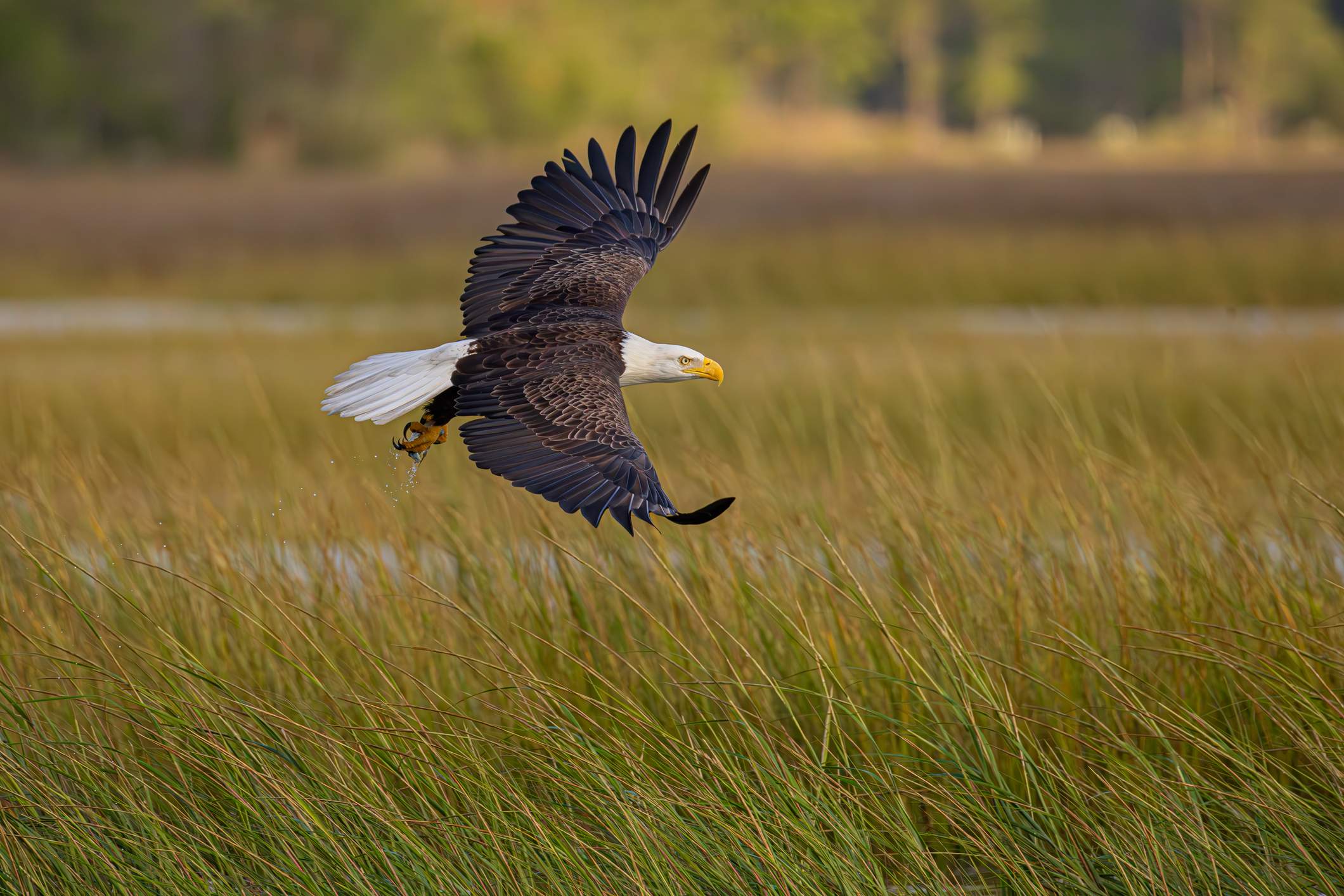
Ospreys, great blue herons, bald eagles, and peregrine falcons patrol the skies above the bay and along its shores, hunting fish and other birds. Further inland, the surrounding forests and uplands provide habitat for black bears, minks, and owls, including barn owls and barred owls.
Today, the Chesapeake Bay Program, a regional partnership established in 1983, works to protect this unique ecosystem - one that emerged from the ashes of a devastating asteroid impact 35 million years ago.
top image: Near-Earth asteroid, computer artwork. Credit: Science Photo Library-Andrzej wojcicki/ Getty Images
Discover more wildlife stories from around the world:
- "Alan fired off a dart. Relatives clustered around her as the drug began taking effect, and within 15 minutes they were all sedated"
- “Inside lay a grisly collection of bodies, hapless creatures that crawled in but never crawled out.” 1km down in the Gulf lies the ‘Hot Tub of Despair'
- It was the size of a dog – and had a trunk. What was this prehistoric beast?


