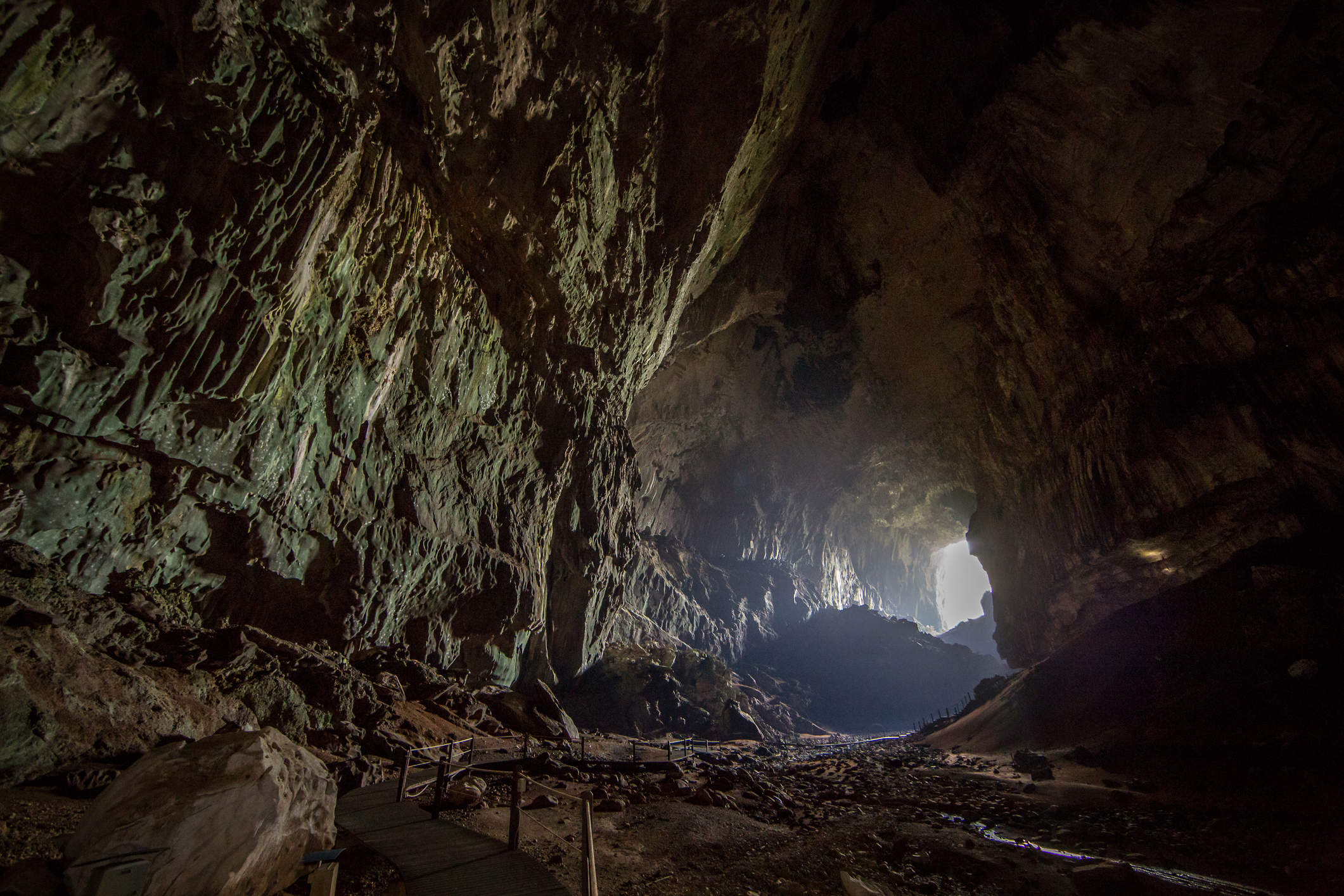
“This is undoubtedly one of the world’s speleological wonders,” wrote Dave Brook and Tony Waltham of Deer Cave in an article originally published in Caving International in the late 1970s.
“Our survey showed that the monstrous passage was 174 metres wide and 122 metres high in one section . . . and it passes right through a mountain for a distance of one kilometre.”
To indicate just how great these dimensions are, it’s been said the entrance to Deer Cave, hidden deep within the tropical rainforest of Gunung Mulu National Park in Malaysian Sarawak on the island of Borneo, is so vast you could pick up St Paul’s Cathedral and plonk it down inside.
With such a cave-scape on their hands, it’s not surprising that local tourist operators run trips into this and the many other caves in the region that have been hollowed out of the limestone mountains over millions of years.
- “It was just bones all over the floor.” Fossil hunters make astounding discovery in Texan water cave
And these do not only offer the opportunity to gawp at the geological wonders, spectacular as they are.
The cave is also home to an estimated 3 million wrinkle-lipped free-tailed bats, which pour out of the massive entrance at twilight for their night-time feed.
Also living in the cave are millions of cave swiftlets. These birds construct nests from their own saliva, which is excreted from glands just inside their beaks. The nests have been collected, made into soup and consumed, primarily for their medicinal qualities, in many parts of Asia since at least the 1500s.
All these bats and birds, of course, produce a lot of excrement, and this in turn attracts coprophagous insects, and these are preyed on by predatory centipedes and spiders.
- An elephant-like animal was discovered in this gigantic underwater cave. And that’s not all
- “Once they descend into the cave, they trudge 150m in the pitch black, feeling around with their trunks.” 9 weird animals found in caves
As this blog from 2014 explains, the recycling efforts of those species at the bottom of the foodchain help to keep waste levels down. “The guano piles are less than a metre deep, highlighting a rapid recycling rate by the myriad of insects that live in this twilight zone,” says blogger Andy Farrant who has explored many of the caves in this region.
Having said that, however, the Caves episode of the 2006 BBC natural history series Planet Earth, some of which was filmed in Deer Cave, showcases one 100-metre high mound of bat droppings. It reveals in gruesome detail the millions of cockroaches that feed on the guano, in addition to anything else that is unfortunate to fall into the mound, such as some hapless bats, as narrator Sir David Attenborough tells viewers. The cockroaches are, in turn preyed upon by 20cm-long centipedes.
Even more bizarrely, there are crabs here, as well, sifting through the treasure like gold miners.
- There’s a cave in Kentucky that’s 426 miles long, 118 metres deep – and fish-eating spiders lurk in it
- Scientists went into an ancient cave in New Zealand and found a 'lost world' hiding within
When the bats leave the cave in the evening, the amazing footage captured by the BBC shows how they coalesce into a doughnut-shaped murmuration to confuse avian assailants.
Nevertheless, some birds of prey have clearly mastered the art of bat predation, and there’s a memorable sequence of peregrine falcons and bat hawks hunting the bats. It really doesn’t look as though they have to try too hard as they seize the tiny mammals in their talons with disdainful ease.
- "It can carry Ebola, a nasty virus that causes bleeding from every orifice and is usually fatal." Meet the world's 7 deadliest bats, famous for carrying lethal diseases
- This mammal's bizarre tongue is so long it has to tuck it up inside its ribcage. Here's why
The Mulu caves probably first came on the radar of western explorers as far back as 1858, when references was made to them in a book entitled Life in the Forests of the Far East. GE Wilford of the Malaysian Geological Survey visited the area in 1961, but the first thorough survey was carried out by a UK team in 1977-78, and there have been many more since as scientists seek to reveal more of this remarkable area’s hidden secrets.
top image: Wide view of the entrance to Deer Cave in Gunung Mulu National Park, Sarawak, Malaysia. Credit: Marek Stefunko/ Getty Images
More wildlife stories from around the world: