
If asked to imagine a bird, most people would picture something small enough to perch on their shoulder. Few would picture a giant towering over them, capable of crushing them underfoot. Yet such birds really did exist - and they lived far more recently than you might expect.
What were elephant birds?
The elephant birds were a group of giant, flightless birds native to the island of Madagascar.
They belong to a wider group of birds known as the palaeognaths, which includes other flightless birds such as ostriches, emus, kiwis, cassowaries, and rheas, as well as a single flighted family, the tinamous.
Despite looking like oversized ostriches, elephant birds are actually more closely related to kiwis than any other palaeognaths.
- What bird laid the biggest egg?
- "It’s just so weird." Scientists just found something very strange inside the guts of this freaky prehistoric bird...
This bizarre evolutionary relationship was revealed by a 2014 study, which sequenced ancient DNA from elephant bird remains and compared it to the DNA of living relatives. The split between these two groups is very deep, though, with the ancestors of kiwis and elephant birds diverging from one another around 54 million years ago.
What did elephant birds look like?
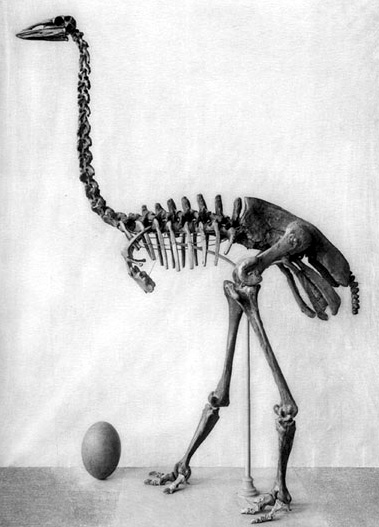
The largest of three currently recognised species - Aepyornis maximus - stood 3m tall, which is comparable in height to an African elephant and 20cm taller than their Asian cousins!
While these elephant-like proportions may have partly inspired the group’s name, it’s said the name ‘elephant bird’ may originate from tales of the ‘Roc’ - a giant, legendary bird of prey described by Marco Polo in his famous 13th-century travel accounts. According to the famous Venetian explorer, the ‘Roc’ was large enough to carry off an elephant.
- These prehistoric terror birds – with 'walking bolt cutters' for beaks – would have petrified early humans
- It clatters like a machine gun, has a deadly prehistoric-looking beak, can live for 25 years and can grow up to a whopping 1.5m tall with a wingspan of 2.6m
Though they may have been as tall as modern day elephants, elephant birds were nowhere near as heavy; weighing up to 800kg, they were roughly 13% the mass of a fully grown African elephant.
Like ostriches and other palaeognaths, elephant birds had coarse, hair-like body feathers, which would have given them a similarly shaggy appearance. They also had long legs, elongate necks, and small heads relative to their body sizes.
Their heads, while small, bore thick, conical beaks that narrowed to a point at the end.
Where did elephant birds live?
All three recognised species of elephant birds were endemic to Madagascar.
Despite only lying 400km off the southeast coast of Africa, Madagascar separated from the mainland approximately 180 million years ago during the Jurassic, following the breakup of a supercontinent known as Gondwana.
- Only two complete dodo skulls are known to exist. Scientists just looked inside them – and discovered this
- "Its vicious-looking, self-sharpening teeth were designed to slice effortlessly through tough meat." 10 deadliest, most ruthless prehistoric cats ever
The flighted ancestors of elephant birds are thought to have flown to Madagascar some time in the Late Oligocene, just over 20 million years ago. Once there, they were subject to an evolutionary process known as ‘island gigantism’, whereby a lack of large predators allows animals that were previously small to grow massive.
In growing so large, elephant birds lost their ability to fly - not that they’d have cared too much, at their size they were the proverbial kings and queens of Madagascar. Well, until humans arrived on the island roughly 1,500 years ago - but more on that later.
What did elephant birds eat?
They may have been big enough to stamp our ancestors to death, but elephant birds were strict vegetarians.
A 2022 study on the makeup of their bones found that one species, Aepyornis hildebrandti, was a mixed feeder, switching between grazing on low-growing plants and browsing higher vegetation depending on the season.
The other species, Aepyornis maximus and Mullerornis modestus, are thought to have predominantly been browsers, eating leaves, twigs, and fruits in forested environments.
Some studies have suggested elephant birds may have played an important role in dispersing seeds across Madagascar, like Cassowaries do in New Guinea today.
How large were elephant birds’ eggs?
Measuring up to 40cm long and 25cm in length, elephant birds’ eggs were roughly the size of basketballs.
The eggs of Aepyornis maximus are the largest known of any egg-laying animal, with a volume of around 13 litres. That’s roughly seven times the size of an ostrich egg, or the equivalent of 180 chicken eggs - just imagine the size of the omelette you could make with one!
To grow such large eggs, female elephant birds are thought to have drawn on reservoirs of calcium they stored in their femurs.
The eggs of elephant birds have been found across Madagascar, as well as in Western Australia, surprisingly. In the 1930s and 1992, two whole eggs were found buried in dune deposits along the southwest coast and identified as belonging to Aepyornis maximus, rather than any extinct giant bird native to Australia.
It’s thought the eggs may have floated from Madagascar to Australia on the Antarctic Circumpolar Current - a journey of nearly 9,000km. This may sound implausible, but penguin eggs from Antarctic islands have washed up in Western Australia before, and an ostrich egg was once found floating in the Timor Sea in the early 1990s!
Why did elephant birds become extinct?
While there’s no clear cut evidence of overhunting like there is of the giant, flightless moa of New Zealand, it’s widely believed that the extinction of elephant birds was a result of human activity.
The settling of Madagascar is a hotly debated topic. In 2018, a study identified what it interpreted as cut marks on several elephant bird bones dating to around 12,000 years ago.
If genuine, these marks would suggest humans arrived on Madagascar much earlier than previously thought and had a long history of coexistence with elephant birds. However, other researchers have questioned whether these marks are actually evidence of human butchery.
- Its legs are as thick as wrists and it's able to rip monkeys from branches with its deadly talons: Meet the world's most powerful bird
- Don’t think birds can look scary? Think again – these 7 creepy birds look like they're straight out of a horror film
The oldest, widely accepted evidence for humans arriving on Madagascar is dated to the mid-first millennium AD. A 2021 study that analysed radiocarbon dates of the latest elephant bird remains found the flightless giants became extinct between 800-1050 AD, roughly 500 years after they encountered humans.
This interval coincides with major environmental changes across Madagascar, which were driven by humans transforming forested habitats into grassland in order to farm cattle.
There may be little evidence of humans actually hunting elephant birds, but by clearing the forests they called home, it’s no surprise we’re widely blamed for their untimely extinction.
top image: Reconstruction of the elephant bird (Aepyornis maximus). Credit: Aepyorner, CC BY 4.0 https://creativecommons.org/licenses/by/4.0, via Wikimedia Commons
More wildlife stories from around the world:
- How high do birds fly? One amazing species has been recorded at an astonishing 11,300m
- "While she goes off to fetch water, it reveals a dark side to the relationship with its nest mate"
- When complete darkness fell on Antarctica, researchers used satellites to spy on one of its most secretive animals


